

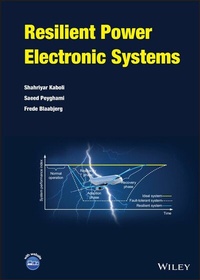
Resilient Power Electronic Systems
Description

Discover an advanced reference offering a powerful novel approach to the design and use of reliable and fault-tolerant power electronic systems
In Resilient Power Electronic Systems, a team of accomplished researchers deliver an insightful treatment of the challenges faced by practitioners and researchers working with power electronic converters and attempting to analyze internal and external failure mechanisms. The authors expertly present advanced techniques for reducing noise effects on fault detection and prognosis.
Comprised of thirteen chapters, the authors discuss the concepts of resilience and effective operative life in the context of power electronics. The differences between reliable and efficient systems are discussed, as well as the nature of these differences in complex systems. Finally, the book explores various methods to improve the resilience of power converters.
Resilient Power Electronic Systems is packed with features, including illustrations, practice problems, and PowerPoint presentations. The book also includes:
* A thorough introduction to the application of power electronics in various industries, as well as the concept of resilience in a power converter
* Comprehensive explorations of resilience against fault tolerance, including fault-tolerant power converters and resilient power converters
* Practical discussions of the state-of-the-art in resilient power converters, including examinations of mission-critical applications
* In-depth examinations of internal and external fault in power converters with mission-critical applications
Resilient Power Electronic Systems is an indispensable resource for researchers, professionals, and postgraduate students studying power electronics. It's also an ideal reference for research and development engineers working with the design and development of power electronic converters.
More details
Other editions
Additional editions
Persons
Shahriyar Kaboli, PhD, is Professor with the Department of Electrical Engineering at Sharif University of Technology Tehran, Iran.
Saeed Peyghami, PhD, is Assistant Professor with the Department of AAU Energy at the Aalborg University, Denmark.
Frede Blaabjerg, PhD, is Professor with the Department of AAU Energy at Aalborg University, Denmark. He is the former President of the IEEE Power Electronics Society and Vice-President of the Danish Academy of Technical Sciences.
Content
Preface
Part 1: Resilient Power Electronic Systems
Chapter 1 Resilient Systems
Chapter 2 Mission Critical Power Electronic Systems
Chapter 3 Resilience in Power Electronics
Chapter 4 State of the Art of Resilience
Part 2: Useful Life of the Power Electronic Systems
Chapter 5 Useful Life Modeling
Chapter 6 Internal Faults: Converter Level
Chapter 7 Internal Faults: Element Level
Chapter 8 External Faults
Chapter 9 Malfunctioning: Influence of Noise and Disturbance
Part 3: Health Estimation of the Power Electronic Systems
Chapter 10 Condition Monitoring
Chapter 11 Fault Prognosis
Chapter 12 Fault Diagnosis
Part 4: Methods of Resilience in Power Electronic Systems
Chapter 13 Resilience Against Internal Faults
Chapter 14 Resilience Against External Faults
Chapter 15 Inherently Resilient Power Electronic Converters
Preface
The application of power electronics in industries has grown considerably in recent years due to a global paradigm shift to carbon-free energy technologies such as renewable energy resources, micro- and smart-grids, and e-transportation, which strongly depend on power electronics. Therefore, modern electronic-based power systems are almost young in comparison with conventional power systems. Regarding the wide usage of the above-mentioned systems in industries, an estimation of their effective operative life and reliability is considered to be crucial. Furthermore, penetration of power electronics converters is increasing in power systems and the classical reliability assessment tools and concepts in power systems need to be modified taking into account the reliability of power converters. One of these concepts is resilience. Resilience is the property that enables a system to continue operating properly in the event of the failure of some of its components. As the application of power electronic converters becomes more and more crucial in the coming years, the necessity of having non-stop operation in converters is undergoing rapid growth. In some industries, any stop in operation of power converters leads to a great penalty. On the other hand, a power electronic converter is faced with many internal and external faults. These faults can interrupt the continuous operation of the power converter. Therefore, implementing smart techniques for non-stop operation of power converters are high in importance. In other words, power electronic systems must be resilient in mission critical applications.
This book deals with resilience and effective operative life concepts in the field of power electronics. Resilience is almost the only method for achieving a desired reliability in a converter that operates with non-zero fault possibility. However, resilience is a bit different from fault tolerance. In some applications, resilience means achieving "zero" probability of failure with regards to the mission profile. In this book, advanced methods for resilient power electronic converters are presented. Furthermore, the fault mechanism is explained to determine the reason for failure in power converters. Finally, various methods are presented to improve the resilience of the power converters. The following aspects are covered and discussed in this book:
- Analysis of failure mechanisms in power electronic converters including internal and external faults are described.
- Fault prognosis and diagnosis concepts are described and the certain methods for fault detection in power electronics are presented.
- Advanced techniques for reducing the noise effect on the fault detection and prognosis are explained.
- Classic methods of resilience are reviewed and a comprehensive perspective is provided.
- Advanced methods of resilience are presented regarding the mission of the power electronic converter.
- Reconfiguring of a power electronic converter as a design consideration is presented.
The book will have the following specific objectives:
- Enhancement of the knowledge on the subject of resilience in power electronics converters.
- Explore the challenges and concerns of resilience and fault tolerance in power electronics.
- Introduce some new concepts such as the tradeoff between the resilience and efficiency in power electronics.
- Show the basic principles and provide guidelines for design of a resilient power converter.
- The book will lead to the advancement of the current state-of-the-art advantages of resilient power converters. Moreover, the book will generate relative practical case studies and experimental results for most of the chapters.
The book has been prepared in four parts. This division helps the readers to follow the contents easily. The first part, Resilient Power Electronic Systems, presents a general view of the resilience concept in power electronic systems and is contained in four chapters. Chapter 1 provides an introduction for entering the concept of resilience in power electronics. In this chapter, the resilience concept is described in its general form and mission critical systems are introduced. In this chapter, the reader is also introduced to the techniques that are used in industries and nature for reaching a resilient performance. The contents of this chapter are used in the following chapters, with a focus on the appearance of these concepts in the field of power electronics. In Chapter 2, we introduce the concept of resilience in power electronic converters with an introduction to these devices and a recognition of their main functions as well as their importance. Some typical industrial examples are presented and the elements of power electronics are introduced. We used this introduction to describe the reasons for faulty conditions in power electronic converters, described in the next part of the book. Finally, mission critical power electronic converters are introduced. In Chapter 3, the resilience concept is described in power electronic systems. The possible faulty conditions are explained in a power electronic system and the conditions for supporting the load during the fault are presented. Internal and external faults are explained and their effects on the converter resilience are presented. The requirements for resilience of a power electronic system are described. The main part of this chapter deals with the difference between fault tolerance and resilience. In Chapter 4, a survey is presented about the state of the resilience in power electronic converters. In the second part of the book, Useful Life of the Power Electronic Systems, the failure mechanisms of the power electronic systems are presented. In Chapter 5, the concept of useful life and the methods for useful life modeling are described. These definitions are used to group the faults. This chapter provides a quantitative view to the reader about evaluation of the system useful life and can be used in the next chapters for achieving the resilient characteristics. In Chapter 6, internal faults of the power electronic systems are reviewed at the converter level, where the main important issues at the design and montage stages of the converters are presented. In Chapter 7, the random faults and wear-out failures of the power electronic systems are discussed. Various types and reasons for wear-out failures are presented and packaging of the power electronic modules is explained. Thermal and mechanical shocks, which are two important factors of wear-out failures, are described. In Chapter 8, the external faults that lead to unavailability of the power electronic converters are described. It is shown that these faults act as stressors and affect the lifetime of the converter components. On the other hand, the external faults interact with the protection system of the converter and lead the converter to be out of service. The right decision in the external fault period is explained. In Chapter 9, the availability of electric power converters is described. One of the most important factors for this undesired state is the influence of noise. In this chapter, electromagnetic interference and certain methods for reducing its undesired effects on electric power converters are presented. Implementation of the methods for resilience achievement needs to have enough information about the condition of the converter. The third part of the book, Health Estimation of the Power Electronic Systems, presents the methods for system health monitoring. In Chapter 10, commonly used methods for condition monitoring the converters are presented. In Chapter 11, the methods of fault prognosis in power electronic systems are described. It is important to have an expectation about the useful life of a system before its construction or even its remaining useful life during its operation. The fault prognosis in the power electronic systems are presented in both converter-level and element-level categories. In Chapter 12, fault diagnosis in the power electronic converters is described. Two goals of the fault diagnosis, fault isolation and fault root cause analysis, are explained. Some of the methods for fault diagnosis in power electronic systems are presented. In the last part of the book, Methods of Resilience in Power Electronic Systems, guidelines for achieving resilience are presented. These methods are used in both design and operation processes of the converter. In Chapter 13, methods for reducing the stresses on the power electronic systems are described at both system and component levels. Algorithms for derating a faulty power supply are described. In Chapter 14, resilient operation of power electronic converters against external faults such as a load short circuit is studied. The subject of this chapter is the converters that are not damaged but cannot operate normally. In this chapter, the availability of electric power converters as a most important parameter in the topic of resilience is described. In Chapter 15, some of the methods and techniques for inherently resilient operation of the power electronic converters are reviewed. In these cases, the failure factor is applied to the converter but its effect is not sensed by the converter. The main requirement of resilient operation is a short recovery time and a small drop in the system performance index. One of these methods is the application of fault-tolerant structures for the power converters. Applications of active replacement...
