

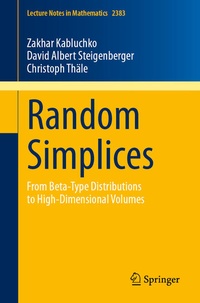
Random Simplices
Description

This book provides an introduction to the theory of random beta-type simplices and polytopes, exploring their connections to key research areas in stochastic and convex geometry. The random points defining the beta-type simplices, a class of random simplices introduced by Ruben and Miles, follow beta, beta-prime, or Gaussian distributions in the Euclidean space, and need not be identically distributed. A key tool in the analysis of these simplices, the so-called canonical decomposition, is presented here in a generalized form and is employed to derive explicit formulas for the moments of the volumes of beta-type simplices and to prove distributional representations for these volumes. Three independent approaches are described, including the original Ruben-Miles method. In addition, a version of the canonical decomposition for beta-type polytopes is provided, characterizing their typical faces as volume-weighted beta-type simplices. This is then applied to compute various expected functionals of beta-type polytopes, such as their volume, surface area and number of facets. The formulas for the moments of the volumes are also used to investigate several high-dimensional phenomena. Among these, a central limit theorem is established for the logarithmic volume of beta-type simplices in the high-dimensional limit. The canonical decomposition further motivates the study of beta-type distributions on affine Grassmannians, a subject to which the last chapter is dedicated.
Largely self-contained, requiring minimal prior knowledge, the book connects these topics to a broad range of past and current research, serving as an excellent resource for graduate students and researchers seeking to engage with the field of stochastic and integral geometry.
More details
Other editions
Additional editions
Persons
Zakhar Kabluchko studied mathematics at the Universities of Kyiv and Göttingen, earning his PhD from the University of Göttingen in 2007. Following a postdoctoral position in Göttingen, he was appointed Assistant Professor at the University of Ulm in 2009. Since 2014, he has been Professor of Probability Theory at the University of Münster.
David Albert Steigenberger studied mathematics and philosophy at the University of Münster, where he completed his master's degree in 2022 under the supervision of Zakhar Kabluchko. Since then, he has been pursuing his doctoral studies as a Researcher at the University of Münster, also under the guidance of Zakhar Kabluchko.
Christoph Thäle studied mathematics in Jena and received his PhD in 2010 from the Université de Fribourg. After postdoctoral positions in Osnabrück and Bochum, he became a Full Professor for Probability at Ruhr University Bochum in 2016, focusing on spatial random structures.
Content
Chapter 1. Prologue.- Part I. Introduction.- Chapter 2. Beta-type distributions: Key properties and first applications.- Chapter 3. Blaschke-Petkantschin formulas.- Part II. Beta-type simplices.- Chapter 4. Beta-type simplices and canonical decomposition of Ruben and Miles.- Chapter 5. Volumes of beta-type parallelotopes.- Chapter 6. Volumes of beta-type simplices.- Chapter 7. Alternative approaches to volumes of beta-type simplices.- Part III. Applications and further results.- Chapter 8. Facets and volumes of beta-type polytopes.- Chapter 9. Limit theorems for volumes of beta-type simplices.- Chapter 10. Properties of beta-type distributions on affine Grassmannians.
