

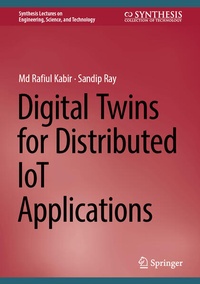
Digital Twins for Distributed IoT Applications
Description

This book provides a comprehensive treatment of the concepts and applications of digital twins and related virtual prototyping technologies for a variety of distributed Internet-of-Things (IoT) applications. It can serve as a reference for practitioners to understand the scope and limitations of these complex technologies and how they can be used in a range of real-world applications. It can also be used as a starting point for researchers interested in exploring this area. The range of applications covered includes transportation, healthcare, manufacturing, and many others.
More details
Other editions
Additional editions
Persons
Md Rafiul Kabir is an Assistant Professor at the School of Engineering and Technology, Central Michigan University. He received his Ph.D. from the Department of Electrical and Computer Engineering, University of Florida. Before that, he was an Electrical Engineer at Horizon Global Americas in Michigan, where he worked in the design and development of OEM Trailer Brake Controllers used in automobiles. Prior to that, he got his MSc degree in Electrical Engineering from the University of Toledo, where his research was on renewable energy applications. He received his B.Sc. degree in Electrical and Electronic Engineering from Ahsanullah University of Science and Technology, Dhaka, Bangladesh. Dr. Kabir's research interests are the Internet of Things, digital twins, automotive safety & cybersecurity, and healthcare applications.
Sandip Ray is a Professor at the University of Florida at Gainesville, Florida, USA where he holds the Warren B. Nelms Endowed Professorship in the Department of Electrical and Computer Engineering. Before joining University of Florida, he was a Senior Principal Engineer at NXP Semiconductors, and prior to that, Research Scientist with the Intel Strategic CAD Laboratories. Dr. Ray's current research targets correct, dependable, secure, and trustworthy computing through cooperation of specification, synthesis, architecture, and validation technologies. He is the author of three books and over 100 publications in international journals and conferences. He has also served as Technical Program Committee Member of over 50 international conferences, as Program Chair of ACL2 2009, FMCAD 2013, and IFIP IoT 2019, as Guest Editor for IEEE Design & Test, IEEE TMSCS, and ACM TODAES, and as Associate Editor of Springer HaSS and IEEE TMSCS. Dr. Ray has a Ph.D. from University of Texas at Austin and is a Senior Member of IEEE.
Content
Introduction.- Virtual prototyping for energy system and smart grid.- Virtual prototyping for vehicular system.- Virtual prototyping for healthcare.- Virtual prototyping for industrial automation and manufacturing.- Virtual prototyping for agriculture.
