

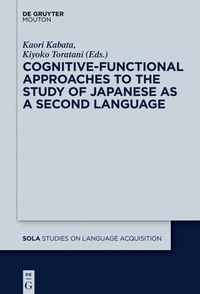
Cognitive-Functional Approaches to the Study of Japanese as a Second Language
1st Edition
Published on 15. January 2016
IX, 371 pages
978-1-61451-502-9 (ISBN)
Description

This innovative and original volume brings together studies that apply cognitive and functional linguistics to the study of the L2 acquisition of Japanese. With each article grounded on the usage-based model and/or conceptual notions such as foregrounding and subjectivity, the volume sheds light on how cognitive and functional linguistics can help us understand aspects of Japanese acquisition that have been neglected by traditionalists.
More details
Other editions
Additional editions
Kaori Kabata | Kiyoko Toratani
Cognitive-Functional Approaches to the Study of Japanese as a Second Language
E-Book
01/2016
1st Edition
De Gruyter Mouton
€149.95
Available for download
Kaori Kabata | Kiyoko Toratani
Cognitive-Functional Approaches to the Study of Japanese as a Second Language
Book
01/2016
1st Edition
De Gruyter Mouton
€149.95
Article not available at the moment
Persons
Kaori Kabata, University of Alberta, Canada; Kiyoko Toratani, York University, Canada.
Content
- Intro
- Table of contents
- Preface
- List of contributors
- 1. Application of cognitive-functional linguistics to the study of Japanese as a second and foreign language: An introduction
- Part I: Usage-based approaches
- 2. The acquisition of linguistic categories in second language acquisition: A functionalist approach
- 3. Friendly and respectful politeness: A functional analysis of L2 utterances
- 4. What learners know about lexical aspect in L2: Motion verbs kuru 'come' and iku 'go' and the acquisition of imperfective -teiru in Japanese
- 5. A usage-based account of learner acquisition of Japanese particles ni and de
- 6. A usage-based approach to relativization: An investigation of advanced-learners' written production of relative clauses in Japanese
- Part II: Conceptual approaches
- 7. A multimedia encyclopedia of Japanese mimetics: A frame-semantic approach to L2 sound-symbolic words
- 8. A cognitive approach to the comprehension of intransitive constructions in L1 and L2 Japanese
- 9. An L2 corpus study of the Japanese grammatical marker -te-simau: An application of force dynamics
- 10. The L2 acquisition of Japanese Motion event descriptions by L1 English speakers: An exploratory study
- 11. Influence of L1 English on the descriptions of motion events in L2 Japanese with focus on deictic expressions
- 12. Subject-object contrast (shukakutairitsu) and subject-object merger (shukaku-gouitsu) in "thinking for speaking"¹: A typology of the speaker's preferred stances of construal across languages and its implications for language teaching
- Part III: Current state and future directions of cognitive-functional-linguistics-informed L2 studies
- 13. A survey of work published in Japan at the dawn of the new millennium
- 14. Towards better integration of linguistics research, SLA, and pedagogy
- Subject index
