

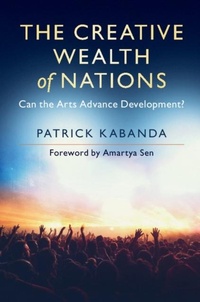
The Creative Wealth of Nations
Can the Arts Advance Development?
Published on 25. April 2018
978-1-108-53470-3 (ISBN)
Description

Development seen from a more holistic perspective looks beyond the expansion of material means and considers the enrichment of people's lives. The arts are an indispensable asset in taking a comprehensive approach toward the improvement of lives. Incorporating aspects of international trade, education, sustainability, gender, mental health and social inclusion, The Creative Wealth of Nations demonstrates the diverse impact of applying the arts in development to promote meaningful economic and social progress. Patrick Kabanda explores a counterintuitive and largely invisible creative economy: whilst many artists struggle to make ends meet, the arts can also be a promising engine for economic growth. If nations can fully engage their creative wealth manifested in the arts, they are likely to reap major monetary and nonmonetary benefits from their cultural sector. Drawing from his own experience of the support music provided growing up amidst political and economic turmoil in Uganda, Kabanda shows us the benefits of an arts-inclusive approach to development in Africa, and beyond.
Reviews / Votes
'Creativity and imagination go together. One leads to the other. Kabanda hits the very central point of human progress, the creativity and how it relates to development. Without inspiration for imagination the world is a dead place. Kabanda presented in a very convincing way the role of creative industry and arts in the broad framework of development discourse. Anybody interested in development must read it. It gives a completely new perspective.' Muhammad Yunus, Nobel Peace Prize Laureate, 2006 'The Creative Wealth of Nations very originally calls our attention to the role of the arts and intellectual progress in increasing economic growth. It is marked by an interesting combination of surveying research and anecdote and will be very persuasive in introducing a new element of policy.' Kenneth J. Arrow, Nobel Laureate in Economics, 1972 'All individuals and all communities live by the stories they tell and by the music they produce. The Creative Wealth of Nations opens up a new field in economic development by showing the importance of the arts, in people's economic and social lives. As a dividend to the reader, this superbly written book is itself a work of art: with every page filled with fascinating observations and facts.' George Akerlof, Nobel Laureate in Economics, 2001 'This is an important book which shows how the arts can nurture creativity and promote economic growth and development. Patrick Kabanda grew up in Uganda, amidst the strange duality of the sound of music at home, and political conflict outside, casting shadow on a child's life. When Kabanda, a talented musician and composer with interest in economic development, came to the World Bank to work with me I was curious about what he would contribute. Among his other work during this period, was this book. It draws on his early experience and later research, and is a must read whether you are interested in art and arias, or growth rates and gross incomes.' Kaushik Basu, Cornell University 'The distinctive feature of Patrick Kabanda's book is that it brings together his knowledge of the arts, as a practitioner of music, with his experience and training in international affairs. He adds his understanding of Africa to his observations and experience of growth in developed countries. With his unique background, he points out the varying qualities and levels of development of the multitude of people in such places as Africa and how they might be joined to global business initiatives and development priorities. The result is a distinctly African approach to development across the world, especially on the continent that will one day play a major role in global business and social development.' Sir James Wolfensohn, KBE AO, former President of the World Bank (1995-2005) 'The distinguishing feature of this book is that while other studies have been concerned mainly with general principles and broad evidence, Kabanda starts from an intensely personal experience as a musician who grew up in a poor suburb in Uganda and blends the insights gleaned from that experience with broader considerations. This blending of the personal with the general brings a distinctive flavour of passion and authenticity to the book that renders the experience of reading it highly enjoyable and richly rewarding at the same time.' S. R. Osmani, Journal of Human Development and CapabilityMore details
Language
English
Place of publication
Cambridge
United Kingdom
Target group
Professional and scholarly
Illustrations
Worked examples or Exercises; 10 Tables, black and white; 5 Line drawings, black and white
File size
3,58 MB
ISBN-13
978-1-108-53470-3 (9781108534703)
Copyright in bibliographic data and cover images is held by Nielsen Book Services Limited or by the publishers or by their respective licensors: all rights reserved.
Schweitzer Classification
Other editions
Additional editions
Book
05/2018
Cambridge University Press
€136.50
Shipment within 15-20 days
Persons
Patrick Kabanda is a Juilliard-trained organist and a Fletcher-trained international affairs professional. He received Juilliard's William Schuman Prize for outstanding achievement and leadership in music in 2003, and from 2012 to 2013 he was a Charles Francis Adams Scholar at The Fletcher School. Besides concertizing and lecturing worldwide, he has taught at Phillips Academy, consulted for the World Bank's Office of the Senior Vice President and Chief Economist, and contributed to the World Development Report 2016 and UNDP's Human Development Report 2015. He was awarded the 2013 Presidential Award for Citizenship and Public Service from Tufts University, Massachusetts. Amartya Sen is Thomas W. Lamont University Professor, and Professor of Economics and Philosophy, at Harvard University, Massachusetts and until 2004 was Master of Trinity College, Cambridge. He has served as President of the American Economic Association, the Indian Economic Association, the International Economic Association, and the Econometric Society. His awards include Bharat Ratna (India); Commandeur de la Legion d'Honneur (France); the National Humanities Medal (USA); Honorary Companion of Honour (UK); Ordem do Merito Cientifico (Brazil); and the Nobel Prize in Economics. Sen's books have been translated into more than thirty languages.
Content
Foreword Amartya Sen; Prelude; Acknowledgements; Overture: from sustainable to meaningful development: the role of the arts; Part I. The Arts, The Economy, and Development: 1. An untapped and unmeasured economy: on the value of the arts; 2. Arts in education: cultivating creative minds for development; 3. The arts and environmental stewardship; Part II. Trade in Services: A Three-Part Suite: 4. International trade in cultural services; 5. Artists without borders in the digital age; 6. On cultural tourism; Part III. Variations on a Theme: 7. The unsettled question of women in the performing arts; 8. The arts in mental health, social healing, and urban renewal; Part IV. Rondo: A Round-Up of Data; 9. Creative data collection; Finale:on imagination and choice; Annexes; Notes; Glossary of selected musical terms; References; Index.
