

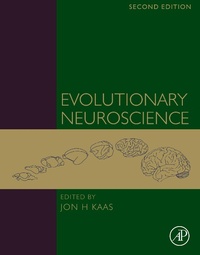
Evolutionary Neuroscience
2nd Edition
Published on 30. May 2020
962 pages
978-0-12-820606-5 (ISBN)
Description

Evolutionary Neuroscience, Second Edition, is a collection of chapters on brain evolution that combines selected topics from the recent comprehensive reference, Evolution of Nervous Systems (Elsevier, Academic Press, 2017, 9780128040423). The selected chapters cover a broad range of topics, from historical theory, to the most recent deductions from comparative studies of brains. The articles are organized in sections focused on history, concepts and theory, the evolution of brains from early vertebrates to present-day fishes, amphibians, reptiles and birds, the evolution of mammalian brains, and the evolution of primate brains, including human brains.
Each chapter is written by a leader or leaders in the field. Specific topics include brain character reconstruction, principles of brain scaling, basic features of vertebrate brains, the evolution of the major sensory systems, other parts of brains, what we can learn from fossils, the origin of neocortex, and the evolution of specializations of human brains. The collection of articles will be interesting to anyone who is curious about how brains evolved from the simpler nervous systems of the first vertebrates into the many different complex forms now found in present-day vertebrates.
- Provides the most comprehensive, authoritative and up-to-date single volume collection on brain evolution
- Presents a full color treatment, with many illustrations
- Written by leading scholars and experts
- Features chapters on brain character reconstruction, principles of brain scaling, basic features of vertebrate brains, the evolution of the major sensory systems, and other parts of brains
- Discusses what we can learn from fossils, the origin of neocortex, and the evolution of specializations of human brains
More details
Other editions
Additional editions
Jon H. Kaas
Evolutionary Neuroscience
Book
05/2020
2nd Edition
Academic Press
€184.50
Shipment within 15-20 days
Content
Part 1: History, Concepts, and Theory1. History of Ideas on Brain Evolution2. Phylogenetic Character Reconstruction3. The role of endocasts in the study of brain evolution4. Invertebrate origins of vertebrate nervous systems
Part 2: The Brains of Fish, Amphibians, Reptiles and Birds5. The nervous systems of jawless vertebrates6. The brains of cartilaginous fishes7. The organization of the central nervous system of amphibians8. The brains of reptiles and birds9. Function and evolution of the reptilian cerebral cortex10. The cerebellum of non-mammalian vertebrates
Part 3: Early Mammals and Subsequent Adaptations11. Emergence of mammals12. Mammalian Evolution: The phylogenetic story13. Organization of neocortex in early mammals14. What modern mammals teach us about the cellular composition of early brains and mechanisms of brain evolution15. Consistencies and variances in the anatomical organization of aspects of the mammalian brain stem16. Comparative anatomy of glial cells in mammals17. The monotreme nervous system18. Evolution of flight and echolocation in bats19. Carnivore brains: Effects of sociality on inter- and intra-specific comparisons of regional brain volumes
Part 4: Primates20. Phylogeny of primates21. Expansion of the cortical sheet in primates22. Scaling up the simian primate cortex: A conserved pattern of expansion across brain sizes23. Evolution of visual cortex in primates24. Evolution of subcortical pathways to the extrastriate cortex25. Evolved mechanisms of high-level visual perception in primates26. Evolution of parietal cortex in primates27. Evolution of parietal-frontal networks in primates28. Evolution of the prefrontal cortex in early primates and anthropoids
Part 5: Evolution of Human Brains29. Introduction to human brain evolutionary studies30. Human evolutionary history31. Evolution of human life history32. The fossil evidence of human brain evolution33. Remarkable, but not special: What human brains are made of34. Timing of brain maturation, early experience, and the human social niche35. Human association cortex: Expanded, untethered, neoteneous, and plastic36. On the evolution of the frontal eye field: comparisons of monkeys, apes and humans37. The evolution of auditory cortex in humans38. Language evolution39. The search for human cognitive specializations
