

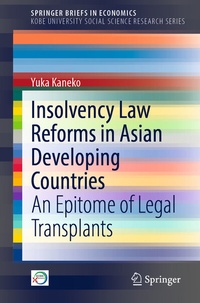
Insolvency Law Reforms in Asian Developing Countries
Description

This book examines the outcomes of the economic law reforms in Asian developing countries, guided by the leading international development financiers such as the World Bank and the Asian Development Bank. Included is a particular focus on the recent "insolvency law" reforms in the Asian emerging economies, such as Vietnam, Laos, and Myanmar. Such legal reforms are the results of the "transplant" of the model law provided by these donor agencies, a law that was created in the post-Asian Currency Crisis in the 1990s. This book therefore examines the outcomes of three decades of donor-guided legal reforms. Appropriately, it applies not only the static approach to the legal texts but also an empirical methodology through interview surveys of the corporate and financial sectors.
Following the introduction in Chapter I, Chapter II reviews the basic theories and presents the methodological framework. Chapter III then analyzes the contents of insolvency law reforms in the major target countries, namely, Vietnam, Laos, and Myanmar. Chapter IV provides a closer investigation into the design choices of Myanmar's 2020 Insolvency Law as a typical example of the law reform involving the inter-donor conflict of law models between the Asian Development Bank and Japan's official development assistance project. Lastly, Chapter V applies an empirical approach to the functioning of insolvency law, through international collaboration for interview surveys with small and medium-sized enterprises (SMEs) and their financiers.
More details
Other editions
Additional editions
Person
Yuka Kaneko LL.D. is a professor in Kobe University Center for Social Systems Innovation. She is active in the field of Asian comparative law as well as in the sociology of law. She is one of the executive board member of the Japanese Association of Sociology of Law. She is the author of numbers of books, including Asian Crisis and Financial Law Reforms, Shinzan-Sya in 2004; Law Reforms and Legal Development in Asia, Daigakukyoiku-Shuppan in 2010; Asian Law in Disasters: Toward a Human-Centered Recovery, Routledge in 2016; Law and Development of Myanmar, Koyo-Syobo in 2018; Civil Law Reforms in Post-Colonial Asia: Beyond Western Capitalism, Springer in 2019; and Land Law and Disputes in Asia: In Search of an Alternative for Development, Routledge in 2021.
Content
1. Purpose: Analyzing the Validity of the Insolvency Law Model .- 2. Overview of Insolvency Law Theories and Contexts.- 3. Methodological Framework.- 4. Vietnam.- 5. Laos.- 6. Myanmar.- 7. Introduction.- 8. Colonial Insolvency Regime in Present Time.- 9. Corporate Insolvency in Practice.- 10. Read-through of the 2020 Insolvency Law.- 11. Alternative Approach of JICA Draft.- 12. Introduction.- 13. Practice of SME Finance and Insolvency Law under Pandemic.- 14. Conclusion.
