

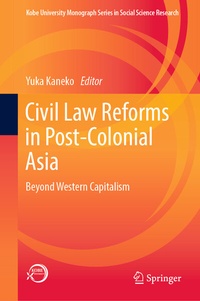
Civil Law Reforms in Post-Colonial Asia
Description

This book focuses on the legal systems of the late-developing countries of ASEAN (Cambodia, Laos, Myanmar, and Vietnam, often referred to as the CLMV countries). These nations are apt to be placed in an economically disadvantageous situation within the opportunity of communalization of legal systems being advanced by the ASEAN Economic Community (AEC) launched in 2015, and the book clarifies the dynamics of the changes within these legal systems. Concurrently, there is an intention to analyze the "legal system development support" that has continued to be provided to these countries since the mid-1990s via international development support from international organizations and developed countries including Japan. In particular, the emphasis has been on the area of civil law, where the main subject of Japan's support has been centered on the civil code and civil procedure code.
The legal system of the recipient country is complicated by the crisscrossing ofthe remnants of previous eras, from the inherent laws that have existed since before colonization, the laws of the colonial powers that were introduced during the colonial era (French law in Cambodia, Laos, and Vietnam; English law in Myanmar), the influence of socialist law after independence from colonization, and the path of modern industrialization and development, such that one country's legal system is the combination of all of these influences.
For the reader to understand the dynamics of these changing laws, each chapter of the book combines two methodological perspectives. The first is to ascertain the spatial range as to how far the civil law extends across social phenomena. The second is a historical perspective in which the trends in legal changes will be understood on a time axis.
More details
Other editions
Additional editions
Person
Yuka Kaneko
Professor, Law & Development Program, Graduate School of International Cooperation Studies, Kobe University. Japan. LL.B. Tokyo University; LL.M., Georgetown University; LL.D. Kyushu University
Content
Part I Historical Review of Legal Changes in Civil Spheres .- 1 Civil law in the French Asian Colonies (Beatrice Jaluzot).- 2 Contract Law in Myanmar: An Outcome of British Colonial Law (Yuka Kaneko).- 3 The Role of the Japanese Civil Code in the Codification in the Kingdom of Siam (Shiori Tamur).- 4 The Pathway of Civil Law Development in Indonesia: Laws on Land (Lukman Hakim Rudy).- Part II: Spatial Aspects on the Outcomes of Legal Technical Assistance. - 5 Some Fundamental Studies on the Revised Civil Code of Vietnam the 2015 Civil Code of Vietnam (Nguyen Hong Hai).- 6 One Aspect of Civil Procedure Reform in Asia; Placing the Focus upon Civil Procedure Promulgation Support in Vietnam (Shiro Kawashima).- 7 Issues of Compulsory Execution in Myanmar: A Comparative Approach from Practical Viewpoints based on Japanese Law (Yoshifumi Akanishi).- 8 Japan's Civil Code-Centered Legal Assistance to Asian Market Reform Countries: Normative Choiceof Reforms (Yuka Kaneko).- Index.
