

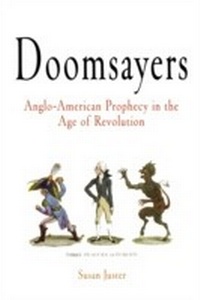
Doomsayers
Anglo-American Prophecy in the Age of Revolution
1st Edition
Published on 3. August 2010
288 pages
978-0-8122-0238-0 (ISBN)
Description

The age of revolution, in which kings were dethroned, radical ideals of human equality embraced, and new constitutions written, was also the age of prophecy. Neither an archaic remnant nor a novel practice, prophecy in the eighteenth century was rooted both in the primitive worldview of the Old Testament and in the vibrant intellectual environment of the philosophers and their political allies, the republicans. In Doomsayers: Anglo-American Prophecy in the Age of Revolution, Susan Juster examines the culture of prophecy in Great Britain and the United States from 1765 to 1815 side by side with the intellectual and political transformations that gave the period its historical distinction as the era of enlightened rationalism and democratic revolution.
Although sometimes viewed as madmen or fools, prophets of the 1790s and early 1800s were very much products of a liberal commercial society, even while they registered their disapproval of the values and practices of that society and fought a determined campaign to return Protestant Anglo-America to its biblical moorings. They enjoyed greater visibility than their counterparts of earlier eras, thanks to the creation of a vigorous new public sphere of coffeehouses, newspapers, corresponding societies, voluntary associations, and penny pamphlets. Prophecy was no longer just the art of applying biblical passages to contemporary events; it was now the business of selling both terror and reassurance to eager buyers. Tracking the careers of several hundred men and women in Britain and North America, most of ordinary background, who preached a message of primitive justice that jarred against the cosmopolitan sensibilities of their audiences, Doomsayers explores how prophetic claims were formulated, challenged, tested, advanced, and abandoned. The stories of these doomsayers, whose colorful careers entertained and annoyed readers across the political spectrum, challenge the notion that religious faith and the Enlightenment represented fundamentally alien ways of living in and with the world.
From the debates over religious enthusiasm staged by churchmen and the literati to the earnest offerings of ordinary men and women to speak to and for God, Doomsayers shows that the contest between prophets and their critics for the allegiance of the Anglo-American reading public was part of a broader recalibration of the norms and values of civic discourse in the age of revolution.
Although sometimes viewed as madmen or fools, prophets of the 1790s and early 1800s were very much products of a liberal commercial society, even while they registered their disapproval of the values and practices of that society and fought a determined campaign to return Protestant Anglo-America to its biblical moorings. They enjoyed greater visibility than their counterparts of earlier eras, thanks to the creation of a vigorous new public sphere of coffeehouses, newspapers, corresponding societies, voluntary associations, and penny pamphlets. Prophecy was no longer just the art of applying biblical passages to contemporary events; it was now the business of selling both terror and reassurance to eager buyers. Tracking the careers of several hundred men and women in Britain and North America, most of ordinary background, who preached a message of primitive justice that jarred against the cosmopolitan sensibilities of their audiences, Doomsayers explores how prophetic claims were formulated, challenged, tested, advanced, and abandoned. The stories of these doomsayers, whose colorful careers entertained and annoyed readers across the political spectrum, challenge the notion that religious faith and the Enlightenment represented fundamentally alien ways of living in and with the world.
From the debates over religious enthusiasm staged by churchmen and the literati to the earnest offerings of ordinary men and women to speak to and for God, Doomsayers shows that the contest between prophets and their critics for the allegiance of the Anglo-American reading public was part of a broader recalibration of the norms and values of civic discourse in the age of revolution.
Reviews / Votes
"This delightful and provocative book describes a dimension of Anglo-American culture typically lost from view." (Journal of the Early Republic) "This original, richly textured book . . . skillfully challenges comfortable notions about the historical interplay between faith and reason." (William and Mary Quarterly) "Juster's finely grained description overturns assumptions that secular culture displaced supernaturalism without a struggle. . . . Highly recommended." (Choice) "Outstanding." (Journal of Church and State) "With dazzling execution, Susan Juster not only gives us a fascinating cast of human characters but brings alive the Anglo-American ferment in the Age of Revolution over religious change, theories of what connects body to mind and soul, modes of self-presentation and communication, and critiques of modernity. This elegant study contains many wonderful surprises." (Cornelia H. Dayton, University of Connecticut) "In the retrieval of early American religion, Susan Juster is not just the smartest, most imaginative scholar of her generation. She is also the most artful and the edgiest. Her luminous, atmospheric study of prophecy in the early republic will change forever the way you think about the democratization of American culture. And her doomsayers themselves, rendered brilliantly in the tangles of authenticity and imposture that define democracy, will steal your heart even as they unsettle you." (Michael Zuckerman, University of Pennsylvania)More details
Series
Language
English
Place of publication
Pennsylvania
United States
Target group
College/higher education
Illustrations
5 illus.
5 illus.
File size
2,55 MB
ISBN-13
978-0-8122-0238-0 (9780812202380)
Copyright in bibliographic data and cover images is held by Nielsen Book Services Limited or by the publishers or by their respective licensors: all rights reserved.
Schweitzer Classification
Other editions
Additional editions
Book
05/2006
University of Pennsylvania Press
€28.50
Shipment within 10-20 days
Person
Susan Juster is the Rhys Isaac Collegiate Professor of History at the University of Michigan and a John Simon Guggenheim Memorial Foundation Fellow. She is coeditor of Empires of God: Religious Encounters in the Early Modern Atlantic, also available from the University of Pennsylvania Press.
Content
- Cover
- Title Page
- Copyrights Page
- Table of Contents
- Preface
- Introduction
- 1: The Making of a Prophet
- 2: Varieties of Prophecy: Fortune-Tellers, Visionists, and Millenarians
- 3: Body and Soul: The Epistemology of Revelation
- 4: Millenarian Politics: Language and the Public Sphere
- 5: A Rogues' Gallery: Richard Brothers and Nimrod Hughes
- 6: Women of Revelation: Jemima Wilkinson and Joanna Southcott
- Epilogue
- Index
