

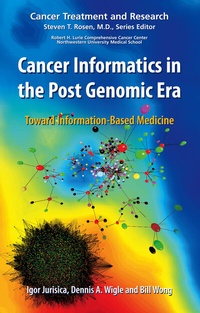
Cancer Informatics in the Post Genomic Era
Description

Medical information science requires analytic tools. This is achieved by developing and assessing methods and systems for the acquisition, processing, and interpretation of patient data, aided by scientific discovery. Cancer Informatics in Post-Genomic Era provides both the necessary methodology and practical information tools.
Key challenges include integrating research and clinical care, sharing data, and establishing partnerships within and across sectors of patient diagnosis and treatment.
Addressing important clinical questions in cancer research will benefit from expanding computational biology.
The advent of genomic and proteomic technologies has ushered forth the era of genuine medicine. The promise of these advances is true "personalized medicine" where treatment strategies can be individually tailored and advance to initiating intervention before visible symptoms appear.
More details
Other editions
Additional editions
Persons
Igor Jurisica, PhD
Dr. Jurisica is a Canada Research Chair in Integrative Computational Biology, a Scientist at the Ontario Cancer Institute, University Health Network since 2000, Associate Professor in the Departments of Computer Science and Medical Biophysics, University of Toronto, Adjunct Professor at School of Computing Science, Queen's University, and a Visiting Scientist at the IBM Centre for Advanced Studies. He earned his Dipl. Ing. degree in Computer Science and Engineering from the Slovak Technical University in 1991, M.Sc. and Ph.D. in Computer Science from the University of Toronto in 1993 and 1998 respectively. Dr. Jurisica's research focuses on computational biology, and representation, analysis and visualization of high dimensional data generated by high-throughput biology experiments. Of particular interest is the use of comparative analysis for the mining of integrated datasets such as protein-protein interaction, gene expression profiling, and high-throughput screens for protein crystallization.
Dennis A. Wigle, MD, PhD
Since August 2006, Dennis Wigle has been a clinician-scientist at the Mayo Clinic Cancer Center in Rochester Minnesota. He is a practicing thoracic surgeon with an interest in thoracic oncology. His laboratory investigates the genetic basis and molecular sequence of events underlying thoracic malignancies. He holds an MD from the University of Toronto and a PhD from the Department of Anatomy and Cell Biology at Queen's University in Kingston, Canada. His interests include the application of novel computational methods to the analysis of high-throughput data in cancer biology.
Bill Wong, BSc, MBA
Bill Wong has an extensive background is software deployment technologies and has been working with a variety of database technologies. Some of his previous roles included being the Information Management product manager for Life Sciences, Linux, and Grid solutions. His current roleis Program Director for Advanced Database Competitive Technologies at IBM. He works out of the Toronto Lab and can often be found speaking at conferences on information management future trends and directions.
