

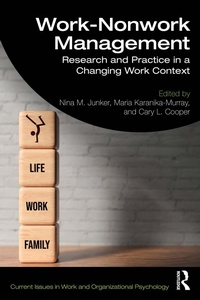
Work-Nonwork Management
Research and Practice in a Changing Work Context
Published on 19. December 2025
302 pages
978-1-040-68638-6 (ISBN)
Description

Work-Nonwork Management: Research and Practice in a Changing Work Context advances the understanding of how individuals, couples, teams, and organizations can effectively navigate work-nonwork integration in ways that promote wellbeing and productivity.
The book considers how individuals form and shape boundaries between their work and nonwork roles, sheds light on the role of supervisors in enabling individuals' work-nonwork management while effectively leading teams with diverging work-nonwork needs and interests and clarifies how organizations can develop and implement effective work-nonwork policies. Highlighting the importance of embracing work-nonwork diversity within organizational culture, the expert contributors offer hands-on recommendations to facilitate the handling of and benefit from having multiple roles in this new work context. Going beyond the traditional, the book considers the experiences of blue-collar and non-standard workers, individuals employed in family businesses and small-to-medium-sized businesses, and LGBTQIA+ individuals, as well as adopting a global perspective by looking at cross-cultural differences in how individuals reconcile and negotiate their work and nonwork roles.
Essential reading for students and academics in psychology and management studying the work-nonwork interface, this volume also serves as an invaluable resource for supervisors, HR professionals, and organizational decision-makers seeking to support employee wellbeing while enhancing organizational attractiveness in an increasingly competitive talent marketplace.
The book considers how individuals form and shape boundaries between their work and nonwork roles, sheds light on the role of supervisors in enabling individuals' work-nonwork management while effectively leading teams with diverging work-nonwork needs and interests and clarifies how organizations can develop and implement effective work-nonwork policies. Highlighting the importance of embracing work-nonwork diversity within organizational culture, the expert contributors offer hands-on recommendations to facilitate the handling of and benefit from having multiple roles in this new work context. Going beyond the traditional, the book considers the experiences of blue-collar and non-standard workers, individuals employed in family businesses and small-to-medium-sized businesses, and LGBTQIA+ individuals, as well as adopting a global perspective by looking at cross-cultural differences in how individuals reconcile and negotiate their work and nonwork roles.
Essential reading for students and academics in psychology and management studying the work-nonwork interface, this volume also serves as an invaluable resource for supervisors, HR professionals, and organizational decision-makers seeking to support employee wellbeing while enhancing organizational attractiveness in an increasingly competitive talent marketplace.
Reviews / Votes
'Amid constant societal and technological changes, managing work-nonwork roles has become a highly relevant and pressing issue for all. With its unique multifoci perspective-considering individuals and couples, leaders and teams, and entire organizations-this collection sets a new standard for understanding the complexities of work-nonwork dynamics in contemporary life'.Eunae Cho, Assistant Professor in the Department of Business Administration, National Chengchi University, Taipei, Taiwan
'The editors have assembled a diverse group of talented scholars to dissect the features of today's work scene and examine actions that can be taken by three stakeholders-employees and their families, supervisors and work teams, and organizations-to successfully address the challenges'.
Jeffrey H. Greenhaus, Professor Emeritus of Management, Drexel University, Philadelphia, USA
'A unique feature of this edited book I particularly enjoyed is its novel chapters on especially under-examined topics such as managing work-life issues in teams, couples, non-hetero-normative families, smaller enterprises, and for fathers'.
Dr. Ellen Ernst Kossek, Distinguished Management and Family Scholar, Purdue University West Lafayette, Indiana USA
More details
Series
Language
English
Place of publication
London
United Kingdom
Publishing group
Taylor & Francis Ltd
Target group
College/higher education
Professional and scholarly
Product notice
Reflowable
Illustrations
2 Tables, black and white; 3 Line drawings, black and white; 5 Halftones, black and white; 8 Illustrations, black and white
File size
3,25 MB
ISBN-13
978-1-040-68638-6 (9781040686386)
Copyright in bibliographic data and cover images is held by Nielsen Book Services Limited or by the publishers or by their respective licensors: all rights reserved.
Schweitzer Classification
Other editions
Additional editions
Nina M. Junker | Maria Karanika-Murray | Cary L. Cooper
Work-Nonwork Management
Research and Practice in a Changing Work Context
Book
approx. 12/2025
1st Edition
Routledge
€64.10
Not yet published
Nina M. Junker | Maria Karanika-Murray | Cary L. Cooper
Work-Nonwork Management
Research and Practice in a Changing Work Context
Book
approx. 12/2025
1st Edition
Routledge
€208.10
Not yet published
Persons
Nina M. Junker is a Professor in Work and Organizational Psychology at the University of Oslo. Prior to her current appointment, she worked as an Assistant Professor in Social Psychology at Goethe University Frankfurt, where she also obtained her PhD. She is a work-nonwork scholar with a particular aim of contributing to a better understanding of how individuals can successfully manage multiple roles and deal with gaining and losing social roles and group memberships. Her work has been published in leading outlets, including the Journal of Applied Psychology, the Journal of Occupational Health Journal, and the Leadership Quarterly. She currently serves as an Associate Editor for Organizational Psychology Review, and her prior work received funding from German and Norwegian funders.
Maria Karanika-Murray is a Full Professor of Work and Organizational Psychology at the University of Leicester. Her research focuses on well-being and performance and a range of questions around understanding and promoting both, individually and in tandem, including presenteeism, the work-non-work interface, workplace health interventions, and sustainable work. Her work on presenteeism was honored with the Human Relations Paper of the Year Award 2020. She has delivered research for national research councils, European funders, charities, Government, and industry, and has written widely for academic, policy, and practitioner audiences. Through her work she brings disparate stakeholders together to build knowledge and fortify practice.
Cary L. Cooper is the 50th Anniversary Professor of Organizational Psychology and Health at the Alliance Manchester Business School, University of Manchester. He is a founding President of the British Academy of Management, Immediate Past President of the Chartered Institute of Personnel and Development (CIPD), former President of RELATE and President of the Institute of Welfare. He was the Founding Editor of the Journal of Organizational Behavior, former Editor of the scholarly journal Stress and Health and is the Editor-in-Chief of the Wiley-Blackwell Encyclopaedia of Management, now in its' 3rd Edition. He has been an advisor to the World Health Organisation, ILO, and EU in the field of occupational health and wellbeing, was Chair of the Global Agenda Council on Chronic Disease of the World Economic Forum (2009-2010) (then served for 5 years on the Global Agenda Council for mental health of the WEF) and was Chair of the Academy of Social Sciences 2009-2015. He was Chair of the Sunningdale Institute in the Cabinet Office and National School of Government 2005-2010. Professor Cooper is currently the Chair of the National Forum for Health & Wellbeing at Work (comprised of 40 global companies, e.g., BP, Microsoft, NHS Executive, UK government (wellbeing lead), Rolls Royce, John Lewis Partnership, etc.). Professor Cooper is the author/editor of over 250 books in the field of occupational health psychology, workplace wellbeing, women at work and occupational stress. He was awarded the CBE by the Queen for his contributions to occupational health, and in 2014 he was awarded a Knighthood for his contribution to the social sciences.
Maria Karanika-Murray is a Full Professor of Work and Organizational Psychology at the University of Leicester. Her research focuses on well-being and performance and a range of questions around understanding and promoting both, individually and in tandem, including presenteeism, the work-non-work interface, workplace health interventions, and sustainable work. Her work on presenteeism was honored with the Human Relations Paper of the Year Award 2020. She has delivered research for national research councils, European funders, charities, Government, and industry, and has written widely for academic, policy, and practitioner audiences. Through her work she brings disparate stakeholders together to build knowledge and fortify practice.
Cary L. Cooper is the 50th Anniversary Professor of Organizational Psychology and Health at the Alliance Manchester Business School, University of Manchester. He is a founding President of the British Academy of Management, Immediate Past President of the Chartered Institute of Personnel and Development (CIPD), former President of RELATE and President of the Institute of Welfare. He was the Founding Editor of the Journal of Organizational Behavior, former Editor of the scholarly journal Stress and Health and is the Editor-in-Chief of the Wiley-Blackwell Encyclopaedia of Management, now in its' 3rd Edition. He has been an advisor to the World Health Organisation, ILO, and EU in the field of occupational health and wellbeing, was Chair of the Global Agenda Council on Chronic Disease of the World Economic Forum (2009-2010) (then served for 5 years on the Global Agenda Council for mental health of the WEF) and was Chair of the Academy of Social Sciences 2009-2015. He was Chair of the Sunningdale Institute in the Cabinet Office and National School of Government 2005-2010. Professor Cooper is currently the Chair of the National Forum for Health & Wellbeing at Work (comprised of 40 global companies, e.g., BP, Microsoft, NHS Executive, UK government (wellbeing lead), Rolls Royce, John Lewis Partnership, etc.). Professor Cooper is the author/editor of over 250 books in the field of occupational health psychology, workplace wellbeing, women at work and occupational stress. He was awarded the CBE by the Queen for his contributions to occupational health, and in 2014 he was awarded a Knighthood for his contribution to the social sciences.
Content
1. Why we Need to Advance our Understanding of the Work-Nonwork Interface 2. Setting the Scene: Work-Nonwork Theories and Conceptualizations Part A: Working in the "New Work" world 3. The Individual's and the Couple's Perspective: Boundary Management - To Blend or not to Blend Work and Nonwork Roles? 4. The Team Perspective: Adopting a work-life lens when managing hybrid employees and teams 5. The Organizational Perspective: Work Design, Organizational Policies, and their Effectiveness Part B: Working aligned with changing values and preferences 6. The Individual and the Couple Perspective: Everything Changes - Shifting Values and Priorities around Work and Family in the Couple Context 7. The Team Perspective: Managing Work-Life Diversity in Teams 8. The Organizational Perspective: A Culture for Diversity in Work-Nonwork Decisions Part C: Embracing the "whole person approach" 9. The Individual's and the Couple's Perspective: The Multiple Roles we Have, the Interdependency of Domain Actors, and their Implications for Work and Life 10. The Team Perspective: How can Team Members and Leaders Support Positive Transitions Between Work and Nonwork Roles? 11. The Organizational Perspective: Life-course Oriented Sustainable HRM Part D: "One size does not fit all" 12. Beyond White-Collar and Standard Workers - Work-Life Management Across Worker Groups 13. Beyond Large Enterprises - Work-Life Management in SMEs and Family Businesses 14. Beyond the Cis-Heteronormative Family: Work-Life Management for LGBTQIA+ Individuals 15. Beyond Mothers - How Fathers Matter for Work-Life Management 16. Beyond WEIRD Countries - Work-Life Management Across the Globe
