

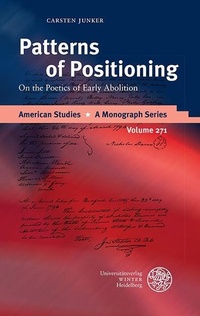
Patterns of Positioning
On the Poetics of Early Abolition
Published on 13. May 2016
XV, 515 pages
978-3-8253-7591-1 (ISBN)
Description

'Patterns of Positioning' examines, in the time span prior to the US abolition of the trade of enslaved Africans in 1808, how the early transatlantic discourse of abolition unfolded in the North American sphere. It starts out from the premise that abolition was a set of formalized practices - a poetics - which gave formal shape to abolitionist discourse. By accessing canonical and non-canonized as well as previously unexamined material, and identifying argumentative patterns, narrative figures, and generic frames, this study provides a newly-informed and complex perspective on early abolition. It considers how the poetics of abolition reconfigured the discursive positioning of the enslaved and the protagonists of the poetics of abolition themselves.
'Patterns of Positioning' thus highlights how strategies geared toward overcoming structural inequality potentially reified such inequality and allowed for the personal self-aggrandizement of those who publicly denounced slavery and the transatlantic slave trade. By introducing a vocabulary to American Studies which reads the critique of the apparatus of enslavement as a poetics, 'Patterns of Positioning' facilitates an analysis of the fundamental dynamics of Western modern civil society, its practices and discourses.
More details
Other editions
Additional editions
Book
05/2016
1st Edition
Universitätsverlag Winter
€48.00
No shipping information available
Content
- Cover
- Title Page
- Copyright
- Contents
- Illustrations
- Fig. 1. John Wesley, Thoughts Upon Slavery, 1774
- Fig. 2. Minimal layout of arguments according to Toulmin
- Fig. 3. Complex layout of arguments according to Toulmin
- Fig. 4. N. Davies, "Emancipation of N Davies's Negroes," 1794
- Fig. 5. N. Davies, "Emancipation of N Davies's Negroes," 1794
- Fig. 6. Pomp and J. Plummer, "Dying Confession of Pomp," 1795
- Fig. 7. "The Story of Inkle and Yarico," 1762
- Fig. 8. "Remarks on the Slave Trade," 1789
- Fig. 9. Samuel West, Family Anecdotes and Memoirs, 1808
- Abbreviations
- Acknowledgments
- Introduction-The Poetics of Early Abolition
- 1 Positioning and Feeling for the Enslaved
- 2 Conceptual Framework-Desiderata
- 3 Research Questions-Methodology
- I Arguing Abolition-Argumentative Patterns
- 1 Discursive Fields of Topoi
- 1.1 Religious Grounds
- 1.2 Moral and Political-Philosophical Grounds
- 1.3 Economic Grounds
- 1.4 Historical Grounds
- 1.5 National Grounds
- 1.6 Grounds of 'Race
- 1.7 Reflections on Arguing Abolition
- 2 Referents of Topoi
- 2.1 The Free
- 2.2 The Unfree
- 3 Functions of Topoi
- 3.1 Subject Positioning
- 3.2 Object Positioning
- 3.3 Abject Positioning
- II Narrating Abolition-Narrative Figures
- 1 Criminal Confession and Conversion
- 2 Repentance and Remission
- 3 Avarice and Abuse
- 4 Generosity and Gratitude
- 5 Deprivation and Dispersion
- III Generating Abolition-Generic Frames
- 1 Genre as Frame for Dialogic Space
- 2 Genre as Frame for Emotionalization
- 3 Genre as Frame for Speaking Positions
- Conclusion-Patterns of Abolitionist Self-Aggrandizement
- Works Cited
- Index
