

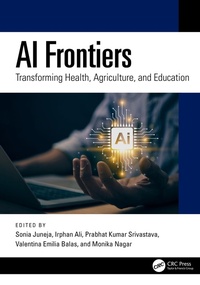
AI Frontiers
Transforming Health, Agriculture, and Education
Published on 10. October 2025
292 pages
978-1-040-42360-8 (ISBN)
Description

The rapid advancement of artificial intelligence (AI) is revolutionizing key sectors critical to global progress. AI Frontiers: Transforming Health, Agriculture, and Education delves into how cutting-edge AI innovations are addressing some of the world's most pressing challenges. This comprehensive volume explores the transformative impact of AI across healthcare, agriculture, and industrial landscapes, offering insights into practical applications, emerging trends, and future opportunities. By blending theoretical foundations with real-world case studies, this book empowers readers with actionable knowledge to leverage AI effectively.
What sets this book apart is its interdisciplinary approach, combining technical depth with sector-specific insights. It goes beyond the basics to highlight ethical considerations, data governance frameworks, and sustainable development initiatives. Each chapter presents a roadmap for integrating AI solutions to enhance productivity, efficiency, and decision-making in diverse industries.
Key Features:
In-depth exploration of AI's role in healthcare, from predictive analytics in diagnostics to AI-driven drug discovery and personalized treatment strategies.
Detailed insights into AI applications in agriculture, including precision farming, crop disease prediction, and resource optimization.
Coverage of industrial innovations powered by AI, such as predictive maintenance, process automation, and quality control systems.
Case studies illustrating successful AI implementations in real-world scenarios.
Discussion of ethical AI deployment, data privacy challenges, and strategies to bridge the digital divide.
Forward-looking perspectives on AI's role in advancing the United Nations' Sustainable Development Goals (SDGs).
This book is an essential resource for researchers, industry professionals, policymakers, and students seeking to understand the transformative power of AI. Whether you are a tech enthusiast, academic, or decision-maker, AI Frontiers offers valuable insights to help you navigate the rapidly evolving landscape of AI-driven innovation.
What sets this book apart is its interdisciplinary approach, combining technical depth with sector-specific insights. It goes beyond the basics to highlight ethical considerations, data governance frameworks, and sustainable development initiatives. Each chapter presents a roadmap for integrating AI solutions to enhance productivity, efficiency, and decision-making in diverse industries.
Key Features:
In-depth exploration of AI's role in healthcare, from predictive analytics in diagnostics to AI-driven drug discovery and personalized treatment strategies.
Detailed insights into AI applications in agriculture, including precision farming, crop disease prediction, and resource optimization.
Coverage of industrial innovations powered by AI, such as predictive maintenance, process automation, and quality control systems.
Case studies illustrating successful AI implementations in real-world scenarios.
Discussion of ethical AI deployment, data privacy challenges, and strategies to bridge the digital divide.
Forward-looking perspectives on AI's role in advancing the United Nations' Sustainable Development Goals (SDGs).
This book is an essential resource for researchers, industry professionals, policymakers, and students seeking to understand the transformative power of AI. Whether you are a tech enthusiast, academic, or decision-maker, AI Frontiers offers valuable insights to help you navigate the rapidly evolving landscape of AI-driven innovation.
More details
Language
English
Place of publication
London
United Kingdom
Publishing group
Taylor & Francis Ltd
Target group
College/higher education
Professional and scholarly
Illustrations
22 Tables, black and white; 61 Line drawings, black and white; 19 Halftones, black and white; 80 Illustrations, black and white
File size
11,87 MB
ISBN-13
978-1-040-42360-8 (9781040423608)
Copyright in bibliographic data and cover images is held by Nielsen Book Services Limited or by the publishers or by their respective licensors: all rights reserved.
Schweitzer Classification
Other editions
Additional editions
Sonia Juneja | Irphan Ali | Prabhat Kumar Srivastava
AI Frontiers
Transforming Health, Agriculture, and Education
Book
10/2025
1st Edition
CRC Press
€170.60
Shipment within 10-20 days
Persons
Dr. Sonia Juneja is a Professor in the Department of Computer Science at IMS Engineering College, Ghaziabad with 22 years of academic experience. She is committed to comprehensive problem-solving abilities, ability to cope and work with people in groups, leadership quality and analytical and interpersonal skills. Her active participation in conferences and workshops reflects her keen interest in continuous learning and self-upgradation. She has been associated with multiple journals as reviewer. She has made significant contributions to the field, authoring peer-reviewed journal articles, conference papers, and book chapters. Her research areas include software cost estimation, computational intelligence-based techniques, nature inspired optimization algorithms, machine learning, and fuzzy systems. She is a member of IEEE and CSI.
Dr. Irphan Ali is a strategic academic leader and EdTech innovator with a Ph.D. in Computer Science and Engineering, specializing in Artificial Intelligence and Machine Learning. With over 21 years of experience across India, Canada, and global academic ecosystems, he brings extensive expertise in higher education, academic administration, digital learning, and EdTech product development. Currently, Dr. Ali serves as the Chief Learning Officer at Florida Coastal University, USA, and as the Global Head of Academics at Innivec Ventures Inc., Canada. In these roles, he leads the design and deployment of next-generation educational technology solutions, drives curriculum innovation, and manages global academic partnerships. His portfolio encompasses strategic initiatives in online university governance, ministry compliance, quality assurance, and the development of workforce-aligned programs for skill enhancement and digital transformation. Dr. Ali's core strengths include EdTech product strategy, AI integration in education, implementation of flipped and blended learning models, regulatory alignment, and large-scale project and team management. He has successfully spearheaded initiatives that have strengthened academic credibility, enhanced operational efficiency, and expanded global visibility for both institutions and startups.He is deeply committed to improving learner experiences, aligning education with emerging industry demands, and creating scalable, inclusive education models. A strong believer in continuous learning and research-led innovation, Dr. Ali champions global collaboration to make education more impactful, accessible, and future-ready.
Dr. Prabhat Kumar Srivastava is presently working as Professor in the Department of Computer Science & Engineering at IMS Engineering College, Ghaziabad. He holds Ph.D. in Computer Science from Sam Higginbottom University of Agriculture and Technology & Science Allahabad U.P., (Formerly Known as Allahabad Agriculture University, Allahabad). He completed B.Sc., MCA and M.Tech. in Computer Science & Engineering. Prior to that he has worked as Professor and Program Officer in Quantum University Roorkee, Uttarakhand and Babu Banarasi Das University, Lucknow. Her overall experience is almost 24 years. He has 65 publications including Conference and Journal papers. He has published 35 research papers in International Journals SCI, ESCI, Scopus and International/National Conferences and authored Six Books. He has published 15 patents and also having 5 Patents grant in his credit. He is serving as Conference Chair, General Chair, Technical Programme Committee (TPC) Member and a Reviewer in various Springer, IEEE international conferences. His research area includes Soft Computing, Fuzzy Systems (Interval Type-2 Fuzzy Systems and Type-2 Fuzzy Systems), Evolutionary Algorithms (Genetic Algorithms), Genetic Fuzzy Systems, Machine Learning. He has published many Papers in National Conferences, International Conferences, and International Journals. He has also published Indian Patent and Australian Patent. He is Member of IEEE & ISTE.
Dr. Valentine Emilia Balas has over 30 years of experience in applied electronics and telecommunications, she is a professor and PhD at Aurel Vlaicu University of Arad, where she teaches and supervises students in the fields of intelligent systems, soft computing, and fuzzy control. She also holds a certified verified peer reviewer certification from Publons, demonstrating her commitment to advancing scientific knowledge and quality. Her research interests and expertise include artificial neural networks, machine learning, fuzzy logic, and iris recognition. She has published multiple papers in reputable journals and books, such as Springer Verlag, and presented her findings at international conferences and workshops. Her mission is to explore and develop innovative and practical solutions for complex and real-world problems using evolutionary and biometric approaches.
Dr. Monika Nagar received her B.Tech degree from A.K.T.U, Uttar Pradesh, India in 2012 in Computer Science and Engineering and her MBA in IT from A.K.T.U, Uttar Pradesh, India in 2014. She completed her PhD at the Department of Management, Shri Venkateshwara University, Gajraula, Ghaziabad, India. Her areas of interest are Data Analytics, cloud computing, and Innovation technology. She has published several papers at National and International conferences. She intends to pursue a deep-rooted career in a Teaching-related prospectus that suits her knowledge criteria.
Dr. Irphan Ali is a strategic academic leader and EdTech innovator with a Ph.D. in Computer Science and Engineering, specializing in Artificial Intelligence and Machine Learning. With over 21 years of experience across India, Canada, and global academic ecosystems, he brings extensive expertise in higher education, academic administration, digital learning, and EdTech product development. Currently, Dr. Ali serves as the Chief Learning Officer at Florida Coastal University, USA, and as the Global Head of Academics at Innivec Ventures Inc., Canada. In these roles, he leads the design and deployment of next-generation educational technology solutions, drives curriculum innovation, and manages global academic partnerships. His portfolio encompasses strategic initiatives in online university governance, ministry compliance, quality assurance, and the development of workforce-aligned programs for skill enhancement and digital transformation. Dr. Ali's core strengths include EdTech product strategy, AI integration in education, implementation of flipped and blended learning models, regulatory alignment, and large-scale project and team management. He has successfully spearheaded initiatives that have strengthened academic credibility, enhanced operational efficiency, and expanded global visibility for both institutions and startups.He is deeply committed to improving learner experiences, aligning education with emerging industry demands, and creating scalable, inclusive education models. A strong believer in continuous learning and research-led innovation, Dr. Ali champions global collaboration to make education more impactful, accessible, and future-ready.
Dr. Prabhat Kumar Srivastava is presently working as Professor in the Department of Computer Science & Engineering at IMS Engineering College, Ghaziabad. He holds Ph.D. in Computer Science from Sam Higginbottom University of Agriculture and Technology & Science Allahabad U.P., (Formerly Known as Allahabad Agriculture University, Allahabad). He completed B.Sc., MCA and M.Tech. in Computer Science & Engineering. Prior to that he has worked as Professor and Program Officer in Quantum University Roorkee, Uttarakhand and Babu Banarasi Das University, Lucknow. Her overall experience is almost 24 years. He has 65 publications including Conference and Journal papers. He has published 35 research papers in International Journals SCI, ESCI, Scopus and International/National Conferences and authored Six Books. He has published 15 patents and also having 5 Patents grant in his credit. He is serving as Conference Chair, General Chair, Technical Programme Committee (TPC) Member and a Reviewer in various Springer, IEEE international conferences. His research area includes Soft Computing, Fuzzy Systems (Interval Type-2 Fuzzy Systems and Type-2 Fuzzy Systems), Evolutionary Algorithms (Genetic Algorithms), Genetic Fuzzy Systems, Machine Learning. He has published many Papers in National Conferences, International Conferences, and International Journals. He has also published Indian Patent and Australian Patent. He is Member of IEEE & ISTE.
Dr. Valentine Emilia Balas has over 30 years of experience in applied electronics and telecommunications, she is a professor and PhD at Aurel Vlaicu University of Arad, where she teaches and supervises students in the fields of intelligent systems, soft computing, and fuzzy control. She also holds a certified verified peer reviewer certification from Publons, demonstrating her commitment to advancing scientific knowledge and quality. Her research interests and expertise include artificial neural networks, machine learning, fuzzy logic, and iris recognition. She has published multiple papers in reputable journals and books, such as Springer Verlag, and presented her findings at international conferences and workshops. Her mission is to explore and develop innovative and practical solutions for complex and real-world problems using evolutionary and biometric approaches.
Dr. Monika Nagar received her B.Tech degree from A.K.T.U, Uttar Pradesh, India in 2012 in Computer Science and Engineering and her MBA in IT from A.K.T.U, Uttar Pradesh, India in 2014. She completed her PhD at the Department of Management, Shri Venkateshwara University, Gajraula, Ghaziabad, India. Her areas of interest are Data Analytics, cloud computing, and Innovation technology. She has published several papers at National and International conferences. She intends to pursue a deep-rooted career in a Teaching-related prospectus that suits her knowledge criteria.
Content
1. Role of AI in transforming different sectors of Industry 5.0, 2. Role of artificial intelligence in transforming banking sectors in Industry 5.0, 3. Generative AI for Industry 5.0 and sustainability: How artificial intelligence is transforming industries with smart technologies, 4. The role of AI in today's healthcare: From prediction to management, 5. AI-powered tools for illness detection and diagnosis prediction: Indian perspectives and innovations, 6. Exploring the biomedical metaverse and its impact on healthcare innovation, 7. Multimodal emotion recognition from voice data using machine learning techniques: A comparative study, 8. Enabling enhanced patient care aided by artificial intelligence: HealthAI connect, 9. Ethics, privacy, and security in AI-driven healthcare, 10. Application of AI for the betterment of patient care, 11. Education in the age of AI: Redefining pedagogy and learning environments, 12. Generative AI in education: A case study for ESL learners, 13. Meta-synthesis analysis on artificial intelligence applications in healthcare: A qualitative synthesis of outcomes and effectiveness, 14. AI's role in monitoring chronic disease and predicting health outcomes, 15. Monitoring agricultural health and drought conditions to support Papua New Guinea's oil palm industry using multispectral satellite images, 16. Case studies of AI applications in healthcare, 17. Case studies of AI applications in agriculture, 18. Education in the age of AI
