

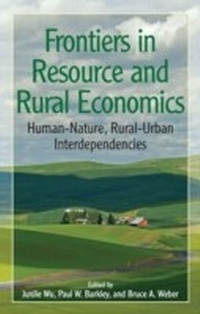
Frontiers in Resource and Rural Economics
Human-Nature, Rural-Urban Interdependencies
1st Edition
Published on 30. September 2010
266 pages
978-1-136-52584-1 (ISBN)
Description

Most land in the United States is in rural areas, as are the sources of most of its fresh water and almost all its other natural resources. One of the first books to approach resource economics and rural studies as fundamentally interconnected areas of study, Frontiers in Resource and Rural Economics integrates the work of 18 leading scholars in resource economics, rural economics, rural sociology and political science in order to focus on two complex interdependencies-one pertaining to natural resources and human welfare, the other to urban and rural communities and their economies.
The book reviews the past 50 years of scholarship in both natural resource and rural economics. It contrasts their different intellectual and practical approaches and considers how they might be refocused in light of pressing demands on human and natural systems. It then proposes a 'new rural economics' that acknowledges the full range of human-ecosystem and urban-rural interdependencies. It explores the relationship between natural resources and economic growth, and considers the prospects for amenity-driven growth that would benefit both new and traditional inhabitants of rural areas. Later chapters explore the politics of place, spatial economics, strategies for reducing rural poverty, and prospects for linking rural and environmental governance. Throughout, the book emphasizes innovative research methods that integrate natural resource, environmental, and rural economics.
The book reviews the past 50 years of scholarship in both natural resource and rural economics. It contrasts their different intellectual and practical approaches and considers how they might be refocused in light of pressing demands on human and natural systems. It then proposes a 'new rural economics' that acknowledges the full range of human-ecosystem and urban-rural interdependencies. It explores the relationship between natural resources and economic growth, and considers the prospects for amenity-driven growth that would benefit both new and traditional inhabitants of rural areas. Later chapters explore the politics of place, spatial economics, strategies for reducing rural poverty, and prospects for linking rural and environmental governance. Throughout, the book emphasizes innovative research methods that integrate natural resource, environmental, and rural economics.
Reviews / Votes
'Many key issues of the 21st Century revolve around ruralurban interdependencies, including alternative energy, protecting our natural environment, and maintaining the vitality of American's rural communities. They require innovative applications of rural development and natural resource policy. Frontiers in Resource and Rural Economics will be valuable to those interested in regional planning, rural community development, urban sprawl and exurban change, and natural resources.'Mark Partridge, The Ohio State University
More details
Edition
1. Auflage
Language
English
Place of publication
London
United Kingdom
Publishing group
Taylor & Francis Ltd
Target group
College/higher education
Product notice
Reflowable
File size
2,57 MB
ISBN-13
978-1-136-52584-1 (9781136525841)
Copyright in bibliographic data and cover images is held by Nielsen Book Services Limited or by the publishers or by their respective licensors: all rights reserved.
Schweitzer Classification
Other editions
Additional editions
Wu JunJie | Paul Barkley | Bruce Weber
Frontiers in Resource and Rural Economics
Human-Nature, Rural-Urban Interdependencies
Book
02/2008
1st Edition
Resources for the Future Press (RFF Press)
€82.70
Shipment within 3-4 weeks
Wu JunJie | Paul Barkley | Bruce Weber
Frontiers in Resource and Rural Economics
Human-Nature, Rural-Urban Interdependencies
Book
02/2008
1st Edition
Resources for the Future Press (RFF Press)
€232.10
Shipment within 3-4 weeks
Persons
JunJie Wu is a professor in the Department of Agricultural and Resource Economics at Oregon State University, where he also holds the Emery N. Castle Professorship.
Paul W. Barkley is professor emeritus in the School of Economic Sciences at Washington State University and courtesy professor in agricultural economics at Oregon State University.
Bruce A. Weber is professor of agricultural and resource economics and director of the Rural Studies Program at Oregon State University.
Paul W. Barkley is professor emeritus in the School of Economic Sciences at Washington State University and courtesy professor in agricultural economics at Oregon State University.
Bruce A. Weber is professor of agricultural and resource economics and director of the Rural Studies Program at Oregon State University.
Content
Preface
Contributors
1. Frontiers in Resource and Rural Economics: A Synthesis
Part 1: The Past 50 Years
2. The Emergence and Evolution of Environmental and Natural Resource Economics
3. Rural Economics: People, Land and Capital
Part 2: Human-Nature and Rural-Urban Interdependence
4. Environmental Economics and the 'Curse' of the Circular Flow
5. The New Rural Economics
6. Exploring the Prospects for Amenity-Driven Growth in Rural Areas
7. Natural Amenities, Human Capital, and Economic Growth: An Empirical Analysis
Part 3: Policies and Programs for People and Places
8. People and Places at the Ragged Edge: Place-Based Policy for Reducing Rural Poverty
9. Rural Human Capital Development
10. Property Taxation and the Redistribution of Rural Resource Rents
11. The Politics of Place: Linking Rural and Environmental Governance
12. Frontiers in Resource and Rural Economics: A Methodological Perspective
Part 4: The Next 25 Years
13. Resources and Rural Communities: Looking Ahead
14. The Future of Rural America Through a Social-Demographic Lens
Index
Contributors
1. Frontiers in Resource and Rural Economics: A Synthesis
Part 1: The Past 50 Years
2. The Emergence and Evolution of Environmental and Natural Resource Economics
3. Rural Economics: People, Land and Capital
Part 2: Human-Nature and Rural-Urban Interdependence
4. Environmental Economics and the 'Curse' of the Circular Flow
5. The New Rural Economics
6. Exploring the Prospects for Amenity-Driven Growth in Rural Areas
7. Natural Amenities, Human Capital, and Economic Growth: An Empirical Analysis
Part 3: Policies and Programs for People and Places
8. People and Places at the Ragged Edge: Place-Based Policy for Reducing Rural Poverty
9. Rural Human Capital Development
10. Property Taxation and the Redistribution of Rural Resource Rents
11. The Politics of Place: Linking Rural and Environmental Governance
12. Frontiers in Resource and Rural Economics: A Methodological Perspective
Part 4: The Next 25 Years
13. Resources and Rural Communities: Looking Ahead
14. The Future of Rural America Through a Social-Demographic Lens
Index
