

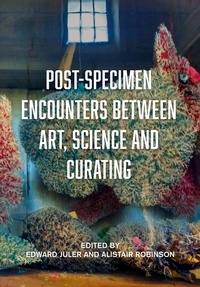
Post-Specimen Encounters Between Art, Science and Curating
Rethinking Art Practice and Objecthood through Scientific Collections
Published on 8. October 2020
250 pages
978-1-78938-313-3 (ISBN)
Description

This edited collection explores a subject of great potential for both art historians and museologists - that of the nature of the specimen and how it might be reinterpreted. Through its cross-disciplinary contributions, written by a team of art historians, artists, poets, anthropologists, critics and curators, this book looks at how artistic encounters in museums, ranging from anatomy museums to contemporary cabinets of curiosity, can provoke new modes of thinking about art, science and curating.
Museological literature in the past focused on artefacts or objects; this is an original contribution to the field and offers new readings of old issues, inspiring new understandings of the relationships between art, science and curating.
Brings together international expertise from art practitioners, historians, creative writers and theorists in France, the United States, United Kingdom and New Zealand. Contributions from creative practitioners draw upon their own experience of producing artworks in response to specific scientific collections while historians, anthropologists, critics and writers examine how museums stimulate, incite and otherwise inspire artistic awareness of science and its specimens.
One of the most important contributions this book will make is drawing together several threads of research and practice to encourage interdisciplinary discussion.
It provides new ways of thinking about the relationships between art, science, museums and their objects. It concentrates on the ways in which scientific collections kindle novel aesthetic strategies and inspire new scholarly interpretations of art, science, curating and epistemology. In so doing it will make a considerable contribution to the fields of art writing, creative practice, art theory, the history of science and curating.
This book will appeal to academics, researchers, undergraduates and postgraduates studying fine art, curating, museology, art history, the history of science, creative writing; visual artists, curators, and other creative practitioners. Also of interest to museum audiences. Reading list potential.
Museological literature in the past focused on artefacts or objects; this is an original contribution to the field and offers new readings of old issues, inspiring new understandings of the relationships between art, science and curating.
Brings together international expertise from art practitioners, historians, creative writers and theorists in France, the United States, United Kingdom and New Zealand. Contributions from creative practitioners draw upon their own experience of producing artworks in response to specific scientific collections while historians, anthropologists, critics and writers examine how museums stimulate, incite and otherwise inspire artistic awareness of science and its specimens.
One of the most important contributions this book will make is drawing together several threads of research and practice to encourage interdisciplinary discussion.
It provides new ways of thinking about the relationships between art, science, museums and their objects. It concentrates on the ways in which scientific collections kindle novel aesthetic strategies and inspire new scholarly interpretations of art, science, curating and epistemology. In so doing it will make a considerable contribution to the fields of art writing, creative practice, art theory, the history of science and curating.
This book will appeal to academics, researchers, undergraduates and postgraduates studying fine art, curating, museology, art history, the history of science, creative writing; visual artists, curators, and other creative practitioners. Also of interest to museum audiences. Reading list potential.
More details
Language
English
Place of publication
Bristol
United Kingdom
Publishing group
Intellect
Target group
Professional and scholarly
Illustrations
50 Illustrations, color
ISBN-13
978-1-78938-313-3 (9781789383133)
Copyright in bibliographic data and cover images is held by Nielsen Book Services Limited or by the publishers or by their respective licensors: all rights reserved.
Schweitzer Classification
Other editions
Additional editions
Edward Juler | Alistair Robinson
Post-Specimen Encounters Between Art, Science and Curating
Rethinking Art Practice and Objecthood through Scientific Collections
Book
01/2021
Intellect Books
€50.00
Shipment within 3-4 weeks
Persons
Edward Juler is lecturer in art history at Newcastle University, UK.
Alistair Robinson is director of the Northern Gallery for Contemporary Art (NGCA) in Sunderland, UK.
Alistair Robinson is director of the Northern Gallery for Contemporary Art (NGCA) in Sunderland, UK.
Content
Introduction
Edward Juler and Alistair Robinson
1: Narratives of the 'Fetish'
John Mack
2: Curating Interobjectively in Museums
Alistair Robinson
3: 'A Readiness to Find What Surrounds Us Strange and Odd': Objects in the Relational Curiosity Museum
Marion Endt-Jones
4: Art, Science and the Mutant Object
Rahma Khazam
5: Models of Subjectivity: Surrealism, Physics and Psychoanalysis
Gavin Parkinson
6: Glimpsed Phantoms of Sensation: Or, a Psychogeographical Investigation of Various Anatomical Specimens with Reference to Christine Borland's Cet etre-la, c'est a toi de le creer!
Edward Juler
7 ... as far back as I will remember
Nadia Lichtig
8: Poetry and the Pathology Museum: A Model of Difference
Christy Ducker
9: The Scientist and the Magician
Irene Brown
10: Choosing, Unpicking and Connecting: On Drawing Museum Objects
Richard Talbot
11: Post-Specimens and Present Ancestors: Passing Fables and Comparative Readings at the Wildgoose Memorial Library
Jane Wildgoose
12: Moving beyond the Specimen (From Drawing Objects to Drawing Processes)
Gemma Anderson
13: Desiccation, Suspension, Extraction: The Inhuman Art of Christine Borland
Andrew Patrizio
Afterword: What's at Stake?
Ludmilla Jordanova
Edward Juler and Alistair Robinson
1: Narratives of the 'Fetish'
John Mack
2: Curating Interobjectively in Museums
Alistair Robinson
3: 'A Readiness to Find What Surrounds Us Strange and Odd': Objects in the Relational Curiosity Museum
Marion Endt-Jones
4: Art, Science and the Mutant Object
Rahma Khazam
5: Models of Subjectivity: Surrealism, Physics and Psychoanalysis
Gavin Parkinson
6: Glimpsed Phantoms of Sensation: Or, a Psychogeographical Investigation of Various Anatomical Specimens with Reference to Christine Borland's Cet etre-la, c'est a toi de le creer!
Edward Juler
7 ... as far back as I will remember
Nadia Lichtig
8: Poetry and the Pathology Museum: A Model of Difference
Christy Ducker
9: The Scientist and the Magician
Irene Brown
10: Choosing, Unpicking and Connecting: On Drawing Museum Objects
Richard Talbot
11: Post-Specimens and Present Ancestors: Passing Fables and Comparative Readings at the Wildgoose Memorial Library
Jane Wildgoose
12: Moving beyond the Specimen (From Drawing Objects to Drawing Processes)
Gemma Anderson
13: Desiccation, Suspension, Extraction: The Inhuman Art of Christine Borland
Andrew Patrizio
Afterword: What's at Stake?
Ludmilla Jordanova
