

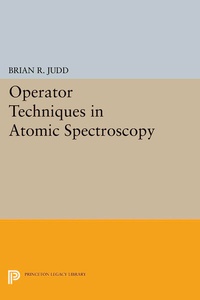
Operator Techniques in Atomic Spectroscopy
1st Edition
Published on 14. July 2014
256 pages
978-1-4008-6477-5 (ISBN)
Description

In the 1920s, when quantum mechanics was in its infancy, chemists and solid state physicists had little choice but to manipulate unwieldy equations to determine the properties of even the simplest molecules. When mathematicians turned their attention to the equations of quantum mechanics, they discovered that these could be expressed in terms of group theory, and from group theory it was a short step to operator methods.
This important development lay largely dormant until this book was originally published in 1963. In this pathbreaking publication, Brian Judd made the operator techniques of mathematicians comprehensible to physicists and chemists. He extended the existing methods so that they could handle heavier, more complex molecules and calculate their energy levels, and from there, it was another short step to the mathematical analysis of spectra. This book provides a first-class introduction to continuous groups for physicists and chemists. Although first written from the perspective of atomic spectroscopy, its major topics and methods will appeal to anyone who has an interest in understanding particle theories of nuclear physics.
Originally published in 1998.
The Princeton Legacy Library uses the latest print-on-demand technology to again make available previously out-of-print books from the distinguished backlist of Princeton University Press. These editions preserve the original texts of these important books while presenting them in durable paperback and hardcover editions. The goal of the Princeton Legacy Library is to vastly increase access to the rich scholarly heritage found in the thousands of books published by Princeton University Press since its founding in 1905.
This important development lay largely dormant until this book was originally published in 1963. In this pathbreaking publication, Brian Judd made the operator techniques of mathematicians comprehensible to physicists and chemists. He extended the existing methods so that they could handle heavier, more complex molecules and calculate their energy levels, and from there, it was another short step to the mathematical analysis of spectra. This book provides a first-class introduction to continuous groups for physicists and chemists. Although first written from the perspective of atomic spectroscopy, its major topics and methods will appeal to anyone who has an interest in understanding particle theories of nuclear physics.
Originally published in 1998.
The Princeton Legacy Library uses the latest print-on-demand technology to again make available previously out-of-print books from the distinguished backlist of Princeton University Press. These editions preserve the original texts of these important books while presenting them in durable paperback and hardcover editions. The goal of the Princeton Legacy Library is to vastly increase access to the rich scholarly heritage found in the thousands of books published by Princeton University Press since its founding in 1905.
More details
Other editions
Additional editions
Brian R. Judd
Operator Techniques in Atomic Spectroscopy
Book
04/2016
Princeton University Press
€104.00
Article not available at the moment
Brian R. Judd
Operator Techniques in Atomic Spectroscopy
Book
07/2014
Princeton University Press
€39.80
Article not available at the moment

Brian R. Judd
Operator Techniques in Atomic Spectroscopy
Book
05/1998
Princeton University Press
€30.95
Article exhausted; check different version
Person
Brian R. Judd
With a new preface by the author
Content
Preface to the Paperback Edition
Preface
Ch. 1 Classical Methods 1
Ch. 2 Crystal Fields 25
Ch. 3 The n-j Symbols 54
Ch. 4 Configurations of two Electrons 76
Ch. 5 Continuous Groups 95
Ch. 6 Seniority 154
Ch. 7 Fractional Parentage Coefficients 166
Ch. 8 Configurations of More than Two Equivalent Electrons 193
App. 1 Radial Integrals for Hydrogenic Eigenfunctions 225
App. 2 The Coefficients (UL\U'L' + f) and (WU\W'U' + f) 227
References 233
Index 237
Preface
Ch. 1 Classical Methods 1
Ch. 2 Crystal Fields 25
Ch. 3 The n-j Symbols 54
Ch. 4 Configurations of two Electrons 76
Ch. 5 Continuous Groups 95
Ch. 6 Seniority 154
Ch. 7 Fractional Parentage Coefficients 166
Ch. 8 Configurations of More than Two Equivalent Electrons 193
App. 1 Radial Integrals for Hydrogenic Eigenfunctions 225
App. 2 The Coefficients (UL\U'L' + f) and (WU\W'U' + f) 227
References 233
Index 237
