

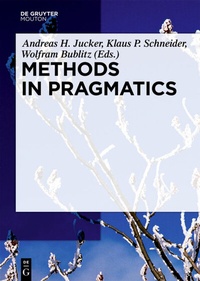
Methods in Pragmatics
Description

Methods in Pragmatics provides a systematic overview of the different types of data, the different methods of data collection and data analysis used in pragmatic research. It offers authoritative and comprehensive surveys of the entire breadth of methods and methodologies. Part 1 covers introspectional, philosophical and cognitive pragmatics. Part 2 is devoted to experimental pragmatics, including discourse completion and dialogue construction tasks, role-plays and other production and comprehension tasks. Part 3 reviews observational pragmatics including ethnographic and discourse analytic methods, and part 4, finally, is devoted to corpus pragmatics including accounts of corpus compilation, annotation and data retrieval specific to pragmatic research. Each contribution provides a state-of-the-art account of the precise workings of one particular method, its applications in the relevant research literature as well as a critical assessment of its strengths and weaknesses and the type of pragmatic research questions for which it is most suitable.
Reviews / Votes
"In sum, the book is inspiring in more than one respect: besides getting an insight into the richness and workability of methods in pragmatics, the reader may also learn how to conduct pragmatic inquiry in a sophisticated, undogmatic and flexible, yet fruitful and constructive way. The handbook is undoubtedly one of the highlights among the recent achievements in pragmatics. Working linguists as well as students of linguistics should not hesitate to consult this seminal work and to use it during their studies and research."
András Kertész in: Sprachtheorie und germanistische Linguistik 28/2 (2018), 277-283
More details
Other editions
Additional editions
Persons
Content
- Intro
- Preface to the handbook series
- Preface
- Table of contents
- I. Introduction
- 1. Data in pragmatic research
- 2. Methods and ethics of data collection
- 3. The art of transcription: Systems and methodological issues
- II. Introspectional pragmatics
- 4. Introduction to part 2: Introspectional pragmatics
- 5. Philosophical pragmatics
- 6. Research methodology in classical and neo-Gricean pragmatics
- 7. Cognitive pragmatics: Relevance-theoretic methodology
- III. Experimentational pragmatics
- 8. Introduction to part 3: Experimentational pragmatics
- 9. Discourse completion tasks
- 10. Assessing the comprehension of pragmatic language: Sentence judgment tasks
- 11. Psycholinguistic production tasks
- 12. Role plays
- IV. Observational pragmatics
- 13. Introduction to part 4: Observational pragmatics
- 14. Ethnographic methods in pragmatics
- 15. Ethnomethodology and conversation analysis
- 16. Discourse analysis
- 17. Critical Discourse Analysis
- V. Corpus pragmatics
- 18. Introduction to part 5: Corpus pragmatics
- 19. Corpus construction
- 20. Corpus annotation
- 21. Historical corpus pragmatics
- 22. Corpus pragmatics: From form to function
- 23. Corpus-based function-to-form approaches
- 24. Corpus-based metapragmatics
- Bionotes
- Name index
- Subject index
