

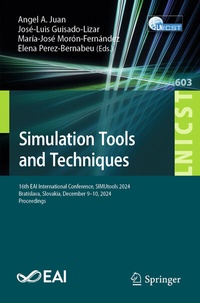
Simulation Tools and Techniques
Description

This book constitutes the refereed post-conference proceedings of the 16th EAI International Conference on Simulation Tools and Techniques, SIMUTools 2024, held in Bratislava, Slovakia, in December 2024.
The 26 full papers included in this book were carefully reviewed and selected from 63 submissions. They were organized in topical sections as follows: simulation tools and methods, traffic simulations, logistics and manufacturing, robotics simulations, applications of simulations, and network simulations.
More details
Other editions
Additional editions
Content
Simulation Tools and Methods.- Sim-Learnheuristics: A Tool for Decision Making under Stochastic and Dynamic Conditions.- The Role of Interfaces in Modelling.- Interfaces in Ecosystems: Concepts, Form, and Implementation.- Minimalistic System Modelling: Behaviours, Interfaces, and Local Reasoning.- Traffic Simulations.- Integrating Simulation and AI for Optimal Electric Vehicle Charging Infrastructure: Achievements and Future Directions.- Integrating Fast Electric Vehicle Charging and Charge-Site Power-Limiting in SUMO.- A Simheuristic for the Stochastic Multi-Depot Traveling Facility Location Problem with Electric Vehicles.- Effect of Maintenance and Failure on Electrical Vehicles Charging Scheduling at an Airport.- Validation and Verification Techniques in Simulation Modelling for Freight Transportation.- Logistics and Manufacturing.- A Simulation-Optimisation Tool for Routing Drones in Realistic Conditions.- AKRIMA - An Automated Adaptive System for Crisis Monitoring and Management.- ARMS: Activity-Resource Modelling Simulator.- Improvements to the Region-based Petri Nets Synthesis Algorithm for Process Mining.- Cross-Dataset Generalization: Bridging the Gap Between Real and Synthetic LiDAR Data.- Robotics Simulations.- On the Simulation of a Neuromorphic Robotic Arm with Dynamic Control for Rapid Trajectories Evaluation.- On Implementing the Sparse Events Closed-Loop Control Theory for the CartPoleSimulation.- Simulation and Operation of a 6DoF Robotic Arm: A Microservices Approach.- Flexible Visualization for Modular Autonomy Cores of Autonomous Robot Swarms.- Applications of Simulations.- A653MSim: An ARINC 653 Multicore Simulator.- Docker-based Web Service to Aid Prostate Cancer Diagnosis using Deep-learning Techniques.- Seamless Data Persistence in Simulation Models: A Metaprogramming Approach in Julia.- Network Simulations.- Positioning of a Next Generation Mobile Cell to Maximise Aggregate Network Capacity.- Dynamic Data Radio Bearer Management for O-RAN Slicing in 5G Standalone Networks.- CyReal: A Unified Framework for Continuous Evaluation of Simulations, Emulations, and Real Systems.- JASPER: An Agent-Based Simulation Tool for Test and Evaluation of Jammer-Angle Allocation Algorithms.- Barriers and Challenges of Network Simulation Tools: A Case Study on CORE/EMANE.
