

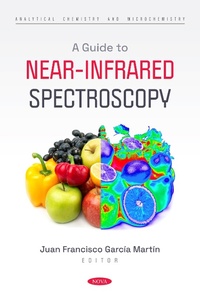
Guide to Near-Infrared Spectroscopy
Published on 21. August 2023
223 pages
979-8-88697-968-8 (ISBN)
Description

The principles, theory, instrumentation and data analysis of the near-infrared spectroscopy and the hyperspectral imaging equipment are described in this book, including the basics of chemometrics for the treatment of large spectral dataset. In addition, a comprehensive discussion on the current applications and future prospects of near-infrared spectroscopy to food quality and the determination of energy properties of biomass is provided.
More details
Other editions
Additional editions
Juan Francisco Garcia Martin
A Guide to Near-Infrared Spectroscopy
Book
08/2023
Nova Science Publishers Inc
€211.28
Shipment within 10-20 days
Content
- Intro
- Contents
- Preface
- Chapter 1
- Principles, Theories and Applications of Near-Infrared Spectroscopy for Food Quality and Safety Control
- Abstract
- Introduction
- Theory
- Instrumentation
- Laboratory Stationary (i.e., Benchtop) NIR Spectrometer
- Handheld and Micro NIR Spectrometers
- Online NIR Spectrometer
- Sample Presentation
- Chemometrics
- Spectral Data Pre-Processing
- Classification Modelling
- Principal Component Analysis (PCA)
- Discriminant Analysis (DA)
- Regression Modelling
- Partial Least Square Regression (PLS)
- Machine Learning Regression
- Applications
- Meat, Fish, and Fishery Products
- Edible Oils, Milk and Dairy Products
- Grains and Grain Products
- Fruit and Vegetables
- Future Directions
- Conclusion
- References
- Chapter 2
- The Current and Potential Roles of Near-Infrared Spectroscopy in the Digital Food Era
- Abstract
- Introduction
- Current Applications of NIR Spectroscopy
- Future and Potential Applications of NIR Spectrosopy in Food
- Food Functionality
- Food Security and Safety
- Conclusion
- References
- Chapter 3
- The Determination of Olive Oil's Moisture by a Hand-Held Near-Infrared Spectrometer
- Abstract
- Abbreviations
- Olive Oil
- Olive Cultivation
- Economy and Market of Olive Oil
- Relevance of Olive Oil
- Physico-Chemical Parameters of Olive Oil
- Moisture in Olive Oil
- NIR Spectroscopy (NIRS)
- NIRS Application to the Olive Oil Industry
- Chemometrics
- Stages of the Modeling Process
- Data Pre-Treatment
- Building of the Chemometric Model
- Evaluation of the Calibration Model by the Validation Set
- Parameters to Assess PLS-NIRS Results
- Experimental Procedure
- Olive Oils
- Acquisition of NIR Spectra
- Determination of the Moisture of VOO
- Calculation of Standard Error of Laboratory (SEL)
- Calibration Procedure
- Results and Discussion
- Moisture and Volatile Matter
- NIR Spectra of VOOs
- PLS Calibration Models
- Development of the PLSLC Calibration Model
- Development of the PLSCV Calibration Model
- Prediction of Moisture in the Validation Set of Samples
- Conclusion
- References
- Introduction
- Main Components and Principal of Hyperspectral and Multispectral System
- MSI Image Collection Using Multispectral Camera with Visible, Near Infrared and Thermal Waves
- Spectral Image Analysis
- Hyperspectral Image Acquisition and Principles
- Multispectral Image Acquisition and Basic Principles
- Radiometric Calibration
- Image Processing and Extraction of Area of Interest
- Predictive Modeling
- Spectral Preprocessing
- Variable Dimensionally Reduction and Featured Wavelength Selection
- Application of HSI in Fruits and Vegetables
- Application of MSI in Fruits and Vegetables
- Conclusion
- References
- Chapter 5
- The Prediction of Respiratory and Degradation Rates of Horticultural Crops by Near-Infrared Spectroscopy and Hyperspectral Imaging
- Abstract
- Introduction
- Preservation Methods for Freshness of Horticultural Products
- Relationship between Respiratory Enzymes and Degradation of Freshness
- Measurement of the Respiratory Rate of Horticultural Crops
- Relationship between Respiratory Enzymes and Light Absorption
- Estimation of O2 Uptake Rate of Tomato Fruits by NIRS
- Prediction of Degradation of Horticultural Crops by Hyperspectral Imaging
- Conclusion
- Acknowledgments
- References
- Introduction
- NIR Spectroscopy System
- Light Source
- NIR Spectrometers
- NIR Dispersive Spectrometer
- NIR Fourier Transform Spectrometer, FT-NIR Spectrometer
- NIR Linear Variable Filter (LVF) Spectrometer
- NIR Diode Array Spectrometer
- NIR Micro-Electro Mechanical (MEM) Spectrometer
- Detector
- NIR Si Photodetector
- NIR Hyperspectral Image System
- Near-Infrared Hyperspectral Image Principle
- Components of the NIR Hyperspectral Image and Multispectral Systems
- Tungsten Halogen Lamp
- Xenon Lamp
- Laser-Driven Light Source (LDLSTM)
- Light Emitting Diode (LED) of Specific Band
- Digital Camera or Area Detector
- Image Spectrograph
- Diffraction Gratings
- The Prism-Grating-Prism Imaging Spectrograph
- The Offner Spectrograph
- The Czerny-Turner Spectrograph
- Electronically Tunable Filter
- Acousto-Optic Tunable Filter
- Liquid Crystal Tunable Filter
- Beam Splitter
- Multivariate Analysis
- Applications of NIR Spectroscopy, Hyperspectral, Multispectral Imaging in Energy Properties of Biomass
- NIR Spectroscopy for Measurement of Energy Properties of Biomass
- Rapid Elemental Composition Measurement of Commercial Pellets Using Line-Scan Hyperspectral Imaging Analysis
- Machine Learning: Based Prediction of Selected Parameters of Commercial Biomass Pellets Using Line Scan Near-Infrared-Hyperspectral Imaging
- A Low-Cost System for Moisture Content Detection of Bagasse Upon a Conveyor Belt with Multispectral Imaging and Various Machine Learning Methods
- Conclusion
- References
- Chapter 7
- The Determination of D-Xylose and Xylitol by Near-Infrared Spectroscopy Over the Fermentation of Olive Stone Hydrolysates
- Abstract
- Introduction
- Application of NIRS to Fermentation Monitoring
- Materials and Methods
- Fermentation Samples
- Reference Data
- Spectra Acquisition
- Calibration Procedure
- Results and Discussion
- Spectrum of the Fermentation Culture Medium
- Prediction of D-Xylose by PLS-NIRS
- Prediction of Xylitol by PLS-NIRS
- Conclusion
- References
- Index
- Editor's Contact Information
- Chapter 4
- Near-Infrared Hyperspectral and Multispectral Imaging Principles and Applications in the Quality of Fruits and Vegetables
- Abstract
- Chapter 6
- Near-Infrared Spectroscopy, Hyperspectral, Multispectral Imaging Principles and Applications in Energy Properties of Biomass
- Abstract
- Blank Page
