

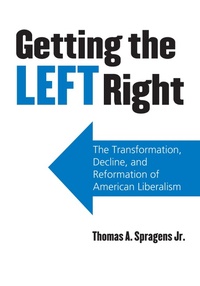
Getting the Left Right
Description

American liberalism has much to be proud of. It is largely responsible for the democratization of political power during the nineteenth century and the harnessing of buccaneer capitalism, for the New Deal's social safety nets and the civil rights legislation of the 1960s. But as the social agenda?and perceived snobbery?of postsixties liberalism alienated the working classes whose interests liberalism had previously championed, ?liberal? soon became a dirty word on the political landscape.
>
Blending political theory with astute analysis of the contemporary scene, Spragens steps back from the ?high liberalism? of John Rawls, Ronald Dworkin, and others, arguing instead that the success of liberalism hinges upon its recognition of the limits of social justice and its rededication to the core values of popular self-rule and universal self-realization?especially the capacity of ordinary citizens for personal development through education, occupation, and the practice of politics itself.
Spragens first offers a detailed account of the contrast between the older and more recent versions of liberal public philosophy and considers the causes of these political philosophical transformations. He then examines the problematic aspects of contemporary liberalism and provides suggestions for a reoriented social agenda that is more compelling morally and more appealing politically. He concludes by addressing liberals' legitimate concerns about advancing social equality, their worries about imposing values in a pluralistic society, and their fears regarding the possible dangers of self-rule.
Forcefully argued and well grounded within recent debates in political philosophy, Getting the Left Right compellingly argues that if twenty-first century liberalism defines its main mission as the egalitarian reallocation of social resources, it will doom itself to political futility and defeat. But if it instead champions the achievement of a society in which all democratic citizens can govern themselves and lead fulfilling lives, it can write a bright new chapter in its illustrious career.
More details
Other editions
Additional editions

Person
Thomas A. Spragens Jr. is professor of political science at Duke University and author of six books, including most recently Civic Liberalism: Reflections on Our Democratic Ideals.
Content
Introduction
1. My/Traditional American Liberalism: A Recollection of Recurrent Themes
2. The New Face of American Liberalism
3. Why Did It Happen?
4. The Deontology Trap
5. New Democratic Vistas
Afterword
Notes
Index
