

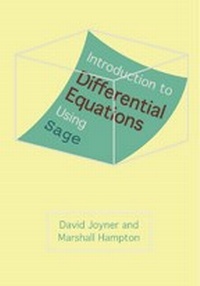
Introduction to Differential Equations Using Sage
Published on 27. October 2012
280 pages
978-1-4214-0724-1 (ISBN)
Description

Differential equations can be taught using Sage as an inventive new approach.
David Joyner and Marshall Hampton's lucid textbook explains differential equations using the free and open-source mathematical software Sage.
Since its release in 2005, Sage has acquired a substantial following among mathematicians, but its first user was Joyner, who is credited with helping famed mathematician William Stein turn the program into a usable and popular choice.
Introduction to Differential Equations Using Sage extends Stein's work by creating a classroom tool that allows both differential equations and Sage to be taught concurrently. It's a creative and forward-thinking approach to math instruction.
Topics include:
First-Order Differential Equations
Incorporation of Newtonian Mechanics
Second-Order Differential Equations
The Annihilator Method
Using Linear Algebra with Differential Equations
Nonlinear Systems
Partial Differential Equations
Romeo and Juliet
David Joyner and Marshall Hampton's lucid textbook explains differential equations using the free and open-source mathematical software Sage.
Since its release in 2005, Sage has acquired a substantial following among mathematicians, but its first user was Joyner, who is credited with helping famed mathematician William Stein turn the program into a usable and popular choice.
Introduction to Differential Equations Using Sage extends Stein's work by creating a classroom tool that allows both differential equations and Sage to be taught concurrently. It's a creative and forward-thinking approach to math instruction.
Topics include:
First-Order Differential Equations
Incorporation of Newtonian Mechanics
Second-Order Differential Equations
The Annihilator Method
Using Linear Algebra with Differential Equations
Nonlinear Systems
Partial Differential Equations
Romeo and Juliet
More details
Language
English
Place of publication
Baltimore
United States
Target group
College/higher education
Illustrations
80 s/w Zeichnungen, 3 s/w Photographien bzw. Rasterbilder
3 Halftones, black and white; 80 Line drawings, black and white
File size
11,50 MB
ISBN-13
978-1-4214-0724-1 (9781421407241)
DOI
10.1353/book.72082
Copyright in bibliographic data and cover images is held by Nielsen Book Services Limited or by the publishers or by their respective licensors: all rights reserved.
Schweitzer Classification
Other editions
Additional editions
David Joyner | Marshall Hampton
Introduction to Differential Equations Using Sage
Book
10/2012
Johns Hopkins University Press
€65.00
Shipment within 10-20 days
Persons
David Joyner is a professor in the Mathematics Department at the U.S. Naval Academy. He is the author of Adventures in Group Theory: Rubik's Cube, Merlin's Machine, and Other Mathematical Toys, also published by Johns Hopkins. Marshall Hampton is a professor in the Department of Mathematics and Statistics at the University of Minnesota, Duluth.
Content
Preface
Acknowledgments
1. First-order differential equations
1.1. Introduction to DEs
1.2. Initial value problems
1.3. Existence of solutions to ODEs
1.3.1. First-order ODEs
1.3.2. Second-order homogeneous ODEs
1.4. First-order ODEs: Separable and linear cases
1.4.1. Separable DEs
1.4.2. Autonomous ODEs
1.4.3. Substitution methods
1.4.4. Linear first-order ODEs
1.5. Isoclines and direction fields
1.6. Numerical solutions: Euler's and improved Euler's method
1.6.1. Euler's method
1.6.2. Improved Euler's method
1.6.3. Euler's method for systems and higher-order DEs
1.7. Numerical solutions II: Runge-Kutta and other methods
1.7.1. Fourth-order Runge-Kutta method
1.7.2. Multistep methods: Adams-Bashforth
1.7.3. Adaptive step size
1.8. Newtonian mechanics
1.9. Application to mixing problems
1.10. Application to cooling problems
2. Second-order differential equations
2.1. Linear differential equations
2.1.1. Solving homogeneous constant-coefficient ODEs
2.2. Linear differential equations, revisited
2.3. Linear differential equations, continued
2.4. Undetermined coefficients method
2.4.1. Simple case
2.4.2. Nonsimple case
2.5. Annihilator method
2.6. Variation of parameters
2.6.1. The Leibniz rule
2.6.2. The method
2.7. Applications of DEs: Spring problems
2.7.1. Introduction: Simple harmonic case
2.7.2. Simple harmonic case
2.7.3. Free damped motion
2.7.4. Spring-mass systems with an external force
2.8. Applications to simple LRC circuits
2.9. The power of series method
2.9.1. Part 1
2.9.2. Part 2
2.10. The Laplace transform method
2.10.1. Part 1
2.10.2. Part 2
2.10.3. Part 3
3. Matrix theory and systems of DEs
3.1. Quick survey of linear algebra
3.1.1. Matrix arithmetic
3.2. Row reduction and solving systems of equations
3.2.1. The Gauss elimination game
3.2.2. Solving systems using inverses
3.2.3. Computing inverses using row reduction
3.2.4. Solving higher-dimensional linear systems
3.2.5. Determinants
3.2.6. Elementary matrices and computation of determinants
3.2.7. Vector spaces
3.2.8. Bases, dimension, linear independence, and span
3.3. Application: Solving systems of DEs
3.3.1. Modeling battles using Lanchester's equations
3.3.2. Romeo and Juliet
3.3.3. Electrical networks using Laplace transforms
3.4. Eigenvalue method for systems of DEs
3.4.1. Motivation
3.4.2. Computing eigenvalues
3.4.3. The eigenvalue method
3.4.4. Examples of the eigenvalue method
3.5. Introduction to variation of parameters for systems
3.5.1. Motivation
3.5.2. The method
3.6. Nonlinear systems
3.6.1. Linearizing near equilibria
3.6.2. The nonlinear pendulum
3.6.3. The Lorenz equations
3.6.4. Zombies attack
4. Introduction to partial differential equations
4.1. Introduction to separation of variables
4.1.1. The transport or advection equation
4.1.2. The heat equation
4.2. The method of superposition
4.3. Fourier, sine, and cosine series
4.3.1. Brief history
4.3.2. Motivation
4.3.3. Definitions
4.4. The heat equation
4.4.1. Method for zero ends
4.4.2. Method for insulated ends
4.4.3. Explanation via separation of variables
4.5. The wave equation in one dimension
4.5.1. Methods
4.6. The Schrodinger equation
4.6.1. Method
Bibliography
Index
Acknowledgments
1. First-order differential equations
1.1. Introduction to DEs
1.2. Initial value problems
1.3. Existence of solutions to ODEs
1.3.1. First-order ODEs
1.3.2. Second-order homogeneous ODEs
1.4. First-order ODEs: Separable and linear cases
1.4.1. Separable DEs
1.4.2. Autonomous ODEs
1.4.3. Substitution methods
1.4.4. Linear first-order ODEs
1.5. Isoclines and direction fields
1.6. Numerical solutions: Euler's and improved Euler's method
1.6.1. Euler's method
1.6.2. Improved Euler's method
1.6.3. Euler's method for systems and higher-order DEs
1.7. Numerical solutions II: Runge-Kutta and other methods
1.7.1. Fourth-order Runge-Kutta method
1.7.2. Multistep methods: Adams-Bashforth
1.7.3. Adaptive step size
1.8. Newtonian mechanics
1.9. Application to mixing problems
1.10. Application to cooling problems
2. Second-order differential equations
2.1. Linear differential equations
2.1.1. Solving homogeneous constant-coefficient ODEs
2.2. Linear differential equations, revisited
2.3. Linear differential equations, continued
2.4. Undetermined coefficients method
2.4.1. Simple case
2.4.2. Nonsimple case
2.5. Annihilator method
2.6. Variation of parameters
2.6.1. The Leibniz rule
2.6.2. The method
2.7. Applications of DEs: Spring problems
2.7.1. Introduction: Simple harmonic case
2.7.2. Simple harmonic case
2.7.3. Free damped motion
2.7.4. Spring-mass systems with an external force
2.8. Applications to simple LRC circuits
2.9. The power of series method
2.9.1. Part 1
2.9.2. Part 2
2.10. The Laplace transform method
2.10.1. Part 1
2.10.2. Part 2
2.10.3. Part 3
3. Matrix theory and systems of DEs
3.1. Quick survey of linear algebra
3.1.1. Matrix arithmetic
3.2. Row reduction and solving systems of equations
3.2.1. The Gauss elimination game
3.2.2. Solving systems using inverses
3.2.3. Computing inverses using row reduction
3.2.4. Solving higher-dimensional linear systems
3.2.5. Determinants
3.2.6. Elementary matrices and computation of determinants
3.2.7. Vector spaces
3.2.8. Bases, dimension, linear independence, and span
3.3. Application: Solving systems of DEs
3.3.1. Modeling battles using Lanchester's equations
3.3.2. Romeo and Juliet
3.3.3. Electrical networks using Laplace transforms
3.4. Eigenvalue method for systems of DEs
3.4.1. Motivation
3.4.2. Computing eigenvalues
3.4.3. The eigenvalue method
3.4.4. Examples of the eigenvalue method
3.5. Introduction to variation of parameters for systems
3.5.1. Motivation
3.5.2. The method
3.6. Nonlinear systems
3.6.1. Linearizing near equilibria
3.6.2. The nonlinear pendulum
3.6.3. The Lorenz equations
3.6.4. Zombies attack
4. Introduction to partial differential equations
4.1. Introduction to separation of variables
4.1.1. The transport or advection equation
4.1.2. The heat equation
4.2. The method of superposition
4.3. Fourier, sine, and cosine series
4.3.1. Brief history
4.3.2. Motivation
4.3.3. Definitions
4.4. The heat equation
4.4.1. Method for zero ends
4.4.2. Method for insulated ends
4.4.3. Explanation via separation of variables
4.5. The wave equation in one dimension
4.5.1. Methods
4.6. The Schrodinger equation
4.6.1. Method
Bibliography
Index
