

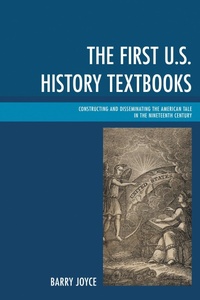
The First U.S. History Textbooks
Constructing and Disseminating the American Tale in the Nineteenth Century
1st Edition
Published on 27. August 2015
1 pages
978-1-9787-8896-1 (ISBN)
Description

This book analyzes the common narrative residing in American History textbooks published in the first half of the 19th century. That story, what the author identifies as the American "creation" or "origins" narrative, is simultaneously examined as both historic and "mythic" in composition. It offers a fresh, multidisciplinary perspective on an enduring aspect of these works. The book begins with a provocative thesis that proposes the importance of the relationship between myth and history in the creation of America's textbook narrative. It ends with a passionate call for a truly inclusive story of who Americans are and what Americans aspire to become.
The book is organized into three related sections. The first section provides the context for the emergence of American History textbooks. It analyzes the structure and utility of these school histories within the context of antebellum American society and educational practices. The second section is the heart of the book. It recounts and scrutinizes the textbook narrative as it tells the story of America's emergence from "prehistory" through the American Revolution-the origins story of America. This section identifies the recurring themes and images that together constitute what early educators conceived as a unified cultural narrative. Section three examines the sectional bifurcation and eventual re-unification of the American History textbook narrative from the 1850s into the early 20th century. The book concludes by revisiting the relationship between textbooks, the American story, and mythic narratives in light of current debates and controversies over textbooks, American history curriculum and a common American narrative.
The book is organized into three related sections. The first section provides the context for the emergence of American History textbooks. It analyzes the structure and utility of these school histories within the context of antebellum American society and educational practices. The second section is the heart of the book. It recounts and scrutinizes the textbook narrative as it tells the story of America's emergence from "prehistory" through the American Revolution-the origins story of America. This section identifies the recurring themes and images that together constitute what early educators conceived as a unified cultural narrative. Section three examines the sectional bifurcation and eventual re-unification of the American History textbook narrative from the 1850s into the early 20th century. The book concludes by revisiting the relationship between textbooks, the American story, and mythic narratives in light of current debates and controversies over textbooks, American history curriculum and a common American narrative.
More details
Edition
1. Auflage
Language
English
Place of publication
United States
Publishing group
Bloomsbury Publishing Plc
Target group
Professional and scholarly
Illustrations
25 b/w illustrations;
ISBN-13
978-1-9787-8896-1 (9781978788961)
Copyright in bibliographic data and cover images is held by Nielsen Book Services Limited or by the publishers or by their respective licensors: all rights reserved.
Schweitzer Classification
Other editions
Additional editions
Barry Joyce
The First U.S. History Textbooks
Constructing and Disseminating the American Tale in the Nineteenth Century
Book
04/2017
Lexington Books
€75.30
Shipment within 15-20 days
Person
Barry Joyce is associate professor of history and the co-coordinator of the Social Studies Secondary Education Program at the University of Delaware.
Content
Chapter 1: A People's Story
Chapter 2: The Text is the Teacher
Chapter 3: Mnemonics, Methods, and Memory: Organizing and Encoding the American Story
Chapter 4: An American Character
Chapter 5: Genesis: Emergence and Migrations
Chapter 6: Apologetics: Why we are who we are
Chapter 7: Slaying the Monster
Chapter 8: The Narrative Divides
Chapter 9: The Narrative Re-joined
Conclusion: Who Will Write This Story?
Chapter 2: The Text is the Teacher
Chapter 3: Mnemonics, Methods, and Memory: Organizing and Encoding the American Story
Chapter 4: An American Character
Chapter 5: Genesis: Emergence and Migrations
Chapter 6: Apologetics: Why we are who we are
Chapter 7: Slaying the Monster
Chapter 8: The Narrative Divides
Chapter 9: The Narrative Re-joined
Conclusion: Who Will Write This Story?
