

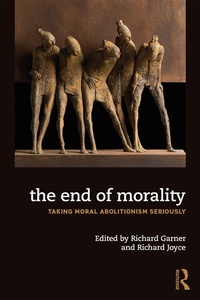
The End of Morality
Taking Moral Abolitionism Seriously
1st Edition
Published on 18. December 2018
246 pages
978-1-351-12214-6 (ISBN)
Description

According to the moral error theorist, all moral judgments are mistaken. The world just doesn't contain the properties and relations necessary for these judgments to be true. But what should we actually do if we decided that we are in this radical and unsettling predicament-that morality is just a widespread and heartfelt illusion? One suggestion is to eliminate all talk and thought of morality (abolitionism). Another is to carry on believing it anyway (conservationism). And yet another is to treat morality as a kind of convenient fiction (fictionalism). We tend to think of moral thinking as valuable and useful (e.g., for motivating cooperative behavior), but we can also recognize that it can be harmful (e.g., hindering compromise) and even disastrous (e.g., inspiring support for militaristic propaganda). Would we be better off or worse off if we stopped basing decisions on moral considerations?
This is a collection of twelve brand new chapters focused on a critical examination of the options available to the moral error theorist. After a general introduction outlining the topic, explaining key terminology, and offering suggestions for further reading, the chapters address questions like:
* Is it true that the more that people are motivated by moral concerns, the more likely it is that society will be elitist, authoritarian, and dishonest?
* Is an appeal to moral values a useful tool for helping resolve conflicts, or does it actually exacerbate conflicts?
* Would it even be possible to abolish morality from our thinking?
* If we were to accept a moral error theory, would it be feasible to carry on believing in morality in everyday contexts?
* Might moral discourse be usefully modeled on familiar metaphorical language, where we can convey useful and important truths by uttering falsehoods?
* Does moral thinking support or undermine a commitment to feminist goals?
* What role do moral judgments play in addressing important decisions affecting climate change?
The End of Morality: Taking Moral Abolitionism Seriously is the first book to thoroughly address these and other questions, systematically investigating the harms and benefits of moral thought, and considering what the world might be like without morality.
This is a collection of twelve brand new chapters focused on a critical examination of the options available to the moral error theorist. After a general introduction outlining the topic, explaining key terminology, and offering suggestions for further reading, the chapters address questions like:
* Is it true that the more that people are motivated by moral concerns, the more likely it is that society will be elitist, authoritarian, and dishonest?
* Is an appeal to moral values a useful tool for helping resolve conflicts, or does it actually exacerbate conflicts?
* Would it even be possible to abolish morality from our thinking?
* If we were to accept a moral error theory, would it be feasible to carry on believing in morality in everyday contexts?
* Might moral discourse be usefully modeled on familiar metaphorical language, where we can convey useful and important truths by uttering falsehoods?
* Does moral thinking support or undermine a commitment to feminist goals?
* What role do moral judgments play in addressing important decisions affecting climate change?
The End of Morality: Taking Moral Abolitionism Seriously is the first book to thoroughly address these and other questions, systematically investigating the harms and benefits of moral thought, and considering what the world might be like without morality.
Reviews / Votes
"This is a an excellently edited collection of essays around a theme which has so far received too little attention. The essays concern which changes we might expect if moral error theory were absorbed in the culture. Would moralizing and moral argumentation cease? The list of authors offers a good mix of experts on error theory and philosophers from other areas who contribute with new perspectives. I can highly recommend the volume to any student of the subject."--Folke Tersman, Uppsala University
More details
Edition
1. Auflage
Language
English
Place of publication
London
United Kingdom
Publishing group
Taylor & Francis Ltd
Target group
College/higher education
Illustrations
1 Tables, black and white; 3 Line drawings, black and white
File size
1,80 MB
ISBN-13
978-1-351-12214-6 (9781351122146)
Copyright in bibliographic data and cover images is held by Nielsen Book Services Limited or by the publishers or by their respective licensors: all rights reserved.
Schweitzer Classification
Other editions
Additional editions
Book
01/2019
1st Edition
Routledge
€63.30
Shipment within 15-20 days
Book
01/2019
1st Edition
Routledge
€206.40
Shipment within 15-20 days
Persons
Richard Garner is Professor Emeritus of Philosophy at Ohio State University, USA. He is the author of Beyond Morality (1994). He has written articles on metaethics, the philosophy of language, and Chinese philosophy.
Richard Joyce is a Professor of Philosophy at Victoria University of Wellington, New Zealand. He is author of The Myth of Morality (2001), The Evolution of Morality (2006), and Essays in Moral Skepticism (2016), as well as numerous articles and book chapters on metaethics and moral psychology. He is also the editor of The Routledge Handbook of Evolution and Philosophy (2018).
Richard Joyce is a Professor of Philosophy at Victoria University of Wellington, New Zealand. He is author of The Myth of Morality (2001), The Evolution of Morality (2006), and Essays in Moral Skepticism (2016), as well as numerous articles and book chapters on metaethics and moral psychology. He is also the editor of The Routledge Handbook of Evolution and Philosophy (2018).
Content
Introduction
PART I: Background thinking
1. Good and gold
Jordan Howard Sobel
2. To hell with morality
Ian Hinckfuss
3. Moral foolishness explained
Hans-Georg Moeller
PART II: The case for abolitionism
4. After such knowledge-what? Living and speaking in a world without objective morality
Russell Blackford
5. A plea for moral abolitionism
Richard Garner
6. Beyond the surf and spray: Erring on the side of error theory
Joel Marks
PART III: Alternatives to abolitionism
7. Moral practice after error theory: Negotiationism
Bjoern Eriksson and Jonas Olson
8. Minimizing the misuse of morality
Jessica Isserow
9. Moral fictionalism: How to have your cake and eat it too
Richard Joyce
PART IV: Moral skepticism: Case studies
10. Morality and oppression
Nicolas Olsson Yaouzis
11. Should feminists be moral error theorists?
Caroline West
12. The effects of morality on acting against climate change
Thomas Poelzler
Index
PART I: Background thinking
1. Good and gold
Jordan Howard Sobel
2. To hell with morality
Ian Hinckfuss
3. Moral foolishness explained
Hans-Georg Moeller
PART II: The case for abolitionism
4. After such knowledge-what? Living and speaking in a world without objective morality
Russell Blackford
5. A plea for moral abolitionism
Richard Garner
6. Beyond the surf and spray: Erring on the side of error theory
Joel Marks
PART III: Alternatives to abolitionism
7. Moral practice after error theory: Negotiationism
Bjoern Eriksson and Jonas Olson
8. Minimizing the misuse of morality
Jessica Isserow
9. Moral fictionalism: How to have your cake and eat it too
Richard Joyce
PART IV: Moral skepticism: Case studies
10. Morality and oppression
Nicolas Olsson Yaouzis
11. Should feminists be moral error theorists?
Caroline West
12. The effects of morality on acting against climate change
Thomas Poelzler
Index
