

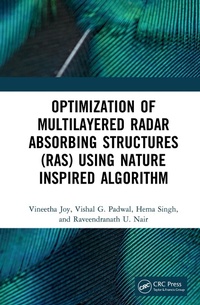
Optimization of Multilayered Radar Absorbing Structures (RAS) using Nature Inspired Algorithm
1st Edition
Published on 18. July 2021
86 pages
978-1-000-40905-5 (ISBN)
Description

Stealth technology is a crucial pre-requisite in the combat zone, where swiftness, surprise and initiative are the decisive elements for survivability. The supreme goal here is to reduce the visibility of military vehicles by shaping, application of radar absorbing materials, passive cancellation, active cancellation etc. With respect to multilayered radar absorbing structures (RAS), this book presents an efficient algorithm based on particle swarm optimization (PSO), for the material selection as well as optimization of thickness of multilayered RAS models considering both normal as well as oblique incidence cases. It includes a thorough overview of the theoretical background required for the analysis of multilayered RAS as well as the step-by-step procedure for the implementation of PSO-based algorithm. The accuracy and computational efficiency of the indigenously developed code is also clearly established using relevant validations and case studies.
FEATURES
Provides step-by-step procedure for the implementation of particle swarm optimization (PSO) based algorithm in the context of multilayered radar absorbing structures (RAS) design
Helps to understand the EM design, analysis and optimization of multilayered RAS
Describes the theoretical background required for the analysis of multilayered RAS
Illustrates in detail the theoretical formulation supported by intuitive ray diagrams and comprehensive flowcharts to implement the algorithm with ease
Includes elaborate validations and case studies
This book will serve as a valuable resource for students, researchers, scientists, and engineers involved in the electromagnetic design and development of multi-layered radar absorbing structures.
FEATURES
Provides step-by-step procedure for the implementation of particle swarm optimization (PSO) based algorithm in the context of multilayered radar absorbing structures (RAS) design
Helps to understand the EM design, analysis and optimization of multilayered RAS
Describes the theoretical background required for the analysis of multilayered RAS
Illustrates in detail the theoretical formulation supported by intuitive ray diagrams and comprehensive flowcharts to implement the algorithm with ease
Includes elaborate validations and case studies
This book will serve as a valuable resource for students, researchers, scientists, and engineers involved in the electromagnetic design and development of multi-layered radar absorbing structures.
More details
Edition
1. Auflage
Language
English
Place of publication
London
United Kingdom
Publishing group
Taylor & Francis Ltd
Target group
Professional and scholarly
College/higher education
Product notice
Reflowable
Illustrations
3 Tables, black and white; 23 Line drawings, black and white; 23 Illustrations, black and white
ISBN-13
978-1-000-40905-5 (9781000409055)
Copyright in bibliographic data and cover images is held by Nielsen Book Services Limited or by the publishers or by their respective licensors: all rights reserved.
Schweitzer Classification
Other editions
Additional editions
Vineetha Joy | Vishal G. Padwal | Hema Singh
Optimization of Multilayered Radar Absorbing Structures (RAS) using Nature Inspired Algorithm
Book
09/2023
1st Edition
CRC Press
€63.23
Shipment within 15-20 days
Vineetha Joy | Vishal G. Padwal | Hema Singh
Optimization of Multilayered Radar Absorbing Structures (RAS) using Nature Inspired Algorithm
Book
07/2021
1st Edition
CRC Press
€131.40
Shipment within 15-20 days
Persons
Mrs. Vineetha Joy is working as Scientist at Centre for Electromagnetics of CSIR-National Aerospace Laboratories, Bangalore, India since March, 2016. She obtained B. Tech in Electronics and Communication Engineering with Second Rank from University of Calicut in 2011 and received M. Tech degree with First Rank in RF & Microwave Engineering from Indian Institute of Technology (IIT), Kharagpur in 2014. She is actively involved in various R&D programs spanning domains like Computational Electromagnetics, Electromagnetic Design and Performance Analysis of Radomes, Design and Development of broadband radar absorbing structures (RAS), Hybrid Numerical Techniques for Scattering Analysis, and Electromagnetic Characterization of Potential Materials for Airborne Structures. She has authored/co-authored over 100 research publications including one book, peer reviewed journal papers, symposium papers, technical documents and test reports.
Mr. Vishal G. Padwal obtained M. E. in Electronics and Tele-communication (Microwave) in 2017 from Department of Electronics & Tele-communication Engineering, Pune Institute of Computer Technology, India and B.E. in Electronics & Tele-communication Engineering from University of Pune, India. He is currently working as Research Scientist at Society for Applied Microwave Electronics Engineering & Research (SAMEER), Mumbai. During 2018-2019, he was working as Project Assistant at Centre for Electromagnetics of CSIR-National Aerospace Laboratories, Bangalore, India. His research interest includes EM design and analysis of Multi-layered Radar Absorbing Structures, Optimization Techniques, Computational Electromagnetics, etc. He has co-authored several conference papers, technical documents and test reports.
Dr. Hema Singh is working as Senior Principal Scientist in Centre for Electromagnetics, National Aerospace Laboratories (CSIR-NAL), Bangalore, India. She has received Ph.D. degree in Electronics Engineering from IIT-BHU, Varanasi India in Feb. 2000. For the period 1999-2001, she was Lecturer in Physics at P.G. College, Kashipur, Uttaranchal, India. She was a Lecturer in EEE of Birla Institute of Technology & Science (BITS), Pilani, Rajasthan, India, for the period 2001-2004. She joined CSIR-NAL as Scientist in January 2005. Her active area of research are Computational Electromagnetics for Aerospace Applications, EM analysis of propagation in an indoor environment, Phased Arrays, Conformal Antennas, Radar Cross Section (RCS) Studies including Active RCS Reduction. She has contributed in the projects not only sponsored by DRDO on low RCS phased array, Active RCS reduction, RAS development, but also in the project sponsored by Boeing USA on EM analysis of RF field build-up within Boeing 787 Dreamliner, She received Best Woman Scientist Award in CSIR-NAL, Bangalore for period of 2007-2008 for her contribution in the area of active RCS reduction. Dr. Singh co-authored 14 books, 2 book chapters, 7 software copyrights, 370 scientific research papers and technical reports.
Dr. Raveendranath U. Nair is working as Senior Principal Scientist & Head in Centre for Electromagnetics, National Aerospace Laboratories (CSIR-NAL), Bangalore, India. He holds a Ph.D. degree in Microwave Electronics from MG University, India. He has over 20 years' experience in the field of electromagnetic design and analysis of radomes, design and development of FSS based structures for airborne platforms, radar cross section (RCS) studies, design and development of artificially engineered materials etc. He has contributed significantly to the National Radome Programs including Doppler Weather Radar (DWR) radome installed at SHAAR Sreeharikota, Fire Control Radar (FCR) radome for Jaguar aircraft, Astra missile ceramic radome, nosecone radome for Saras aircraft, multiband radomes for TU-142M aircraft etc. He has authored/co-authored over 200 research publications including peer reviewed journal papers, symposium papers, technical reports, and two books.
Mr. Vishal G. Padwal obtained M. E. in Electronics and Tele-communication (Microwave) in 2017 from Department of Electronics & Tele-communication Engineering, Pune Institute of Computer Technology, India and B.E. in Electronics & Tele-communication Engineering from University of Pune, India. He is currently working as Research Scientist at Society for Applied Microwave Electronics Engineering & Research (SAMEER), Mumbai. During 2018-2019, he was working as Project Assistant at Centre for Electromagnetics of CSIR-National Aerospace Laboratories, Bangalore, India. His research interest includes EM design and analysis of Multi-layered Radar Absorbing Structures, Optimization Techniques, Computational Electromagnetics, etc. He has co-authored several conference papers, technical documents and test reports.
Dr. Hema Singh is working as Senior Principal Scientist in Centre for Electromagnetics, National Aerospace Laboratories (CSIR-NAL), Bangalore, India. She has received Ph.D. degree in Electronics Engineering from IIT-BHU, Varanasi India in Feb. 2000. For the period 1999-2001, she was Lecturer in Physics at P.G. College, Kashipur, Uttaranchal, India. She was a Lecturer in EEE of Birla Institute of Technology & Science (BITS), Pilani, Rajasthan, India, for the period 2001-2004. She joined CSIR-NAL as Scientist in January 2005. Her active area of research are Computational Electromagnetics for Aerospace Applications, EM analysis of propagation in an indoor environment, Phased Arrays, Conformal Antennas, Radar Cross Section (RCS) Studies including Active RCS Reduction. She has contributed in the projects not only sponsored by DRDO on low RCS phased array, Active RCS reduction, RAS development, but also in the project sponsored by Boeing USA on EM analysis of RF field build-up within Boeing 787 Dreamliner, She received Best Woman Scientist Award in CSIR-NAL, Bangalore for period of 2007-2008 for her contribution in the area of active RCS reduction. Dr. Singh co-authored 14 books, 2 book chapters, 7 software copyrights, 370 scientific research papers and technical reports.
Dr. Raveendranath U. Nair is working as Senior Principal Scientist & Head in Centre for Electromagnetics, National Aerospace Laboratories (CSIR-NAL), Bangalore, India. He holds a Ph.D. degree in Microwave Electronics from MG University, India. He has over 20 years' experience in the field of electromagnetic design and analysis of radomes, design and development of FSS based structures for airborne platforms, radar cross section (RCS) studies, design and development of artificially engineered materials etc. He has contributed significantly to the National Radome Programs including Doppler Weather Radar (DWR) radome installed at SHAAR Sreeharikota, Fire Control Radar (FCR) radome for Jaguar aircraft, Astra missile ceramic radome, nosecone radome for Saras aircraft, multiband radomes for TU-142M aircraft etc. He has authored/co-authored over 200 research publications including peer reviewed journal papers, symposium papers, technical reports, and two books.
Content
1. Introduction 2. EM Wave Propagation in Multilayered Radar Absorbing Structures (RAS) 3. Application of Nature Inspired Algorithms for Optimization Problems 4. PSO-based Algorithm for the EM Design and Optimization of Multilayered RAS 5. Validations and Performance Evaluation
