

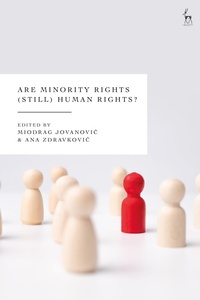
Are Minority Rights (Still) Human Rights?
1st Edition
Published on 19. February 2026
288 pages
978-1-5099-8455-8 (ISBN)
Description

Marking the 75th anniversary of the Universal Declaration of Human Rights and the 25th anniversary of the Framework Convention for the Protection of National Minorities and European Charter for Regional or Minority Languages, this book investigates to what extent minority rights can, or should, be treated as part of the human rights regime.
Internationally renowned experts, both scholars and practitioners, critically assess the current state of protection from different disciplinary perspectives. Key themes include the historical trajectory from the League of Nations to ICCPR Article 27, the 'persons-belonging-to' formula, tensions between individual and collective protection, differences in normativity, and the absence of a universally binding definition of 'minority', with implications for non-derogability, enforcement, and sovereignty.
Designed for students, researchers, and practitioners of international human rights law, European human rights, and minority protection, the volume provides a multi-disciplinary map of doctrine and practice and a focused resource for courses in public international law, particularly human rights law, European law, and minority rights.
Internationally renowned experts, both scholars and practitioners, critically assess the current state of protection from different disciplinary perspectives. Key themes include the historical trajectory from the League of Nations to ICCPR Article 27, the 'persons-belonging-to' formula, tensions between individual and collective protection, differences in normativity, and the absence of a universally binding definition of 'minority', with implications for non-derogability, enforcement, and sovereignty.
Designed for students, researchers, and practitioners of international human rights law, European human rights, and minority protection, the volume provides a multi-disciplinary map of doctrine and practice and a focused resource for courses in public international law, particularly human rights law, European law, and minority rights.
More details
Edition
1. Auflage
Language
English
Place of publication
London
United Kingdom
Publishing group
Bloomsbury Publishing PLC
Target group
Professional and scholarly
ISBN-13
978-1-5099-8455-8 (9781509984558)
Copyright in bibliographic data and cover images is held by Nielsen Book Services Limited or by the publishers or by their respective licensors: all rights reserved.
Schweitzer Classification
Other editions
Additional editions
Miodrag Jovanovic | Ana Zdravkovic
Are Minority Rights (Still) Human Rights?
Book
02/2026
Hart Publishing
€122.80
Shipment within 15-20 days
Persons
Miodrag Jovanovic is Full Professor of Law at the University of Belgrade, Serbia.
Ana Zdravkovic is Research Assistant at Institute of Comparative Law, Serbia.
Ana Zdravkovic is Research Assistant at Institute of Comparative Law, Serbia.
Content
Foreword, Patrick Thornberry (Keele University, UK)
Preface - On Principles and Realities, Tibor Várady (Serbian Academy of Sciences and Arts)
Are Minority Rights (Still) Human Rights? An Introduction, Miodrag Jovanovic and Ana Zdravkovic (University of Belgrade, Serbia)
Part I: Minority Rights as Human Rights - Views from Theory and Practice
1. Special Rights and Obligations: Why Minority Rights Need Institutional Frameworks, Tove H Malloy (Europa-Universität Flensburg, Germany)
2. Minority Rights as Human Rights? Concepts, Doctrine, and Practice, Miodrag Jovanovic and Ivana Krstic (University of Belgrade, Serbia)
Part II: Institutional Setting of Minority Rights Protection
3. The Framework Convention for the Protection of National Minorities and the Northern Ireland Peace Process, Elizabeth Craig (University of Sussex, UK)
4. 25 Years of Implementation of the European Charter for Regional or Minority Languages, Vesna Crnic-Grotic (University of Rijeka, Croatia)
5. Human Rights, Including Rights of Persons Belonging to Minorities, in the External Action of the European Union, Julia Szelivanov (European Union External Action Service, Belgium)
Part III: Spectrum of Minority Rights Protection
6. 'Battling' Nations and Minorities' Fundamental Educational Rights Before the ECtHR: Valiullina's Promises and Missed Opportunities, Kristin Henrard (Brussels School of Governance, Belgium)
7. Minorities' Participation in Public Affairs: A Human Rights Norm or a Conflict Prevention Technique? Milica V Matijevic and Ana Knezevic Bojovic (Institute of Comparative Law, Serbia)
8. Assessing Non-Territorial Autonomy to Protect Minorities in the Digital Age and Digital Minorities, Antoni Abat i Ninet (Autonomous University of Barcelona, Spain)
Part IV: Society, Culture, Diversity: Old and New Minorities
9. New Minorities as a New Frontier for Minority Rights Regimes: The Case of Non-EU Citizens in the Context of EU Member States, Roberta Medda-Windischer and Katharina Crepaz (European Academy of Bolzano, Italy)
10. Indigenous Peoples' Rights and the European Courts: A Category under Construction, Jessika Eichler (Sciences Po Paris, France)
11. Anthropological Theory, Stakeholder Inclusion and Minority Rights: Reflections on the Research and Safeguarding of Serbian Intangible Cultural Heritage in the Western Balkans, MiloS Milenkovic (University of Belgrade, Serbia)
Preface - On Principles and Realities, Tibor Várady (Serbian Academy of Sciences and Arts)
Are Minority Rights (Still) Human Rights? An Introduction, Miodrag Jovanovic and Ana Zdravkovic (University of Belgrade, Serbia)
Part I: Minority Rights as Human Rights - Views from Theory and Practice
1. Special Rights and Obligations: Why Minority Rights Need Institutional Frameworks, Tove H Malloy (Europa-Universität Flensburg, Germany)
2. Minority Rights as Human Rights? Concepts, Doctrine, and Practice, Miodrag Jovanovic and Ivana Krstic (University of Belgrade, Serbia)
Part II: Institutional Setting of Minority Rights Protection
3. The Framework Convention for the Protection of National Minorities and the Northern Ireland Peace Process, Elizabeth Craig (University of Sussex, UK)
4. 25 Years of Implementation of the European Charter for Regional or Minority Languages, Vesna Crnic-Grotic (University of Rijeka, Croatia)
5. Human Rights, Including Rights of Persons Belonging to Minorities, in the External Action of the European Union, Julia Szelivanov (European Union External Action Service, Belgium)
Part III: Spectrum of Minority Rights Protection
6. 'Battling' Nations and Minorities' Fundamental Educational Rights Before the ECtHR: Valiullina's Promises and Missed Opportunities, Kristin Henrard (Brussels School of Governance, Belgium)
7. Minorities' Participation in Public Affairs: A Human Rights Norm or a Conflict Prevention Technique? Milica V Matijevic and Ana Knezevic Bojovic (Institute of Comparative Law, Serbia)
8. Assessing Non-Territorial Autonomy to Protect Minorities in the Digital Age and Digital Minorities, Antoni Abat i Ninet (Autonomous University of Barcelona, Spain)
Part IV: Society, Culture, Diversity: Old and New Minorities
9. New Minorities as a New Frontier for Minority Rights Regimes: The Case of Non-EU Citizens in the Context of EU Member States, Roberta Medda-Windischer and Katharina Crepaz (European Academy of Bolzano, Italy)
10. Indigenous Peoples' Rights and the European Courts: A Category under Construction, Jessika Eichler (Sciences Po Paris, France)
11. Anthropological Theory, Stakeholder Inclusion and Minority Rights: Reflections on the Research and Safeguarding of Serbian Intangible Cultural Heritage in the Western Balkans, MiloS Milenkovic (University of Belgrade, Serbia)
