

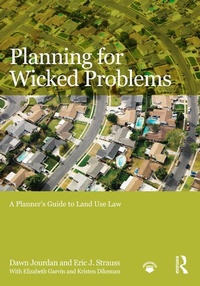
Planning for Wicked Problems
A Planner's Guide to Land Use Law
Published on 23. October 2015
234 pages
978-1-317-74801-4 (ISBN)
Description

Efforts to teach students pursuing graduate degrees in urban and regional planning are often frustrated by the "case books" that have been prepared for use by law professors teaching similar courses. Dawn Jourdan and Eric J. Strauss have attempted to take their concerns to heart in the design of this Planning for Wicked Problems: A Planner's Guide to Land Use Law.
Each chapter begins with a planning problem that is complex and has no "correct" answer. Students should answer this hypothetical before reading the subsequent sections of each of the chapters.
The second section of each chapter provides a primer for each topic. This primer is meant to summarize the basic principles of the law and to identify the types of questions relevant to planners when such issues arise.
The third section of each chapter includes a series of edited court opinions. The cases selected have been identified by American Institute of Certified Planners as those fundamental to planning education.
Each chapter concludes with an answer to the proposed wicked planning problem.
Planning for Wicked Problems has been written to demonstrate to future planners how the law may be a useful tool in helping them invent solutions to wicked planning problems. The book features a companion website for additional study and review.
Each chapter begins with a planning problem that is complex and has no "correct" answer. Students should answer this hypothetical before reading the subsequent sections of each of the chapters.
The second section of each chapter provides a primer for each topic. This primer is meant to summarize the basic principles of the law and to identify the types of questions relevant to planners when such issues arise.
The third section of each chapter includes a series of edited court opinions. The cases selected have been identified by American Institute of Certified Planners as those fundamental to planning education.
Each chapter concludes with an answer to the proposed wicked planning problem.
Planning for Wicked Problems has been written to demonstrate to future planners how the law may be a useful tool in helping them invent solutions to wicked planning problems. The book features a companion website for additional study and review.
Reviews / Votes
"This book meets a longstanding need of urban planning instructors-a text written by planners for planners on the important topic of land use law. It covers critical topics like eminent domain, regulatory takings, equal protection, and free speech in a clear and accessible way by using succinct scenarios and recommended case briefs. The book also provides much needed primer for our students on the procedural side of law and planning; it will prove very useful for core courses on planning law in planning schools across the country." -Ellen Bassett, School of Architecture, University of Virginia"Professors Jourdan and Strauss, both skilled planners and lawyers, have created a marvelous set of materials designed to de-mystify the law for planning professionals. This is a programmed approach that will work-wickedly interesting and relevant problems and questions, summaries of cases with bite-sized excerpts, understandable primers on legal principles, and real-world responses that build on what has been introduced. Who would have thought that something so wicked could be so good?"-Michael Allan Wolf, Richard E. Nelson Chair in Local Government Law, University of Florida Levin College of Law
More details
Language
English
Place of publication
London
United Kingdom
Publishing group
Taylor & Francis Ltd
Target group
College/higher education
Illustrations
15 s/w Zeichnungen
15 Line drawings, black and white
File size
1,98 MB
ISBN-13
978-1-317-74801-4 (9781317748014)
Copyright in bibliographic data and cover images is held by Nielsen Book Services Limited or by the publishers or by their respective licensors: all rights reserved.
Schweitzer Classification
Other editions
Additional editions
Book
11/2015
1st Edition
Routledge
€94.20
Shipment within 10-20 days
Book
11/2015
1st Edition
Routledge
€273.90
Shipment within 10-20 days
Persons
Dawn Jourdan is an Associate Professor and Director of the Division of Regional and City Planning at the University of Oklahoma. Previously, she held a joint appointment between the Colleges of Design, Construction, and Planning and the Levin College of Law at the University of Florida. She began her academic career as an Assistant Professor of Planning at Texas A & M University in College Station, Texas. Before returning to academia, Dawn worked for the State and Local Government Division of Holland & Knight LLPs Chicago offices. Dawn earned a Ph.D. in urban and regional planning from Florida State University in 2004, a joint degree in law and urban planning from the University of Kansas in 2000, and a B.S. in Urban Affairs and Theatre Arts from Bradley University in 1996.
Eric J. Strauss is a Professor of Urban and Regional Planning and Director of Graduate Programs in SPDC at?MSU. He is a former Director of the Urban and Regional Planning Program. He has more than 40 years of experience in planning practice in both the public and private sector. Dr. Strauss has been a planner for federal and state governments, a City and County Planning Director, a City Attorney and a consultant to more than 50 organizations, both public and private, on a wide variety of planning related issues. He has prepared many comprehensive plans and land use regulations at all levels of detail for many communities.
Eric J. Strauss is a Professor of Urban and Regional Planning and Director of Graduate Programs in SPDC at?MSU. He is a former Director of the Urban and Regional Planning Program. He has more than 40 years of experience in planning practice in both the public and private sector. Dr. Strauss has been a planner for federal and state governments, a City and County Planning Director, a City Attorney and a consultant to more than 50 organizations, both public and private, on a wide variety of planning related issues. He has prepared many comprehensive plans and land use regulations at all levels of detail for many communities.
Content
1. Introduction 2. Introduction to the Planning Process 3. Introduction to the Legal System 4. Nuisance 5. Private Land Use Controls 6. Zoning 7. Inserting Flexibility Into Zoning 8. Due Process and Equal Protection 9. Possessory Takings 10. Regulatory Takings 11. First Amendment 12. Affordable Housing 13. Growth Management 14. Historic Preservation and Urban Design
