

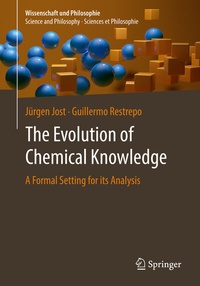
The Evolution of Chemical Knowledge
Description

Chemistry shapes and creates the disposition of the world's resources and provides novel substances for the welfare and hazard of our civilisation at an exponential rate. Can we model the evolution of chemical knowledge? This book not only provides a positive answer to the question, it provides the formal models and available data to model chemical knowledge as a complex dynamical system based on the mutual interaction of the social, semiotic and material systems of chemistry. These systems, which have evolved over the history, include the scientists and institutions supporting chemical knowledge (social system); theories, concepts and forms of communication (semiotic system) and the substances, reactions and technologies (material system) central for the chemical practice. These three systems, which have traditionally been mostly studied in isolation, are brought together in this book in a grand historical narrative, on the basis of comprehensive data sets and supplemented by appropriate tools for their formal analysis. We thereby develop a comprehensive picture of the evolution of chemistry, needed for better understanding the past, present and future of chemistry as a discipline. The interdisciplinary character of this book and its non-technical language make it an ideal complement to more traditional material in undergraduate and graduate courses in chemistry, history of science and digital humanities.
More details
Other editions
Additional editions
Persons
Guillermo Restrepo is a theoretical chemist, historian of science and data scientist, working at the Max Planck Institute for Mathematics in the Sciences in Leipzig. He is an expert on the mathematical and computational analysis of large scale chemical data sets and the 2020 recipient of the Gmelin-Beilstein-Denkmünze of the German Chemical Society.
Jürgen Jost is a mathematician, interdisciplinary researcher on complex systems and a recipient of the Gottfried-Wilhelm-Leibniz Award of the DFG and of an ERC Advanced Grant. His research spans a wide range of scientific disciplines. He is a director at the Max Planck Institute for Mathematics in the Sciences and is an external member of the Santa Fe Institute.
