

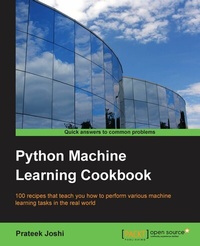
Python Machine Learning Cookbook
100 recipes that teach you how to perform various machine learning tasks in the real world
1st Edition
Published on 3. June 2024
304 pages
978-1-78646-768-3 (ISBN)
Description

100 recipes that teach you how to perform various machine learning tasks in the real worldKey Features - [*]Understand which algorithms to use in a given context with the help of this exciting recipe-based guide
- [*]Learn about perceptrons and see how they are used to build neural networks
- [*]Stuck while making sense of images, text, speech, and real estate? This guide will come to your rescue, showing you how to perform machine learning for each one of these using various techniques
Book DescriptionMachine learning is becoming increasingly pervasive in the modern data-driven world. It is used extensively across many fields such as search engines, robotics, self-driving cars, and more. With this book, you will learn how to perform various machine learning tasks in different environments. We'll start by exploring a range of real-life scenarios where machine learning can be used, and look at various building blocks. Throughout the book, you'll use a wide variety of machine learning algorithms to solve real-world problems and use Python to implement these algorithms. You'll discover how to deal with various types of data and explore the differences between machine learning paradigms such as supervised and unsupervised learning. We also cover a range of regression techniques, classification algorithms, predictive modeling, data visualization techniques, recommendation engines, and more with the help of real-world examples. What you will learn - [*]Explore classification algorithms and apply them to the income bracket estimation problem
- [*]Use predictive modeling and apply it to real-world problems
- [*]Understand how to perform market segmentation using unsupervised learning
- [*]Explore data visualization techniques to interact with your data in diverse ways
- [*]Find out how to build a recommendation engine
- [*]Understand how to interact with text data and build models to analyze it
- [*]Work with speech data and recognize spoken words using Hidden Markov Models
- [*]Analyze stock market data using Conditional Random Fields
- [*]Work with image data and build systems for image recognition and biometric face recognition
- [*]Grasp how to use deep neural networks to build an optical character recognition system
Who this book is forThis book is for Python programmers who are looking to use machine-learning algorithms to create real-world applications. This book is friendly to Python beginners, but familiarity with Python programming would certainly be useful to play around with the code.
- [*]Learn about perceptrons and see how they are used to build neural networks
- [*]Stuck while making sense of images, text, speech, and real estate? This guide will come to your rescue, showing you how to perform machine learning for each one of these using various techniques
Book DescriptionMachine learning is becoming increasingly pervasive in the modern data-driven world. It is used extensively across many fields such as search engines, robotics, self-driving cars, and more. With this book, you will learn how to perform various machine learning tasks in different environments. We'll start by exploring a range of real-life scenarios where machine learning can be used, and look at various building blocks. Throughout the book, you'll use a wide variety of machine learning algorithms to solve real-world problems and use Python to implement these algorithms. You'll discover how to deal with various types of data and explore the differences between machine learning paradigms such as supervised and unsupervised learning. We also cover a range of regression techniques, classification algorithms, predictive modeling, data visualization techniques, recommendation engines, and more with the help of real-world examples. What you will learn - [*]Explore classification algorithms and apply them to the income bracket estimation problem
- [*]Use predictive modeling and apply it to real-world problems
- [*]Understand how to perform market segmentation using unsupervised learning
- [*]Explore data visualization techniques to interact with your data in diverse ways
- [*]Find out how to build a recommendation engine
- [*]Understand how to interact with text data and build models to analyze it
- [*]Work with speech data and recognize spoken words using Hidden Markov Models
- [*]Analyze stock market data using Conditional Random Fields
- [*]Work with image data and build systems for image recognition and biometric face recognition
- [*]Grasp how to use deep neural networks to build an optical character recognition system
Who this book is forThis book is for Python programmers who are looking to use machine-learning algorithms to create real-world applications. This book is friendly to Python beginners, but familiarity with Python programming would certainly be useful to play around with the code.
All prices
More details
Other editions
Additional editions
Prateek Joshi | Vahid Mirjalili
Python Machine Learning Cookbook
100 recipes that teach you how to perform various machine learning tasks in the real world
Book
06/2016
Packt Publishing
€74.10
Shipment within 3-4 weeks
Persons
Joshi Prateek :
Prateek Joshi is the founder of Plutoshift and a published author of 9 books on Artificial Intelligence. He has been featured on Forbes 30 Under 30, NBC, Bloomberg, CNBC, TechCrunch, and The Business Journals. He has been an invited speaker at conferences such as TEDx, Global Big Data Conference, Machine Learning Developers Conference, and Silicon Valley Deep Learning. Apart from Artificial Intelligence, some of the topics that excite him are number theory, cryptography, and quantum computing. His greater goal is to make Artificial Intelligence accessible to everyone so that it can impact billions of people around the world.Mirjalili Vahid :
Vahid Mirjalili is a deep learning researcher focusing on CV applications. Vahid received a Ph.D. degree in both Mechanical Engineering and Computer Science from Michigan State University.
Prateek Joshi is the founder of Plutoshift and a published author of 9 books on Artificial Intelligence. He has been featured on Forbes 30 Under 30, NBC, Bloomberg, CNBC, TechCrunch, and The Business Journals. He has been an invited speaker at conferences such as TEDx, Global Big Data Conference, Machine Learning Developers Conference, and Silicon Valley Deep Learning. Apart from Artificial Intelligence, some of the topics that excite him are number theory, cryptography, and quantum computing. His greater goal is to make Artificial Intelligence accessible to everyone so that it can impact billions of people around the world.Mirjalili Vahid :
Vahid Mirjalili is a deep learning researcher focusing on CV applications. Vahid received a Ph.D. degree in both Mechanical Engineering and Computer Science from Michigan State University.
Content
Table of Contents - The Realm of Supervised Learning
- Constructing a Classifier
- Predictive Modeling
- Clustering with Unsupervised Learning
- Building Recommendation Engines
- Analyzing Text Data
- Speech Recognition
- Dissecting Time Series and Sequential Data
- Image Content Analysis
- Biometric Face Recognition
- Deep Neural Networks
- Visualizing Data
- Constructing a Classifier
- Predictive Modeling
- Clustering with Unsupervised Learning
- Building Recommendation Engines
- Analyzing Text Data
- Speech Recognition
- Dissecting Time Series and Sequential Data
- Image Content Analysis
- Biometric Face Recognition
- Deep Neural Networks
- Visualizing Data

