

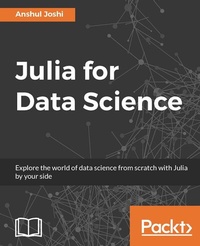
Julia for Data Science
high-performance computing simplified
Published on 8. July 2025
346 pages
978-1-78355-386-0 (ISBN)
Description

Explore the world of data science from scratch with Julia by your side
Key Features
[*] An in-depth exploration of Julia's growing ecosystem of packages
[*] Work with the most powerful open-source libraries for deep learning, data wrangling, and data visualization
[*] Learn about deep learning using Mocha.jl and give speed and high performance to data analysis on large data sets
Book DescriptionJulia is a fast and high performing language that's perfectly suited to data science with a mature package ecosystem and is now feature complete. It is a good tool for a data science practitioner. There was a famous post at Harvard Business Review that Data Scientist is the sexiest job of the 21st century. (https://hbr.org/2012/10/data-scientist-the-sexiest-job-of-the-21st-century). This book will help you get familiarised with Julia's rich ecosystem, which is continuously evolving, allowing you to stay on top of your game. This book contains the essentials of data science and gives a high-level overview of advanced statistics and techniques. You will dive in and will work on generating insights by performing inferential statistics, and will reveal hidden patterns and trends using data mining. This has the practical coverage of statistics and machine learning. You will develop knowledge to build statistical models and machine learning systems in Julia with attractive visualizations. You will then delve into the world of Deep learning in Julia and will understand the framework, Mocha.jl with which you can create artificial neural networks and implement deep learning. This book addresses the challenges of real-world data science problems, including data cleaning, data preparation, inferential statistics, statistical modeling, building high-performance machine learning systems and creating effective visualizations using Julia. What you will learn
[*]Apply statistical models in Julia for data-driven decisions
[*]Understanding the process of data munging and data preparation using Julia
[*]Explore techniques to visualize data using Julia and D3 based packages
[*]Using Julia to create self-learning systems using cutting edge machine learning algorithms
[*]Create supervised and unsupervised machine learning systems using Julia. Also, explore ensemble models
[*]Build a recommendation engine in Julia
[*]Dive into Julia's deep learning framework and build a system using Mocha.jl
Who this book is forThis book is aimed at data analysts and aspiring data scientists who have a basic knowledge of Julia or are completely new to it. The book also appeals to those competent in R and Python and wish to adopt Julia to improve their skills set in Data Science. It would be beneficial if the readers have a good background in statistics and computational mathematics.
Key Features
[*] An in-depth exploration of Julia's growing ecosystem of packages
[*] Work with the most powerful open-source libraries for deep learning, data wrangling, and data visualization
[*] Learn about deep learning using Mocha.jl and give speed and high performance to data analysis on large data sets
Book DescriptionJulia is a fast and high performing language that's perfectly suited to data science with a mature package ecosystem and is now feature complete. It is a good tool for a data science practitioner. There was a famous post at Harvard Business Review that Data Scientist is the sexiest job of the 21st century. (https://hbr.org/2012/10/data-scientist-the-sexiest-job-of-the-21st-century). This book will help you get familiarised with Julia's rich ecosystem, which is continuously evolving, allowing you to stay on top of your game. This book contains the essentials of data science and gives a high-level overview of advanced statistics and techniques. You will dive in and will work on generating insights by performing inferential statistics, and will reveal hidden patterns and trends using data mining. This has the practical coverage of statistics and machine learning. You will develop knowledge to build statistical models and machine learning systems in Julia with attractive visualizations. You will then delve into the world of Deep learning in Julia and will understand the framework, Mocha.jl with which you can create artificial neural networks and implement deep learning. This book addresses the challenges of real-world data science problems, including data cleaning, data preparation, inferential statistics, statistical modeling, building high-performance machine learning systems and creating effective visualizations using Julia. What you will learn
[*]Apply statistical models in Julia for data-driven decisions
[*]Understanding the process of data munging and data preparation using Julia
[*]Explore techniques to visualize data using Julia and D3 based packages
[*]Using Julia to create self-learning systems using cutting edge machine learning algorithms
[*]Create supervised and unsupervised machine learning systems using Julia. Also, explore ensemble models
[*]Build a recommendation engine in Julia
[*]Dive into Julia's deep learning framework and build a system using Mocha.jl
Who this book is forThis book is aimed at data analysts and aspiring data scientists who have a basic knowledge of Julia or are completely new to it. The book also appeals to those competent in R and Python and wish to adopt Julia to improve their skills set in Data Science. It would be beneficial if the readers have a good background in statistics and computational mathematics.
All prices
More details
Edition
Digital original
Language
English
Place of publication
Birmingham
United Kingdom
Target group
Professional and scholarly
US School Grade: College Graduate Student
Edition type
Digital original
File size
17,46 MB
ISBN-13
978-1-78355-386-0 (9781783553860)
Copyright in bibliographic data and cover images is held by Nielsen Book Services Limited or by the publishers or by their respective licensors: all rights reserved.
Schweitzer Classification
Other editions
Additional editions
Book
09/2016
Packt Publishing
€63.40
Shipment within 3-4 weeks
Person
Joshi Anshul :
Anshul Joshi is a data scientist with experience in recommendation systems, predictive modeling, neural networks, and high performance computing. His research interests encompass deep learning, artificial intelligence, and computational physics. Most of the time, he can be caught exploring GitHub or trying anything new he can get his hands on. You can also follow his personal blog.
Anshul Joshi is a data scientist with experience in recommendation systems, predictive modeling, neural networks, and high performance computing. His research interests encompass deep learning, artificial intelligence, and computational physics. Most of the time, he can be caught exploring GitHub or trying anything new he can get his hands on. You can also follow his personal blog.
Content
Table of Contents
The Groundwork: Julia
Data Munging
Data Exploration
Deep dive into inferential statistics
Making sense of data using visualization
Supervised Machine learning
Unsupervised Machine learning
Creating ensemble models
Time Series
Collaborative filtering and recommendation system
Deep Learning
The Groundwork: Julia
Data Munging
Data Exploration
Deep dive into inferential statistics
Making sense of data using visualization
Supervised Machine learning
Unsupervised Machine learning
Creating ensemble models
Time Series
Collaborative filtering and recommendation system
Deep Learning

