

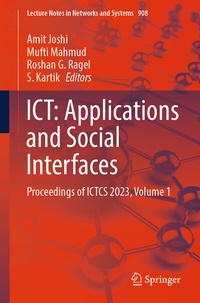
ICT: Applications and Social Interfaces
Description

More details
Other editions
Additional editions
Persons
Dr. Mufti Mahmud received his PhD degree in Information Engineering (specialized in neuroengineering) from the University of Padova - Italy in 2011. A recipient of the Marie-Curie postdoctoral fellowship, Dr Mahmud has served at various positions in the industry and academia in India, Bangladesh, Italy, Belgium, and the UK during the last 17 years. Dr Mahmud aims to leave behind a healthy, secure, and smart world to live in. As an expert of neuroengineering, computational intelligence and data science, his research aims to build predictive, secure and adaptive systems for personalized services to improve quality of life through advancement of healthcare access in low-resource settings. A Senior Member of IEEE and ACM, and Professional Member of BCS, Dr Mahmud holds leadership roles at many technical committees, such as Vice Chair of the Intelligent System Application Technical Committee of IEEE Computational Intelligence Society, Member of the IEEE CIS Task Force on Intelligence Systems for Health, Co-Chair of the IEEE P2733 Standard on Intelligent systems design, with AI/ML, Member of the IEEE R8 Humanitarian Activities Subcommittee, and Project Liaison Officer of the IEEE UK and Ireland Special Interest Group on Humanitarian Technology. Dr Mahmud serves as an Associate Editor of the Cognitive Computation, IEEE Access, Brain Informatics, and Big Data Analytics journals. He also serves at many technical, programme and organisation committees of high-rank conferences including the local organising chair of IEEE- WCCI2020; general chair of BI2020; and programme chair of IEEE-CICARE2020.
Dr. Roshan Ragel is a full professor in Computer Engineering at the University of Peradeniya, Sri Lanka. He is a skilled university lecturer and researcher with a doctorate in computer science and engineering and a passionfor teaching, research and administration. His research interest is in the areas of fault-tolerant and dependable computing, accelerated and high-performance computing, wearable computing and synthesis of secure and reliable embedded processors. Prof. Ragel received his PhD in Computer Science and Engineering from the University of New South Wales, Australia in 2007 and his BSc in Engineering from the University of Peradeniya, Sri Lanka in 2001. He was appointed a Senior Lecturer in Computer Engineering at the University of Peradeniya December 2007 and a full professor since October 2017. Prof. Ragel has co-authored about 150 peer-reviewed articles in topics including Micro- Architectural Support for Reliability and Security in Embedded Processors (SoC), Internet of Things (IoT), Side-Channel Attacks and Countermeasures, Application Specific Processor Design, High-Performance Computing such as Hardware/Software Acceleration of Bioinformatics Algorithms, Wearable Computing, Format-Preserving Digitisation and OCR of Local Language Text, and Completely Automated Public Turing test to tell Computers and Humans Apart (CAPTCHAs) in the Context of Mobile Applications. He has won several best paper awards in conference papers, the most prolific Sri Lankan author award from Elsevier Research in 2017 and the Presidential award for scientific publication in Sri Lanka in 2018. He was a visiting research scholar at the UNSW, Sydney a few times and UIUC, Illinois once. He is a Senior Member of the IEEE and the IEEE Computer Society.
Dr. S. Karthik is presently Professor & Dean in the Department of Computer Science & Engineering, SNS College of Technology, affiliated to Anna University- Chennai, Tamil Nadu, India. He received the M.E and PhD degree from Anna University, Chennai. His research interests include network security, big data, cloud computing, web services and wireless systems. In particular, he is currently working in a research group developing new Internet security architectures and active defence systems against DDoS attacks. Dr. S.Karthik published more than 200 papers in refereed international journals and 125 papers in conferences and has been involved in many international conferences as Technical Chair and tutorial presenter. He is an active member of IEEE, ISTE, IAENG, IACSIT and Indian Computer Society.
Content
