

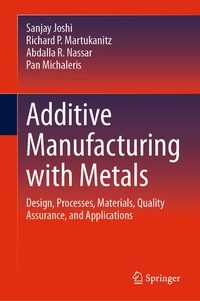
Additive Manufacturing with Metals
Description

More details
Other editions
Additional editions
Persons
Dr. Sanjay Joshi is Professor of Industrial and Manufacturing Engineering at Penn State University. His research and teaching interests are in the areas of Computer Aided Design and Manufacturing (CAD/CAM) with specific focus on Additive Manufacturing, Computer Aided Process Planning, and Manufacturing Systems Design and Analysis. He has been involved in actively teaching AM at the graduate and undergraduate level for over 20 years. He has been on the faculty for 36 years, and has received several national and international research awards.
Dr. Richard Martukanitz is Professor of Material Science and Engineering at the University of Virginia and former Fellow of Virginia's Commonwealth Center for Advanced Manufacturing (CCAM). Prior to joining the University of Virginia, Dr. Martukanitz served as Director of the Pennsylvania State University's Center for Innovative Materials Processing through Direct Digital Deposition (CIMP-3D) and Head of the Laser Processing Division at Penn State's Applied Research Laboratory. He has over 40-years of experience in developing and applying laser-based additive manufacturing techniques for metallic systems.
Dr. Abdalla R Nassar is the Enterprise Additive Manufacturing (AM) Lead for John Deere, where leads AM strategy development, R&D, and servers and the subject matter expert for the global organization. Prior to this role, he served as an Associate Research Professor and Head of the Process Physics, Analytics, and Engineering Department within the Materials Science Division of the Applied Research Laboratory (ARL) at the Pennsylvania State University. At Penn State, he developed and taught courses on Engineering and Scientific Principles of Additive Manufacturing and Laser-Materials Interactions at the graduate level.
Dr. Pan Michaleris is the founder and CEO of PanOptimization LLC. In 2012, he founded Pan Computing LLC which was acquired by Autodesk in 2016. The additive manufacturing process simulation software CUBES developed by Pan Computing was commercialized as Netfabb Simulation. Dr. Michaleris became Sr. Software Architect at Autodesk and supervised the development of additive manufacturing simulation software until 2021. He has over 30 years of experience in high performance computing and thermo-mechanical process modeling such as additive manufacturing, welding and thermal forming. He has a Ph.D. in Theoretical and Applied Mechanics from the University of Illinois at Champaign-Urbana, and has worked as a senior research engineer at Edison Welding Institute (EWI) from 1994 to 1997, and as professor at the Department of Mechanical and Nuclear Engineering of The Pennsylvania State University from 1997 to 2016.
