

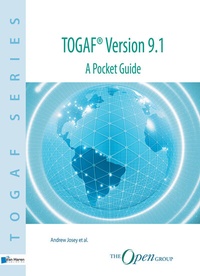
TOGAF® Version 9.1 - A Pocket Guide
Published on 1. January 2016
136 pages
978-90-8753-967-2 (ISBN)
Description

Note: This book is available in several languages: Brazilian Portuguese, English, Spanish, French.
This is the official Open Group Pocket Guide for TOGAF Version 9.1 and is published in hard copy and electronic format by Van Haren Publishing on behalf of The Open Group. TOGAF®, an Open Group Standard, is a proven enterprise architecture methodology and framework used by the worlds leading organizations to improve business efficiency. It is the most prominent and reliable enterprise architecture standard, ensuring consistent standards, methods, and communication among enterprise architecture professionals. Enterprise architecture professionals fluent in TOGAF standards enjoy greater industry credibility, job effectiveness, and career opportunities. TOGAF helps practitioners avoid being locked into proprietary methods, utilize resources more efficiently and effectively, and realize a greater return on investment.
More details
Other editions
Additional editions
Andrew Josey
TOGAF® Version 9.1 - A Pocket Guide
E-Book
01/2016
Van Haren Publishing
€20.99
Available for download
Book
12/2011
Van Haren Publishing BV
€31.80
Shipment within 10-15 days
Content
- Intro
- Cover
- Title Page
- Copyright
- Contents
- Preface
- Trademarks
- About the Authors
- Acknowledgements
- 1 Introduction
- 1.1 Introduction to TOGAF
- 1.2 Structure of the TOGAF Document
- 1.3 What is Architecture in the Context of TOGAF?
- 1.4 What kinds of Architecture does TOGAF deal with?
- 1.5 What does TOGAF Contain?
- 1.5.1 The Architecture Development Method (ADM)
- 1.5.2 ADM Guidelines and Techniques
- 1.5.3 Architecture Content Framework
- 1.5.4 The Enterprise Continuum
- 1.5.5 TOGAF Reference Models
- 1.5.6 The Architecture Capability Framework
- 2 The Architecture Development Method
- 2.1 What is the ADM?
- 2.2 What are the Phases of the ADM?
- 2.3 The ADM in Detail
- 2.3.1 Preliminary Phase
- 2.3.2 Phase A: Architecture Vision
- 2.3.3 Phase B: Business Architecture
- 2.3.4 Phase C: Information Systems Architectures
- 2.3.5 Phase D: Technology Architecture
- 2.3.6 Phase E: Opportunities and Solutions
- 2.3.7 Phase F: Migration Planning
- 2.3.8 Phase G: Implementation Governance
- 2.3.9 Phase H: Architecture Change Management
- 2.3.10 Requirements Management
- 2.4 Scoping the Architecture Activity
- 3 Key Techniques and Deliverables of the ADM Cycle
- 3.1 Tailored Architecture Framework
- 3.2 Organizational Model for Enterprise Architecture
- 3.3 Architecture Principles
- 3.3.1 Developing Architecture Principles
- 3.3.2 Defining Architecture Principles
- 3.3.3 Qualities of Principles
- 3.3.4 Applying Architecture Principles
- 3.4 Business Principles, Business Goals, and Business Drivers
- 3.5 Architecture Repository
- 3.6 Architecture Tools
- 3.7 Request for Architecture Work
- 3.8 Statement of Architecture Work
- 3.9 Architecture Vision
- 3.10 Stakeholder Management
- 3.10.1 Steps in the Stakeholder Management Process
- 3.11 Communications Plan
- 3.12 Business Transformation Readiness Assessment
- 3.13 Capability Assessment
- 3.14 Risk Management
- 3.15 Architecture Definition Document
- 3.15.1 Business Architecture
- 3.15.2 Information Systems Architectures
- 3.15.3 Technology Architecture
- 3.16 Architecture Requirements Specification
- 3.16.1 Business Architecture Requirements
- 3.16.2 Information Systems Architectures Requirements
- 3.16.3 Technology Architecture Requirements
- 3.16.4 Interoperability Requirements
- 3.17 Architecture Roadmap
- 3.18 Business Scenarios
- 3.19 Gap Analysis
- 3.20 Architecture Viewpoints
- 3.21 Architecture Views
- 3.21.1 Developing Views in the ADM
- 3.22 Architecture Building Blocks
- 3.23 Solution Building Blocks
- 3.24 Capability-Based Planning
- 3.25 Migration Planning Techniques
- 3.25.1 Implementation Factor Assessment and Deduction Matrix
- 3.25.2 Consolidated Gaps, Solutions, and Dependencies Matrix
- 3.25.3 Architecture Definition Increments Table
- 3.25.4 Transition Architecture State Evolution Table
- 3.25.5 Business Value Assessment Technique
- 3.26 Implementation and Migration Plan
- 3.27 Transition Architecture
- 3.28 Implementation Governance Model
- 3.29 Architecture Contracts
- 3.30 Change Request
- 3.31 Compliance Assessment
- 3.32 Requirements Impact Assessment
- 4 Guidelines for Adapting the ADM
- 4.1 Introduction
- 4.2 Applying Iteration to the ADM
- 4.3 Applying the ADM across the Architecture Landscape
- 4.4 Security Architecture and the ADM
- 4.5 Using TOGAF to Define and Govern SOAs
- 4.5.1 Using TOGAF for SOA
- 5 Architecture Content Framework
- 5.1 Architecture Content Framework Overview
- 5.2 Content Metamodel
- 5.2.1 Core and Extensions
- 5.2.2 Catalogs, Matrices, and Diagrams
- 5.3 Architectural Artifacts
- 5.4 Architecture Deliverables
- 5.5 Building Blocks
- 6 The Enterprise Continuum
- 6.1 Overview of the Enterprise Continuum
- 6.1.1 The Enterprise Continuum and Architecture Re-Use
- 6.1.2 Using the Enterprise Continuum within the ADM
- 6.2 Architecture Partitioning
- 6.3 Architecture Repository
- 6.3.1 The Enterprise Repository
- 7 TOGAF Reference Models
- 7.1 TOGAF Foundation Architecture
- 7.1.1 Technical Reference Model (TRM)
- 7.2 Integrated Information Infrastructure Reference Model (III-RM)
- 8 Architecture Capability Framework
- 8.1 Establishing an Architecture Capability
- 8.2 Architecture Governance
- 8.3 Architecture Board
- 8.4 Architecture Compliance
- 8.5 Architecture Skills Framework
- Appendix A Migration Summary
- Glossary
- Index
