

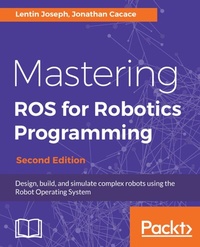
Mastering ROS for Robotics Programming
Design, build, and simulate complex robots using the Robot Operating System
2nd Edition
Published on 23. September 2024
580 pages
978-1-78847-452-8 (ISBN)
Description

Discover best practices and troubleshooting solutions when working on ROSKey Features - Develop complex robotic applications using ROS to interface robot manipulators and mobile robots
- Gain insight into autonomous navigation in mobile robots and motion planning in robot manipulators
- Discover best practices and troubleshooting solutions
Book DescriptionIn this day and age, robotics has been gaining a lot of traction in various industries where consistency and perfection matter. Automation is achieved via robotic applications and various platforms that support robotics. The Robot Operating System (ROS) is a modular software platform to develop generic robotic applications. This book focuses on the most stable release of ROS (Kinetic Kame), discusses advanced concepts, and effectively teaches you programming using ROS. We begin with aninformative overview of the ROS framework, which will give you a clear idea of how ROS works. During the course of this book, you'll learn to build models of complex robots, and simulate and interface the robot using the ROS MoveIt! motion planning library and ROS navigation stacks. Learn to leverage several ROS packages to embrace your robot models. After covering robot manipulation and navigation, you'll get to grips with the interfacing I/O boards, sensors, and actuators of ROS. Vision sensors are a key component of robots, and an entire chapter is dedicated to the vision sensor and image elaboration, its interface in ROS and programming. You'll also understand the hardware interface and simulation of complex robots to ROS and ROS Industrial. At the end of this book, you'll discover the best practices to follow when programming using ROS. What you will learn - Create a robot model with a seven-DOF robotic arm and a differential wheeled mobile robot
- Work with Gazebo and V-REP robotic simulator
- Implement autonomous navigation in differential drive robots using SLAM and AMCL packages
- Explore the ROS Pluginlib, ROS nodelets, and Gazebo plugins
- Interface I/O boards such as Arduino, robot sensors, and high-end actuators
- Simulate and motion plan an ABB and universal arm using ROS Industrial
- Explore the latest version of the ROS framework
- Work with the motion planning of a seven-DOF arm using MoveIt!
Who this book is forIf you are a robotics enthusiast or researcher who want to learn more about building robot applications using ROS, this book is for you. In order to learn from this book, you should have a basic knowledge of ROS, GNU/Linux, and C++ programming concepts. The book is also excellent for programmers who want to explore the advanced features of ROS.
- Gain insight into autonomous navigation in mobile robots and motion planning in robot manipulators
- Discover best practices and troubleshooting solutions
Book DescriptionIn this day and age, robotics has been gaining a lot of traction in various industries where consistency and perfection matter. Automation is achieved via robotic applications and various platforms that support robotics. The Robot Operating System (ROS) is a modular software platform to develop generic robotic applications. This book focuses on the most stable release of ROS (Kinetic Kame), discusses advanced concepts, and effectively teaches you programming using ROS. We begin with aninformative overview of the ROS framework, which will give you a clear idea of how ROS works. During the course of this book, you'll learn to build models of complex robots, and simulate and interface the robot using the ROS MoveIt! motion planning library and ROS navigation stacks. Learn to leverage several ROS packages to embrace your robot models. After covering robot manipulation and navigation, you'll get to grips with the interfacing I/O boards, sensors, and actuators of ROS. Vision sensors are a key component of robots, and an entire chapter is dedicated to the vision sensor and image elaboration, its interface in ROS and programming. You'll also understand the hardware interface and simulation of complex robots to ROS and ROS Industrial. At the end of this book, you'll discover the best practices to follow when programming using ROS. What you will learn - Create a robot model with a seven-DOF robotic arm and a differential wheeled mobile robot
- Work with Gazebo and V-REP robotic simulator
- Implement autonomous navigation in differential drive robots using SLAM and AMCL packages
- Explore the ROS Pluginlib, ROS nodelets, and Gazebo plugins
- Interface I/O boards such as Arduino, robot sensors, and high-end actuators
- Simulate and motion plan an ABB and universal arm using ROS Industrial
- Explore the latest version of the ROS framework
- Work with the motion planning of a seven-DOF arm using MoveIt!
Who this book is forIf you are a robotics enthusiast or researcher who want to learn more about building robot applications using ROS, this book is for you. In order to learn from this book, you should have a basic knowledge of ROS, GNU/Linux, and C++ programming concepts. The book is also excellent for programmers who want to explore the advanced features of ROS.
More details
Other editions
New editions
Lentin Joseph | Jonathan Cacace
Mastering ROS for Robotics Programming
Best practices and troubleshooting solutions when working with ROS
E-Book
09/2024
3rd Edition
Packt Publishing
from
€29.99
Available for download
Additional editions
Lentin Joseph | Jonathan Cacace
Mastering ROS for Robotics Programming - Second Edition
Design, build, and simulate complex robots using the Robot Operating System
Book
02/2018
Packt Publishing
€91.00
Shipment within 3-4 weeks
Previous edition
Lentin Joseph
Mastering ROS for Robotics Programming
Design, build, and simulate complex robots using the Robot Operating System
E-Book
01/2025
1st Edition
Packt Publishing Limited
from
€44.39
Available for download
Persons
Joseph Lentin :
Lentin Joseph is an author and robotics entrepreneur from India. He runs a robotics software company called Qbotics Labs in India. He has 7 years of experience in the robotics domain primarily in ROS, OpenCV, and PCL. He has authored four books in ROS, namely, Learning Robotics using Python, Mastering ROS for Robotics Programming, ROS Robotics Projects, and Robot Operating System for Absolute Beginners. He is currently pursuing his master's in Robotics from India and is also doing research at Robotics Institute, CMU, USA.
Lentin Joseph is an author and robotics entrepreneur from India. He runs a robotics software company called Qbotics Labs in India. He has 7 years of experience in the robotics domain primarily in ROS, OpenCV, and PCL. He has authored four books in ROS, namely, Learning Robotics using Python, Mastering ROS for Robotics Programming, ROS Robotics Projects, and Robot Operating System for Absolute Beginners. He is currently pursuing his master's in Robotics from India and is also doing research at Robotics Institute, CMU, USA.
Content
Table of Contents - Introduction to ROS and Its Package Management
- Getting started with ROS programming
- Working with 3D Robot Modeling in ROS
- Simulating Robots Using ROS and Gazebo
- Simulating Robots Using ROS and V-REP
- Using the ROS MoveIt! And Navigation Stack
- Working with Pluginlib, Nodelets, and Gazebo Plugins
- Writing ROS Controllers and Visualization Plugins
- Interfacing I/O Boards, Sensors, and Actuators to ROS
- Programming Vision Sensors using ROS, Open-CV, PCL and AR Marker Tracking
- Building and Interfacing Differential Drive Mobile Robot Hardware in ROS
- Exploring the Advanced Capabilities of ROS-MoveIt!
- Using ROS in Matlab and Simulink
- ROS for Industrial Robots
- Troubleshooting and Best Practices in ROS
- Getting started with ROS programming
- Working with 3D Robot Modeling in ROS
- Simulating Robots Using ROS and Gazebo
- Simulating Robots Using ROS and V-REP
- Using the ROS MoveIt! And Navigation Stack
- Working with Pluginlib, Nodelets, and Gazebo Plugins
- Writing ROS Controllers and Visualization Plugins
- Interfacing I/O Boards, Sensors, and Actuators to ROS
- Programming Vision Sensors using ROS, Open-CV, PCL and AR Marker Tracking
- Building and Interfacing Differential Drive Mobile Robot Hardware in ROS
- Exploring the Advanced Capabilities of ROS-MoveIt!
- Using ROS in Matlab and Simulink
- ROS for Industrial Robots
- Troubleshooting and Best Practices in ROS
