

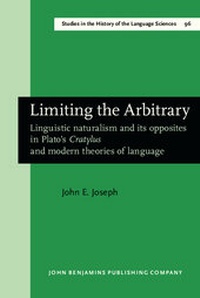
Limiting the Arbitrary
Linguistic naturalism and its opposites in Plato's <i>Cratylus</i> and modern theories of language
1st Edition
Published on 15. October 2000
X, 224 pages
978-90-272-8372-6 (ISBN)
Description

The idea that some aspects of language are 'natural', while others are arbitrary, artificial or derived, runs all through modern linguistics, from Chomsky's GB theory and Minimalist program and his concept of E- and I-language, to Greenberg's search for linguistic universals, Pinker's views on regular and irregular morphology and the brain, and the markedness-based constraints of Optimality Theory. This book traces the heritage of this linguistic naturalism back to its locus classicus, Plato's dialogue Cratylus. The first half of the book is a detailed examination of the linguistic arguments in the Cratylus. The second half follows three of the dialogue's naturalistic themes through subsequent linguistic history - natural grammar and conventional words, from Aristotle to Pinker; natural dialect and artificial language, from Varro to Chomsky; and invisible hierarchies, from Jakobson to Optimality Theory - in search of a way forward beyond these seductive yet spurious and limiting dichotomies.
More details
Other editions
Additional editions
John E. Joseph
Limiting the Arbitrary
Linguistic naturalism and its opposites in Plato's Cratylus and modern theories of language
Book
10/2000
John Benjamins Publishing Co
€111.30
Shipment within 10-15 days
Person
Content
- LIMITING THE ARBITRARY
- Editorial page
- Title page
- Copyright page
- FOREWORD
- Table of contents
- INTRODUCTION NATURAL AND UNNATURAL LANGUAGE
- La limitation de l'arbitraire
- Before reading further,
- Recent versions of naturalness and the paradox they pose
- Guide to the following chapters
- Plato and the Cratylus
- Part One Cratylus
- CHAPTER 1. NATURE AND CONVENTION CRATYLUS 383A1-391D1
- Greek language theory before the Cratylus
- The correctness of words
- Hermogenes: Words are conventional products of individual will
- Socrates: What about truth and falsehood?
- Protagoras' relativist view of truth
- Things have a natural reality of their own
- The word as an instrument
- Teaching and discriminating
- The establisher of customs and laws
- The ideal form of the word
- The dialectician as overseer
- CHAPTER 2. WORDS AND TRUTH CRATYLUS 391D2-422E1
- The study of truth?
- Homer on the words used by gods and mortals
- The names Astyanax and Skamandrios
- Parents and their offspring
- Further etymologies
- The original words as elements of later ones
- CHAPTER 3. IMITATION AND ESSENCE CRATYLUS 422E1-440E7
- The word as imitation
- Imitation and essence
- Alternative explanations
- the meanings of individual sounds
- The return of Cratylus
- The impossibility of speaking falsely
- Pictorial and verbal representation
- The image of Cratylus, or two Cratyli?
- Imitation by sounds (revisited)
- The meaning of r and l
- Habit and convention
- Words and the knowledge of reality
- The consistency of etymology
- Learning about things through words
- Socrates' dream
- Summary
- Part Two After Cratylus
- CHAPTER 4. NATURAL GRAMMAR AND CONVENTIONAL WORDS FROM ARISTOTLE TO PINKER
- Signifying by convention: Aristotle and Plato
- Breathing ethnicity into the language-making body: Epicurus
- Varro's compromise: nature versus will
- Medieval variations: Pater Nomen (Noun the Father)
- Developments in the languages themselves
- Nature v. convention reborn: from ideas and experience to usage and genius
- Convention as nature: Condillac and Rousseau
- What linguistics might have been: Bentham
- 'Reflexion ' and language structure: from Herder and Schlegel to Renan
- Saussure and the sham of arbitrariness
- Chomsky's fix
- Pinker's fix
- The past as roadmap to the future
- CHAPTER 5. NATURAL DIALECT AND ARTIFICIAL LANGUAGE FROM VARRO TO CHOMSKY
- The ideal language and the language of the masses
- Separate rules for poets: Varro
- The nobility of the vernacular: Dante's De vulgari eloquentia
- Political approaches to the standard: Nebrija, Du Bellay
- The realization of standard languages as language standards
- Saussure on 'literary language'
- The unnaturalness of the standard language: Orwell
- Chomsky on 'E-language' and 'I-language'
- The naturalness of artificiality
- CHAPTER 6. INVISIBLE HIERARCHIES FROM JAKOBSON TO OPTIMALITY THEORY
- Worlds within words
- Jakobson and the beginnings of structuralism
- Jakobson's and Trubetzkoy's dissatisfaction with Saussurean phonology
- 'A certain mark'
- Chomsky: 'Core' and 'periphery'
- Greenberg's search for universals and its aftermath
- Iconicity studies
- Optimality Theory
- AFTERWORD LINGUISTICS AFTER NATURALISM
- REFERENCES
- INDEX
