

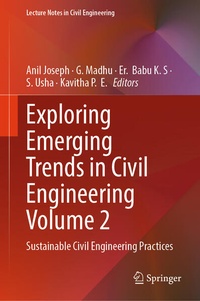
Exploring Emerging Trends in Civil Engineering Volume 2
Description

This national convention on engineering topics will explore the dynamic shifts and emerging trends that are reshaping civil engineering,emphasizing their vital role in developing safer, more efficient, and sustainable infrastructure. Our focus willspan several transformative innovations, beginning with the integration of 3D printing and robotics inconstruction. These technologies are revolutionizing the field by enhancing productivity, slashing labor costs,and improving safety through automated processes and the ability to produce complex structures. The convention will also highlight the increasing importance of resilience in our infrastructure, a response to themore frequent natural disasters driven by climate change. Today's civil engineers integrate considerations ofthese changes in their designs to construct buildings and structures that withstand and adapt to theseevolving conditions. Sustainability remains a crucial theme, driven by the urgent need for environmentalconservation and the realities of climate change. Our discussions will delve into green engineering practices,such as the use of eco-friendly materials, waste minimization, and the design of energy-efficient buildings.Innovations like Geopolymer technology offer rapid strength gain and reduced water use, presenting asustainable alternative to traditional concrete. Similarly, Bacterial Concrete represents a breakthrough inenhancing the durability and reducing the maintenance costs of concrete structures while lowering carbonemissions. The convention will also examine the role of advanced technologies like Cartography, remotesensing, and GIS applications, which are transforming our understanding and representation of the world,pushing the boundaries of traditional cartography into new digital frontiers. Additionally, modular constructionwill be discussed as a key contributor to efficiency, waste reduction, and quality in building processes,especially in its potential to address the critical needs for affordable housing and sustainable urban development. Furthermore, the financial benefits of retrofitting, which reduces energy consumption and offerssignificant cost savings, will be explored, showcasing its attractiveness and positive return on investmentover time. This convention is not just an event, but a call to action for civil engineering professionals toembrace these innovations, stay informed of cutting-edge developments, and play a pivotal role in crafting asafer, more efficient, and sustainable built environment. Join us as we leverage these trends to propel theindustry forward, ensuring our built environment can meet the demands of tomorrow.
More details
Other editions
Additional editions
Persons
Content
Exploring The Parameters for Land use Efficiency Measurement.- The Circular Challenge.- Numerical Modelling of Seawater Intrusion in Coastal Areas of Kochi.- Sediment transport modelling using HEC HMS for Kadambrayar watershed.- Construction Waste.- An Overview of Material Waste Management in Construction Projects.- Universal Representation Theory.- Advanced Recursive Ensemble Linear Regression Based Prediction.- Optimization of multiple factors of PCM integration in building roofs using Response Surface Methodology.- Blending HMA Bitumen with Non Bio Degradable waste to produce Sustainable and Ecofriendly Roads.- Assessment of Reclaimed Asphalt Pavement.- The role of prospect and refuge theory in establishing ideal built environment in restaurants.- Comprehensive Water Audit and Sustainable Water Reuse Strategies for Campus Facilities.- Universal Forecasting Schemes.- Studies on spurs along river Vellar in Tamilnadu.
