

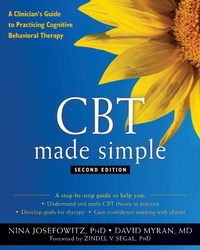
CBT Made Simple
Description

In this second edition of CBT Made Simple, two renowned psychologists and experts in cognitive behavioral therapy (CBT) offer the most comprehensive manual available to help professionals learn CBT and deliver it to clients for better treatment outcomes.
CBT is an evidence-based treatment for several mental health disorders, including anxiety, depression, obsessive-compulsive disorder (OCD), post-traumatic stress disorder (PTSD), and anger problems. This simple, pragmatic guide offers everything you need to know about CBT: what it is, how it works, and how to implement it in session.
This fully revised and updated second edition of CBT Made Simple provides a user-friendly, practical approach to learning CBT using up-to-the-minute teaching methods and learning tools-in particular, the "effective adult learning model," which promotes interactive learning, experiential learning, and self-reflection. Each chapter presents key elements of CBT in clear, accessible language, and includes client dialogues and clinical examples. Practical exercises are incorporated throughout, enabling you to practice and consolidate your learning. In addition, each chapter mimics the structure of an actual CBT session.
This new edition also includes the core components of CBT-core beliefs, intermediate beliefs, and behavioral experiments-to make this the most comprehensive CBT manual you'll find anywhere.
If you are a clinician or student interested in learning more about CBT, this book-part of the New Harbinger Made Simple series that includes ACT Made Simple and DBT Made Simple-has everything you need to hit the ground running. Why not make it a part of your professional library?
More details
Other editions
Additional editions
Content
- Intro
- Contents
- Foreword
- Introduction
- Part 1: CBT Foundation
- 1. Use CBT Theory to Understand Your Clients
- 2. Focus on Your Clients' Problems and Strengths
- 3. Develop Goals for Therapy
- 4. Structure Your Sessions
- Part 2: Understand Your Clients' Problems
- 5. Identify Your Clients' Feelings, Physical Reactions, and Behaviors
- 6. My Clients Have So Many Thoughts-Which Do I Focus On?
- 7. Identify Your Clients' Thoughts
- Part 3: Cognitive and Behavioral Interventions
- 8. Look for Evidence and Create Balanced Thoughts
- 9. Problem Solving-Finding a Better Way
- 10. Behavioral Activation-Action Plans for Depression
- 11. Exposure Therapy-Clients Face Their Fears
- Part 4: Working with Underlying Beliefs
- 12. Working with Core Beliefs
- 13. Underlying Assumptions and Behavioral Experiments
- Part 5: CBT in Action
- 14. Treatment Guidelines and Suzanne and Raoul's Therapy
- Acknowledgments
- Appendix
- Answers to YOUR TURN! Exercises
- References
- About the Authors
- Index
