

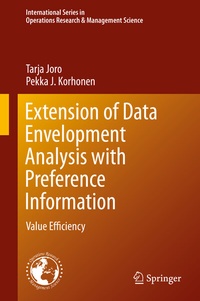
Extension of Data Envelopment Analysis with Preference Information
Description

This book provides an introduction to incorporating preference information in Data Envelopment Analysis (DEA) with a special emphasis in Value Efficiency Analysis. In addition to theoretical considerations, numerous illustrative examples are included. Hence, the book can be used as a teaching text as well. Only a modest mathematical background is needed to understand the main principles. The only prerequisites are a) familiarity with linear algebra, especially matrix calculus; b) knowledge of the simplex method; and c) familiarity with the use of computer software.
The book is organized as follows. Chapter 1 provides motivation and introduces the basic concepts. Chapter 2 provides the basic ideas and models of Data Envelopment Analysis. The efficient frontier and production possibility set concepts play an important role in all considerations. That's why these concepts are considered more closely in Chapter 3. Since the approaches introduced in this study are inspired by Multiple Objective Linear Programming, the basic concepts of this field are reviewed in Chapter 4. Chapter 5 also compares and contrasts Data Envelopment Analysis and Multiple Objective Linear Programming, providing some cornerstones for approaches presented later in the book. Chapter 6 discusses the traditional approaches to take into account preference information in DEA. In Chapter 7, Value Efficiency is introduced, and Chapter 8 discusses practical aspects. Some extensions are presented in Chapter 9, and in Chapter 10 Value Efficiency is extended to cover the case when a production possibility set is not convex. Three implemented applications are reviewed in Chapter 11.
Reviews / Votes
"Researchers and managers who are interested in applications of DEA would seem to be the primary beneficiaries of reading it; professors and instructors might select some themes from the book to complement their DEA courses for OR students. In addition, the theoretician of decision making might be interested in the further development of the nonconvex approach in value efficiency analysis initiated in the book." (Antanas Zilinskas, Interfaces, Vol. 46 (1), 2015)
More details
Other editions
Additional editions
Content
Introduction.- Data Envelopment Analysis.- Production Possibility Set and Efficiency.- Multiple Objective Linear Programming.- Comparison of Data Envelopment Analysis and Multiple Objective Linear Programming.- Incorporating Preference Information to Data Envelopment Analysis.- Value Efficiency Analysis.- Value Efficiency Analysis in Practice.- Extensions to Value Efficiency Analysis.-Non-Convex Value Efficiency Analysis.- Applications of Value Efficiency Analysis.- Conclusion.
