

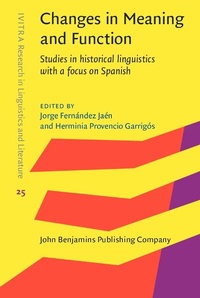
Changes in Meaning and Function
Studies in historical linguistics with a focus on Spanish
1st Edition
Published on 2. April 2020
344 pages
978-90-272-6138-0 (ISBN)
Description

Diachronic linguistics has been experiencing a strong revival during the last few decades, since an increasing number of researchers have assumed that evolutionary and historical factors must be considered to properly understand how natural languages work. This book offers new data and insights on some of the research lines which are currently being developed within the framework of diachronic language research. The papers brought together in this volume are characterized both by their originality and by their methodological diversity; the reader will thus find herein theoretical as well as empirical works, undertaken from various perspectives of analysis (diachronic cognitive semantics, grammaticalization theory, discursive traditions, historical phraseology, etc.). The final outcome is an eclectic volume which offers valuable information for every reader, regardless of whether they are experienced linguists or junior researchers willing to know the latest epistemological advances in this discipline.
More details
Other editions
Additional editions
Jorge Fernandez Jaen | Herminia Provencio Garrigos
Changes in Meaning and Function
Studies in historical linguistics with a focus on Spanish
Book
04/2020
John Benjamins Publishing Co
€123.50
Shipment within 10-15 days
Content
- Intro
- Changes in Meaning and Function
- Editorial page
- Title page
- Copyright page
- Table of contents
- Preface
- Nouns and labelling: The advance of nominalization in Spanish
- 1. Noun vs. verb: Asymmetric categories
- 2. Cognitive effects of labelling
- a. Development and acquisition of concepts
- b. Reformatting representations and cognitive availability
- c. Meta-representation
- 3. Nominalization
- 4. The advance nominalization in the past
- 5. The Latin precedents: Isidore of Seville
- 6. Concluding remarks
- References
- Causative and inchoative constructions with poner and meter ('to put') in Spanish: A diachronic constructional approach
- 1. Introduction
- 2. Materials and methods
- 3. Constructional changes and semantic evolution: Prepositional use as an indication of a metaphorical extension
- 4. Decrease in compositionality and syntactic reanalysis: On the auxiliary status of poner and meter
- 5. Productivity measurements
- 5.1 Development of token frequency
- 5.2 Host-class expansion: Lexical analysis of the INF slot
- 6. Discussion and conclusions
- References
- Auditory verbs in the Spanish language: A historical and cognitive approach
- 1. Theoretical approach and framework
- 2. Semantic and syntactic properties of hearing
- 3. Auditory uses in the history of sentir [to feel]
- 4. Evolution of escuchar [to listen]
- 5. Conclusions
- Bibliography
- Funding information
- From semantics to grammar: Lexical substitution in the evolution of verbal periphrases haber/tener + infinitive
- 1. Introduction: Objectives and hypothesis
- 2. Corpus
- 3. The role of analogy in diachronic change
- 4. Haber and tener as lexical verbs
- 5. From semantics to grammar by way of analogy
- 5.1 The evolution of haber de + infinitive
- 5.2 The evolution of haber que + infinitive
- 5.3 The evolution of tener de + infinitive
- 5.4 The evolution of tener que + infinitive
- 5.5 The evolution of cantarlo tengo (sing it I must)
- 6. Conclusions
- References
- Data sources
- Editions of cited works
- Works cited
- A note on the relative diachronic productivity of metaphor and metonymy
- References
- A cognitive approach to the grammaticalization of the epistemic marker fijo
- 1. Introduction
- 2. A general historical overview of fijo and its variants
- 3. Explanation of the semantic-pragmatic change operated in fijo
- 3.1 Metaphor and metonymy
- 3.2 The grammaticalization process
- 3.3 The expression of modality and evidentiality
- 4. The routinization process experienced by fijo
- 4.1 The study sample
- 4.2 Contexts with an epistemic value
- 4.3 Coding of evidentiality
- 5. Conclusions
- Acknowledgements
- References
- The future tense in Spanish: An enactive approach
- Concluding remarks
- References
- Form and meaning in the development of verbal polysemy
- 1. Introduction
- 2. Development of alcanzar 'understand': Structural change as the result of a change in meaning
- 3. The rise of alcanzar's 'sufficiency' sense: Semantic change triggered by formal change
- Extent function
- Reaching distant objects in space
- Scalar construal of abstract Goals
- The capacity for rational thought and its insufficiency
- 4. Conclusions
- Corpus
- References
- Something seems to have changed: Diachronic evidence for the semantic shift of parecer + infinitive
- 1. Introduction
- 2. The periphrastic nature of parecer + infinitive
- 3. The origin of parecer + infinitive
- 4. The semantic evolution of parecer + infinitive
- 5. Epistemic and evidential meaning
- 6. Parecer + infinitive in first person singular
- 7. Summary and conclusions
- References
- In substance, they came from above: On the acquisition of discourse particles in Medieval Spanish
- 1. Discourse particles: Ausbau and linguistic elaboration
- 1.1 The social gap of grammaticalization theory
- 1.2 Discourse particles that came from above: Social context and elaboration
- 2. The history of the Spanish discourse particle en sustancia
- 2.1 substantia and its legacy
- 2.2 Use of in sustancia in current Spanish
- 3. Diachronic evolution of Spanish
- 3.1 Explanation of the linguistic change of en sustancia
- 4. Conclusions
- Bibliography
- Funding information
- Grammaticalization of en vías de: A multidimensional linguistic change
- 1. Introduction
- 2. Grammaticalization of en vías de: Reanalysis and semantic change
- 3. Frequency index
- 4. Diachronic diffusion of en vía/vías de
- 5. Morphological, syntactic and lexical-diatopical variation of en vías de
- 6. Discursive origin, difussion and adoption of en vías de
- 7. Conclusions
- Textual sources
- References
- Funding information
- On the importance of a diachronic approach to phraseology
- 1. Introduction
- 1.1 Preliminary remarks on terminology
- 1.2 A brief review of Hispanic phraseology
- 1.3 Current state of the art: Conceptual and terminological issues
- 1.4 The importance of a diachronic approach
- 2. Phraseology and language change
- 2.1 Phraseologization and grammaticalization: Similar processes
- 2.2 Phraseologization: A process involving more than a word
- 3. Phraseologization: Structural, semantic and pragmatic fixation
- 3.1 Structural fixation: Fixedness (polylexicality)
- 3.2 Semantic fixation: Idiomaticity I
- 3.3 Pragmatic fixation: Idiomaticity II
- 4. The emergence of phraseological meaning
- 5. Conclusions
- References
- Index
