

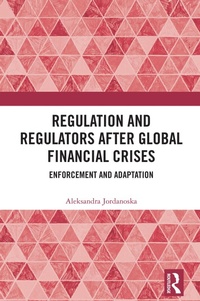
Regulation and Regulators after Global Financial Crises
Enforcement and Adaptation
1st Edition
Published on 31. December 2024
272 pages
978-1-351-06931-1 (ISBN)
Description

This book provides an original theoretically and empirically grounded analysis of regulatory enforcement activism in post-crises periods and the ensuing regulatory interactions.
It critically addresses the 'more regulation' enforcement agenda in the aftermath of the 2008 financial crisis, showing how misconduct was constructed through the enforcement policies and practices of the powerful UK financial conduct regulator, and its interactions with regulated organisations and their legal representatives. Drawing from interviews with current and former regulators, professional intermediaries, and markets participants; documentary analysis; and observations, the volume's interdisciplinary approach is grounded in constructivist perspectives on compliance and deviance, regulation theory, and socio-legal research.
Through a multi-dimensional analytical framework that links shifts in regulatory policy-making, and experimentations with, and use of, legal powers in information-gathering, legal and extra-legal penalties, and individual accountability, the book documents a more interventionist and punitive post-crisis enforcement agenda.
Despite the increased enforcement focus, it is not necessarily the case that the power tilted more towards the regulator or towards more adversarial regulatory interactions. Using the new concept of 'mutual risk mitigation', Jordanoska uncovers and theorises the strong cooperative relationships that enabled promoting strategies of adaptation to the more punitive enforcement agenda.
This fine-grained socio-legal inquiry challenges current thinking in the 'scandal and reform' literature and makes innovative and timely contributions to our understanding of the limitations of regulatory activism, regulatory relationships, the governance of financial markets, and on regulating corporations and the individuals within them. It will appeal to academics, researchers, regulators, and policymakers working in regulation across law, criminology, politics, and sociology.
It critically addresses the 'more regulation' enforcement agenda in the aftermath of the 2008 financial crisis, showing how misconduct was constructed through the enforcement policies and practices of the powerful UK financial conduct regulator, and its interactions with regulated organisations and their legal representatives. Drawing from interviews with current and former regulators, professional intermediaries, and markets participants; documentary analysis; and observations, the volume's interdisciplinary approach is grounded in constructivist perspectives on compliance and deviance, regulation theory, and socio-legal research.
Through a multi-dimensional analytical framework that links shifts in regulatory policy-making, and experimentations with, and use of, legal powers in information-gathering, legal and extra-legal penalties, and individual accountability, the book documents a more interventionist and punitive post-crisis enforcement agenda.
Despite the increased enforcement focus, it is not necessarily the case that the power tilted more towards the regulator or towards more adversarial regulatory interactions. Using the new concept of 'mutual risk mitigation', Jordanoska uncovers and theorises the strong cooperative relationships that enabled promoting strategies of adaptation to the more punitive enforcement agenda.
This fine-grained socio-legal inquiry challenges current thinking in the 'scandal and reform' literature and makes innovative and timely contributions to our understanding of the limitations of regulatory activism, regulatory relationships, the governance of financial markets, and on regulating corporations and the individuals within them. It will appeal to academics, researchers, regulators, and policymakers working in regulation across law, criminology, politics, and sociology.
More details
Edition
1. Auflage
Language
English
Place of publication
London
United Kingdom
Publishing group
Taylor & Francis Ltd
Target group
College/higher education
Illustrations
2 Tables, black and white; 13 Line drawings, black and white; 13 Illustrations, black and white
ISBN-13
978-1-351-06931-1 (9781351069311)
Copyright in bibliographic data and cover images is held by Nielsen Book Services Limited or by the publishers or by their respective licensors: all rights reserved.
Schweitzer Classification
Other editions
Additional editions
Aleksandra Jordanoska
Regulation and Regulators after Global Financial Crises
Enforcement and Adaptation
Book
12/2024
1st Edition
Routledge
€196.50
Shipment within 10-20 days
Person
Aleksandra Jordanoska is Senior Lecturer at the Dickson Poon School of Law, King's College, London.
Content
1. Introduction; 2. The More Punitive Turn in Regulatory Enforcement; 3. Detecting Financial Misconduct and the Informational Traffic: Mutual Risk Mitigation; 4. The Cooperative Context during the Contentious Enforcement Procedure: Investigations and Settlements; 5. Reputation as a Resource in the Governance of Financial Markets; 6. Corporate Managers as 'Objects of Control'; 7. Conclusion
