

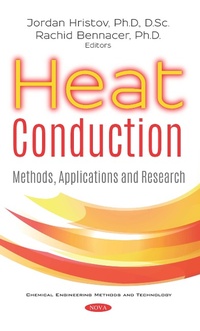
Heat Conduction: Methods, Applications and Research
Published on 8. January 2019
228 pages
978-1-5361-4674-5 (ISBN)
Description

Heat conduction plays an important role in energy transfer at the macro, micro and nano scales. This book collates research results developed by scientists from different countries but with common research interest in the modelling of heat conduction problems. The results reported encompass heat conduction problems related to the Stefan problem, phase change materials related to energy consumption in buildings, the porous media problem with Bingham plastic fluids, thermosolutal convection, rewetting problems and fractional models with singular and non-singular kernels. The variety of analytical and numerical techniques used includes the classical heat-balance integral method in its refined version, double-integration technique and variational formulation applied to the integer-order and fractional models with memories. This book cannot present the entire rich area of problems related to heat conduction, but allows readers to see some new trends and approaches in the modelling technologies. In this context, the fractional models with singular and non-singular kernels and the development of the integration techniques related to the integral-balance approach form fresh fluxes of ideas to this classical engineering area of research. The book is oriented to researchers, masters and PhD students involved in heat conduction problems with a variety of applications and could serve as a rich reference source and a collection of texts provoking new ideas.
More details
Other editions
Additional editions
Book
02/2019
Nova Science Publishers Inc
€210.94
Shipment within 15-20 days
Content
- Intro
- HEAT CONDUCTIONMETHODS, APPLICATIONSAND RESEARCH
- HEAT CONDUCTIONMETHODS, APPLICATIONSAND RESEARCH
- CONTENTS
- PREFACE
- Chapter 1APPROXIMATE SOLUTIONSTO THE ONE-PHASE STEFAN PROBLEMWITH NON-LINEARTEMPERATURE-DEPENDENT THERMALCONDUCTIVITY
- Abstract
- 1. Introduction
- 2. Mathematical Formulation and Exact Solution
- 3. Heat Balance Integral Methods
- 3.1. Approximate Solution Using the Classical Heat BalanceIntegral Method
- 3.2. Approximate Solution Using an Alternative of the HeatBalance Integral Method
- 3.3. Approximate Solution Using a Refined Balance Heat IntegralMethod
- 4. Comparisons between Solutions
- Acknowledgments
- Conclusion
- References
- Chapter 2APPLICATION OF VARIATIONAL INTEGRALMETHOD TO ANALYZE VARIETYOF REWETTING PROBLEMS
- Abstract
- 1. Introduction
- 1.1. Method of Variational Calculus
- 1.1.1. Sparrow and Siegel [2] Approach
- 1.1.2. Arpaci [3] Approach
- 1.2. Application of VIM to Solve Rewetting Problems
- 1.2.1. Two Region Rewetting Model
- Quasi-steady assumption
- One-dimensional formulation
- Sparrow and Siegel [2] approach
- 1.2.2. The Effect of Precursory Cooling on Rewetting of Hot Vertical
- Theoretical analysis
- Solution Procedure
- 1.2.3. The Effect of Property Variation on Rewetting Velocity
- Theoretical analysis
- Solution procedure
- 1.2.4. Multiregion Rewetting Model [23]
- Solution procedure
- Model (1)
- Model (2)
- Model (3)
- 1.2.5. Multi-Region Rewetting Model with Precursory Cooling [25] Several
- Theoretical analysis
- 2. Results and Discussion
- Conclusion
- References
- Chapter 3 THE HEAT RADIATION DIFFUSION EQUATION WITH MEMORY: CONSTITUTIVE APPROACH AND APPROXIMATE INTEGRAL-BALANCE SOLUTIONS
- Abstract
- 1. Introduction
- 2. The Nonlinear Heat Radiation Diffusion Equation:Classical Formulation and Memory Fffects
- 2.1. The Heat Radiation Diffusion without Inertia(without Flux Relaxation)
- 2.2. Memory Formalism and Flux Damping (Relaxation)
- 2.3. The Heat Radiation Diffusion with Inertia:Model Formulation
- 3. Solution Approach: A Necessary Background aboutthe Techniques Used
- 3.1. Integral Balance Method
- 3.2. Assumed Profile
- 3.3. Transformation of the Diffusion Term and the GoverningEquation to a Degenerate Equation
- 4. DIM Solutions: Constant Density Cases
- 4.1. Step Change of Temperature at the Boundary
- 4.2. Temperature-Independent Properties with Time-DependentBoundary Condition (Marshak's Problem)
- 4.2.1. Marshak's Approach
- 4.2.2. Garrnier's Problem: Power-Law Time Dependent BoundaryTemperature
- Conclusion
- References
- Chapter 4FUNDAMENTAL SOLUTIONS TO THE CAUCHYAND DIRICHLET PROBLEMS FOR A HEATCONDUCTION EQUATION EQUIPPEDWITH THE CAPUTO-FABRIZIODIFFERENTIATION
- Abstract
- 1. Introduction
- 2. Preliminaries
- 3. Fundamental Solution of The Cauchy Problem
- 4. Fundamental Solutions to the Dirichlet Problem
- Conclusion
- References
- Chapter 5ABOUT THE HEAT CONDUCTION IMPACTON THE THERMOSOLUTAL STABILITYWITHIN ANNULUS: SILICON CARBIDECERAMIC CASE
- Abstract
- 1. Introduction
- 1.1. Thermosolutal Convection Over the Years
- 1.2. About the Heat Conduction Limit
- 1.3. Aim
- 2. Conductive Fluids between Modelling and Constitutive Equations
- 3. Nature of the Porous Matrix
- 4. Problem Statement and Mathematical Formulation
- 4.1. Problem Statement
- 4.2. Mathematical Formulation
- 5. NumericalModelisation and Code Validity
- 5.1. Numerical Procedure
- 5.2. Brief Code Validation
- 6. Results and Discussion
- 6.1. About the Order of Magnitude Analysis
- 6.2. About the Conduction and the Thermosolutal Stability-Limit
- 6.2.1. Impact of the Boundary Layers Ratio
- 6.2.2. Impact of the Buoyancy Ratio
- 6.2.3. The Transition Phase Against the Annulus Aspect Ratio
- 6.3. About the Heat Conduction and the Oscillatory Flow-Limit
- 6.3.1. Heat Conduction Limit at Fluid Annulus
- 6.3.2. Oscillation Stability Limit
- Conclusion
- References
- Chapter 6HYGROTHERMAL TRANSFERSIN POROUS MEDIA
- Abstract
- 1. Preliminary Considerations on PorousMedia-Projection on Materials
- 1.1. Porous Media, Status of Transfer
- 1.2. Parameters Characterizing the Porous Media
- 1.2.1. Representative Elementary Volume (R.E.V.)
- 1.2.2. Porosity
- 1.2.3. Intrinsic and Apparent Permeability
- 1.3. Interaction of Moisture between the Material and Air
- 1.3.1. Humid Air
- 1.3.2. Dew Temperature
- 1.3.3. RelativeHumidity
- 1.4. Moisture Content
- 1.4.1. Total Pressure
- 2. Method of Confining Moisture in PorousMedia
- 2.1. AdsorbedWater
- 2.2. CapillaryWater
- 2.3. The Hysteresis
- 3. Quantitative Analysis of Moisture TransferPhenomena
- 3.1. Molecular Diffusion
- 3.2. KNUDSEN Transport and Surface Scattering
- 3.3. Thermal Diffusion
- 4. Main Models ofWater Transfer
- 4.1. Darcy's Law (1856)
- 4.2. The Empirical Model of Brinkman
- 4.3. Model with Driving Potential of Steam Pressure/CapillaryPressure
- 4.3.1. Pedersen Model
- 4.4. Liquid DiffusionModel
- 4.4.1. Richards Model
- 4.5. Water/Temperature Transfer Models
- 4.5.1. Model of Philip and De Vries (P.D.V)
- 4.6. Total Pressure Driving Potential Models/Steam Content
- 5. Overview of Driving Potential of Coupled Heat andMoisture Transfer
- 6. Modeling Results
- Conclusion
- References
- Chapter 7ENERGY STORAGE USING PHASECHANGE MATERIALS
- Abstract
- 1. Phase Change Materials for Energy Storage
- 1.1. General Introduction
- 1.2. Strategies in Simulating the Phase Change Source Term
- 2. Properties and Applications of PCMs
- 2.1. Relative Properties of PCMs
- 2.2. Applications of PCMs
- 3. Some Solutions in Phase Change Problems
- 3.1. Analytical Solutions in Semi-Infinite Domain
- 3.2. Short Time Solution in Rectangular Corner
- 3.3. Energy Analysis in Global Freezing Process
- 3.4. A Semi-Analytical Solution in Bounded Domain
- 3.4.1. Calculation of Short Time Solution
- 3.4.2. Calculation of the Interface Position in the Stationary Case
- 3.4.3. Stefan's Problem in a
- 3.5. Multi-Phase Problem in a Cartesian Domain
- 3.6. Phase Change Problem in a Cylindrical Domain
- Conclusion
- References
- ABOUT THE EDITORS
- INDEX
- Blank Page
