

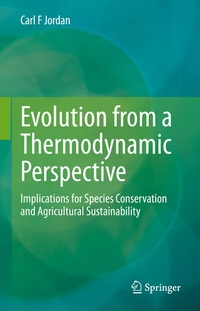
Evolution from a Thermodynamic Perspective
Description

Survival of the fittest" is a tautology, because those that are "fit" are the ones that survive, but to survive, a species must be "fit". Modern evolutionary theory avoids the problem by defining fitness as reproductive success, but the complexity of life that we see today could not have evolved based on selection that favors only reproductive ability. There is nothing inherent in reproductive success alone that could result in higher forms of life. Evolution from a Thermodynamic Perspective presents a non-circular definition of fitness and a thermodynamic definition of evolution. Fitness means maximization of power output, necessary to survive in a competitive world. Evolution is the "storage of entropy". "Entropy storage" means that solar energy, instead of dissipating as heat in the Earth, is stored in the structure of living organisms and ecosystems. Part one explains this in terms comprehensible to a scientific audience beyond biophysicists and ecosystem modelers. Part two applies thermodynamic theory in non-esoteric language to sustainability of agriculture, and to conservation of endangered species. While natural systems are stabilized by feedback, agricultural systems remain in a mode of perpetual growth, pressured by balance of trade and by a swelling population. The constraints imposed by thermodynamic laws are being increasingly felt as economic expansion destabilizes resource systems on which expansion depends.
More details
Other editions
Additional editions
Person
During the 1940s and early 50s, Carl F. Jordan spent boyhood summers at his uncle's hunting and fishing lodge in northern Maine. He enjoyed the wilderness there, especially canoe trips on the Allagash and Penobscot rivers, and deplored the cutting of the spruce-fir forests by the pulp and paper companies. In 1953, he enrolled at the University of Michigan and majored in forestry, because he believed that it could help him conserve the forests, but in those days, forestry was all about "getting out the cut".
After he acquired his Ph.D. in plant ecology from Rutgers Univ.in 1966, he joined H.T. Odum in an Atomic Energy Commission project in Puerto Rico, looking at the dynamics of radioactive isotopes in the rain forest following the world-wide atmospheric testing of nuclear weapons. In 1969, Carl moved to Argonne National Laboratory where he continued studies of radioactive pollution from nuclear power plants. In 1974,he had the opportunity to lead an ecology project for the University of Georgia to determine energy flow and nutrient cycling in the Amazon Region of Venezuela. In 1980, Carl returned to the School of Ecology in Athens Georgia while continuing tropical research in Brazil, Costa Rica, Mexico and Thailand.
In 1993, Carl acquired a farm near Athens Georgia that had once been part of a pre-Civil War cotton plantation and began research on more sustainable ways of farming. He originated the first University course in Georgia on organic farming, and opened the farm to tours and classes interested in sustainable agriculture. Carl retired as Professor Emeritus in 2009, and took his new freedom to begin research for Evolution from a Thermodynamic Perspective, and recently to develop a forum where the controversies raised in that book could be discussed. The forum is available at the website Thermodynamic-Evolution.orgContent
