

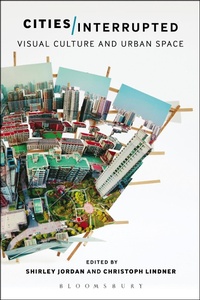
Cities Interrupted
Visual Culture and Urban Space
1st Edition
Published on 25. February 2016
256 pages
978-1-4742-2444-4 (ISBN)
Description

Cities Interrupted explores the potential of visual culture - in the form of photography, film, performance, architecture, urban design, and mixed media - to strategically interrupt processes of globalization in contemporary urban spaces.
Looking at cities such as Amsterdam, Beijing, Doha, London, New York, and Paris, the book brings together original essays to reveal how the concept of 'interruption' in global cities enables new understanding of the forms of space, experience, and community that are emerging in today's rapidly transforming urban environments.
The idea of 'interruption' addressed in this book refers to deliberate interventions in the spaces and communities of contemporary cities - interventions that seek to disrupt or destabilize the experience of everyday urban life through creative practice. Interruption is used as an analytic and conceptual tool to challenge - and explore alternatives to - the narratives of speed, hyper-mobility, rapid growth, and incessant exchange and flow that have dominated critical thinking on global cities.
Bringing art and creative practice into the centre of discussions about the future of cities, alongside discussions of development, design, justice, health, sustainability, technology, and citizenship, this book is essential reading for anyone working at the intersections of a range of urban, cultural and visual fields, including urban studies, urban design and architecture, visual studies, cultural studies, media studies, art history, and social and cultural geography.
Looking at cities such as Amsterdam, Beijing, Doha, London, New York, and Paris, the book brings together original essays to reveal how the concept of 'interruption' in global cities enables new understanding of the forms of space, experience, and community that are emerging in today's rapidly transforming urban environments.
The idea of 'interruption' addressed in this book refers to deliberate interventions in the spaces and communities of contemporary cities - interventions that seek to disrupt or destabilize the experience of everyday urban life through creative practice. Interruption is used as an analytic and conceptual tool to challenge - and explore alternatives to - the narratives of speed, hyper-mobility, rapid growth, and incessant exchange and flow that have dominated critical thinking on global cities.
Bringing art and creative practice into the centre of discussions about the future of cities, alongside discussions of development, design, justice, health, sustainability, technology, and citizenship, this book is essential reading for anyone working at the intersections of a range of urban, cultural and visual fields, including urban studies, urban design and architecture, visual studies, cultural studies, media studies, art history, and social and cultural geography.
More details
Edition
1. Auflage
Language
English
Place of publication
London
United Kingdom
Publishing group
Bloomsbury Publishing PLC
Target group
Professional and scholarly
College/higher education
Illustrations
50 bw illus
ISBN-13
978-1-4742-2444-4 (9781474224444)
Copyright in bibliographic data and cover images is held by Nielsen Book Services Limited or by the publishers or by their respective licensors: all rights reserved.
Schweitzer Classification
Other editions
Additional editions
Book
02/2016
Bloomsbury Academic
€52.18
Shipment within 15-20 days
Persons
Shirley Jordan is Professor of French Literature and Visual Culture at Queen Mary University of London, UK.
Christoph Lindner is Professor of Media and Culture at the University of Amsterdam, the Netherlands.
Christoph Lindner is Professor of Media and Culture at the University of Amsterdam, the Netherlands.
Content
Foreword
Ackbar Abbas (University of California-Irvine, USA)
1. Visual Culture and Interruption in Global Cities
Shirley Jordan (Queen Mary University of London, UK) and Christoph Lindner (University of Amsterdam, the Netherlands)
PART 1 - CRISIS AND RUIN
2. Why We Love 'Interruption': Urban Ruins, Food Trucks, and the Cult of Decay
Richard J. Williams (University of Edinburgh, UK)
3. Rescuing History from the City: Interruption and Urban Development in Beijing
Jeroen de Kloet (University of Amsterdam, the Netherlands)
4. Interrupting New York: Slowness and the High Line
Christoph Lindner (University of Amsterdam, the Netherlands)
5. Sound, Memory, and Interruption: Ghosts of London's M11 Link Road
David Pinder (Roskilde University, Denmark)
PART 2 - RESISTANCE AND RENEWAL
6. Suburbia, Interrupted: Street Art and the Politics of Place in the Paris Banlieues
Gillian Jein (Bangor University, UK)
7. Looking at Digital Visualizations of Urban Redevelopment Projects: Dimming the Scintillating Glow of Unwork
Gillian Rose, Monica Degen, and Clare Melhuish (The Open University, UK)
8. "Here We Are Now": Amsterdam's North-South Metro Line and the Emergence of a Networked Public
Ginette Verstraete (Vrije Universiteit Amsterdam, the Netherlands)
9. Pop-Up Shops as Interruptions in (Post-)Recessional London
Mara Ferreri (Queen Mary University of London, UK)
PART 3 - BODIES AND SPACE
10. Interruption Expanded: Urban Photography's Perspicacious View
Hugh Campbell (University College Dublin, Ireland)
11. Buildering, Urban Interventions, and Public Sculpture
Bill Marshall (University of Stirling, UK)
12. Interrupting the Street
Shirley Jordan (Queen Mary University of London, UK)
Bibliography
Index
Ackbar Abbas (University of California-Irvine, USA)
1. Visual Culture and Interruption in Global Cities
Shirley Jordan (Queen Mary University of London, UK) and Christoph Lindner (University of Amsterdam, the Netherlands)
PART 1 - CRISIS AND RUIN
2. Why We Love 'Interruption': Urban Ruins, Food Trucks, and the Cult of Decay
Richard J. Williams (University of Edinburgh, UK)
3. Rescuing History from the City: Interruption and Urban Development in Beijing
Jeroen de Kloet (University of Amsterdam, the Netherlands)
4. Interrupting New York: Slowness and the High Line
Christoph Lindner (University of Amsterdam, the Netherlands)
5. Sound, Memory, and Interruption: Ghosts of London's M11 Link Road
David Pinder (Roskilde University, Denmark)
PART 2 - RESISTANCE AND RENEWAL
6. Suburbia, Interrupted: Street Art and the Politics of Place in the Paris Banlieues
Gillian Jein (Bangor University, UK)
7. Looking at Digital Visualizations of Urban Redevelopment Projects: Dimming the Scintillating Glow of Unwork
Gillian Rose, Monica Degen, and Clare Melhuish (The Open University, UK)
8. "Here We Are Now": Amsterdam's North-South Metro Line and the Emergence of a Networked Public
Ginette Verstraete (Vrije Universiteit Amsterdam, the Netherlands)
9. Pop-Up Shops as Interruptions in (Post-)Recessional London
Mara Ferreri (Queen Mary University of London, UK)
PART 3 - BODIES AND SPACE
10. Interruption Expanded: Urban Photography's Perspicacious View
Hugh Campbell (University College Dublin, Ireland)
11. Buildering, Urban Interventions, and Public Sculpture
Bill Marshall (University of Stirling, UK)
12. Interrupting the Street
Shirley Jordan (Queen Mary University of London, UK)
Bibliography
Index
