

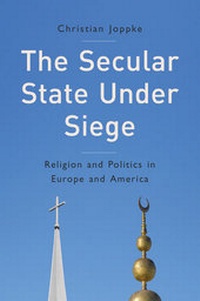
The Secular State Under Siege
Description

In a comparison of Western Europe and North America, Christianity and Islam, Joppke advances far-reaching theoretical, historical, and comparative-political arguments. With respect to theory, it is argued that only a "substantive" concept of religion, as pertaining to the existence of supra-human powers, opens up the possibility of a historical-comparative perspective on religion. At the level of history, secularization is shown to be the distinct outcome of Latin Christianity itself. And at the level of comparative politics, the Christian Right in America which has attacked the "wall of separation" between religion and state and Islam in Europe with the controversial insistence on sharia law and other "illiberal" claims from some quarters are taken to be counterpart incarnations of public religion and challenges to the secular state.
This clearly argued, sweeping book will provide an invaluable framework for approaching an array of critical issues at the intersection of religion, law and politics for advanced students and researchers across the social sciences and legal studies, as well as for the interested public.
More details
Other editions
Additional editions
Person
Content
Chapter 1: Religion in Social and Political Theory
Chapter 2: Secularization and the Long Christian Exit
Chapter 3: Challenge to the Secular State (I): The Christian Right in America
Chapter 4: Challenge to the Secular State (II): Islam in Europe
Conclusion: Islam and Christianity in the Secular State
Endnotes
Bibliography
Introduction
Religion as Structure and as Actor
A small book on so big a topic as "religion and politics" is no minor undertaking. I tackle it from a historical and institutional perspective, with a dual focus on Western Europe and North America, Christianity and Islam. This is still vast enough, but already less than everything. A historical-institutional perspective largely excludes behaviorism, such as the correlating of voting patterns or partisan identification with religious orientation, and so on, which has preoccupied much of the American political sociology of religion.1 The regional focus on the West also excludes, now regrettably, the rest of the world, such as the Middle East or South-east Asia, where religious conflict may be far more dramatic and central to political life than in the temperate zones - this part of the world simply is beyond my competence (also linguistically).
I arrive at this topic as a long-standing student of the nation-state and its contemporary transformation in the West, especially if related to migration and multiculturalism. After the "challenge to the nation-state," to quote an earlier book of mine (Joppke 1998), now there is a "challenge to the secular state." One part of this story is academic, and it is astonishing to see how many fellow intellectual travelers of mine made similar moves.2 But the other half of this story is in the real world, where even in the secularized West "public religion" has had a mighty come-back, to the degree that it had ever disappeared (the first to register this is Casanova 1994). Partially, but not exclusively, the revival of public religion is a result of international migration and the arrival of new religions into Western societies that challenge established arrangements between religion and the secular state.
A historical and institutional perspective takes "religion" both as structuring principle and as actor, as a structural force that has shaped the modern world like perhaps no other force and as a claims-maker within this world that religion helped bring about. On the structural side, religion (more precisely: Christianity) has shaped modern political life, including party systems, public institutions, and state structures and national identities, in the most profound yet often unacknowledged ways - Carl Schmitt (2005 [1922]) even argued famously that the lexicon of basic political concepts (such as "sovereignty") consists largely of secularized theological concepts. No one has articulated the unmatched structuring powers of religion in human history more succinctly than Tocqueville: "There is hardly any human action, however private it may be, which does not result from some very general conception men have of God, of His relations with the human race, of the nature of their soul, and of their duties to their fellows. Nothing can prevent such ideas from being the common spring from which all else originates" (1969 [1835-40]: 442-3).
Tocqueville, of course, was the unmatched theorist of liberal democracy, and he provocatively argued that in a democratic society religion was even more important than in feudalism for bringing about trust and cohesion in society: "[I]f [man] has no faith he must obey, and if he is free he must believe" (p. 444). Turning Tocqueville around, however, there is good reason to argue that liberal democracy itself, in which - pace Tocqueville - religion no longer is the central motive force and legitimizing principle and where society has become secularized (a key term thoroughly scrutinized in this book), could have arisen only in a Christian, and no other religious, context. At the same time, there is much variation in the relations between state and religion as the latter walked out of politics, being different in Europe (where church and state once were rival forces) and in America (where no such rivalry ever existed). Within Europe, religion-state relations differ in Protestant and Catholic or mixed countries, with a whole variety of church-state regimes, all compatible with the strictures of secularism, and with the peculiar presence of Christian Democratic parties in some countries but not in others. In short, religion (or rather Christianity) as structuring principle of even secular and secularizing societies needs to be acknowledged, and it will be done in this book in broad yet comparatively refined brushstrokes.
On the other side, religion is also an actor that appears in secular contexts with specific claims. Of particular interest here are new religions, which have entered Western societies by way of immigration - the standard bearer being, of course, Islam. These new religions stand to be integrated into existing church-state systems, which is a process with twists and frictions that are amply documented in an ever-expanding literature. Much of this literature is a lament over the discriminations and inequities inflicted on the newcomers by the powers that be. This obscures an astonishing and historically unprecedented fact: that nothing short of strict equality is the benchmark of including new religions, especially Islam. If one considers the power of religion (as "structuring principle") to make society and civilizations, which is always the power of a particular and not of any religion (in this case, of Christianity), the standard of equality is astonishing indeed. This is because the once dominant religion is reduced to just one among several religions, however extraneous to the respective culture and society these other religions might be. It is a specificity of the (Christian) West, exacted by the principles of secularism and neutrality that were born out of a specific history yet, once created, are imperative for liberal states and societies in general.
Chapter 1 provides a brief review of "Religion in Social and Political Theory." At its heart is a discussion of the two most imposing classical sociologies of religion that remain acute today, those of Émile Durkheim and Max Weber. Both espoused radically different concepts of religion that continue to be disputed and to inform scholarship today, functionalist (Durkheim) versus substantive (Weber). While each approach has its own virtues and deficiencies, a functionalist approach runs into the difficulty of saying what religion is and why and how it is no longer all-encompassing but one sphere or actor among many in a differentiated and secularized society.
Chapter 2, "Secularization and the Long Christian Exit," homes in on the central concept of the entire social science of religion, past and present, which is "secularization." While, following Casanova (1994: ch. 1), it has become canonical to consider only "differentiation" the heart of secularization, it is difficult to see how secularization could not imply the "decline" and "privatization" of religion, which for many (including Casanova) have been proved wrong by the return of "public religion." In particular, I argue in this chapter that secularism (as the result of secularization) is necessary for a liberal-democratic state, but that it was arrived at in a contingent historical process, in which Latin Christianity was pivotally involved. Take away Christianity, and we would not live in a secular age. This is hardly a new proposition, but it bears to be restated in all its simplicity.
In Chapters 3 and 4, I move away from religion as historical structuring principle or society-maker toward religion as actor and claims-maker in secularized settings. The underlying idea of these chapters is that the Christian Right in America is what Islam is in Europe - the respective side of the Atlantic's major "challenge to the secular state" today.
Chapter 3, "Challenge to the Secular State (I): The Christian Right in America," argues that the main impact of the Christian Right has been not political but legal, partially moving America away from its strict separationist religion-state regime of the past toward a European-style soft establishment, in which state and religion cooperate in the fulfillment of important societal functions.
Chapter 4, "Challenge to the Secular State (II): Islam in Europe," starts by mapping out the principal frictions between Islam and thoroughly secularized Europe, yet moves on to stress the accommodating powers of liberal institutions, including the partial and indirect, yet no less effective, accommodation of Islamic sharia law within liberal state law. While "liberal Islam" is a chimera, Islam has nevertheless found its place as a constitutionally protected minority religion in secular Europe and the West. If there are undeniably problems surrounding Muslim integration in Europe, an insufficient integration of Islam, the religion, is not at the heart of them.
In a concluding chapter, "Islam and Christianity in the Secular State," I weave together the strands of the Christianity-Islam comparison in secular settings by contrasting how the key symbols of the two religions, the Christian crucifix and the Islamic veil, have been processed in the European and American legal orders. Both are instances of "public religion" (Casanova 1994) and have helped spark the renewed interest in the political role of religion. Two questions are central. First, how far can religion be included or...
