

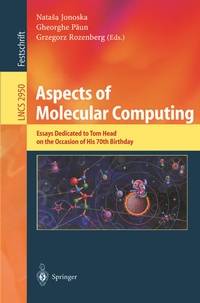
Aspects of Molecular Computing
Description

Molecular computing is a rapidly growing subarea of natural computing. On the one hand, molecular computing is concerned with the use of bio-molecules for the purpose of actual computations while, on the other hand, it attempts to understand the computational nature of molecular processes going on in living cells.
The book presents a unique and authorative state-of-the-art survey on current research in molecular computing: 30 papers by leading researchers in the area are drawn together on the occasion of the 70th birthday of Tom Head, a pioneer in molecular computing. Among the topics addressed are molecular tiling, DNA self-assembly, splicing systems, DNA-based cryptography, DNA word design, gene assembly, and membrane computing.
More details
Other editions
Additional editions
Persons
EDUCATION: PhD June 1, 1993 Department of Mathematical Sciences, SUNY at Binghamton Title: Synchronizing Representations of Sofic Systems; Fall 1988 - Spring 1993 Graduate course work at SUNY Binghamton; Spring 1985 - Spring 1987 Graduate course work at University of Belgrade; Fall 1980 - Fall 1984: B.S. in Mathematics and Computer Science University 'Kiril i Metodij' - Skopje Skopje, Macedonia. Graduation: October 31, 1984. Graduation thesis: The Word Problem in Groups.
POSITIONS HELD: Fall 1998 - present: Associate Professor at the University of South Florida, Tampa Florida. Fall 1993 - Spring 1998: Assistant Professor at the University of South Florida, Tampa Florida. January 1993 - August 1993: Research Assistant at SUNY-Binghamton, supported by the NSF grant CCR-9201345 Summer 1989, Summer 1990 - Fall 1992: Teaching Assistant, Dept. of Math. Sciences, SUNY-Binghamton; Fall 1988 - Spring 1990: Grading Assistant, Dept. Math. Sciences, SUNY-Binghamton, April 1985 - June 1988: Full time employment as assistant, Faculty of Natural and Mathematical Sciences, University 'Kiril i Metodij'-Skopje (Macedonia).
AWARDS AND MEMBERSHIPS: DNA Computation of Complex Problems Research and Creative Scholarship Award, Division of Sponsored Research USF; January 1993 - August 1993 Supported by the NSF grant CCR-9201345 at SUNY Binghamton.
Best graduating student of the year 1984; Faculty of Natural and Mathematical Sciences at the University 'Kiril i Metodij' - Skopje.
Professors Paun and Rozenberg have published/edited quite a number of Springer books in the past years.
