

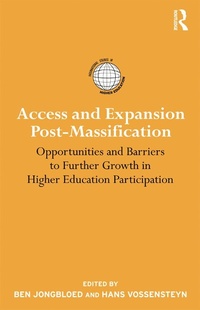
Access and Expansion Post-Massification
Opportunities and Barriers to Further Growth in Higher Education Participation
Published on 14. December 2015
278 pages
978-1-136-81767-0 (ISBN)
Description

The twenty-first century has the potential to be the era of universal higher education access: the post-massification century. The growth of knowledge-based service industries and an increased need for technological and social innovations require more education, training, and re-training at the post-secondary level. This edited collection addresses the crucial issues emerging from this ongoing expansion of higher education, focusing on how national systems of higher education can respond to demands for further expansion when traditional routes to higher education have been largely exhausted.
Does it make a difference how secondary education systems are organised?
Can we encourage under-represented groups to participate in higher education, offering them new ways of experiencing higher education without sacrificing quality?
What role will new suppliers of higher education, such as private providers, and modes of delivery, such as MOOCs, play?
Are there innovative ways to manage the finances of universal access, including tuition fees and student loans?
Will all social groups benefit equally from expansion, and find the institution and programme that fits their needs?
Expansion will require different modes of delivery, new system models, revised qualification structures, changes to the role played by government, and a revision of the public-private finance mix. While this may lead to tensions in terms of the quality, efficiency, or equality of opportunity in the higher education system, there are also new opportunities for students and higher education institutions.
With experienced researchers offering insights, national strategies and policy examples from around the world, Access and Expansion Post-Massification will give researchers and policymakers the tools they need to expand higher education into the era of the knowledge society.
Does it make a difference how secondary education systems are organised?
Can we encourage under-represented groups to participate in higher education, offering them new ways of experiencing higher education without sacrificing quality?
What role will new suppliers of higher education, such as private providers, and modes of delivery, such as MOOCs, play?
Are there innovative ways to manage the finances of universal access, including tuition fees and student loans?
Will all social groups benefit equally from expansion, and find the institution and programme that fits their needs?
Expansion will require different modes of delivery, new system models, revised qualification structures, changes to the role played by government, and a revision of the public-private finance mix. While this may lead to tensions in terms of the quality, efficiency, or equality of opportunity in the higher education system, there are also new opportunities for students and higher education institutions.
With experienced researchers offering insights, national strategies and policy examples from around the world, Access and Expansion Post-Massification will give researchers and policymakers the tools they need to expand higher education into the era of the knowledge society.
More details
Series
Language
English
Place of publication
London
United Kingdom
Publishing group
Taylor & Francis Ltd
Target group
College/higher education
Product notice
Reflowable
Illustrations
15 s/w Tabellen, 13 s/w Zeichnungen
14 Tables, black and white; 13 Line drawings, black and white
File size
3,99 MB
ISBN-13
978-1-136-81767-0 (9781136817670)
Copyright in bibliographic data and cover images is held by Nielsen Book Services Limited or by the publishers or by their respective licensors: all rights reserved.
Schweitzer Classification
Other editions
Additional editions
Ben Jongbloed | Hans Vossensteyn
Access and Expansion Post-Massification
Opportunities and Barriers to Further Growth in Higher Education Participation
Book
05/2017
1st Edition
Routledge
€69.40
Shipment within 10-20 days
Ben Jongbloed | Hans Vossensteyn
Access and Expansion Post-Massification
Opportunities and Barriers to Further Growth in Higher Education Participation
Book
11/2015
1st Edition
Routledge
€262.30
Shipment within 15-20 days
Persons
Ben Jongbloed is a senior research associate of the Center for Higher Education Policy Studies (CHEPS) at the University of Twente, the Netherlands.
Hans Vossensteyn is the Director and a senior researcher of the Center for Higher Education Policy Studies (CHEPS) at the University of Twente, the Netherlands, and Professor of Higher Education and Science Management at the Hochschule Osnabrueck, Germany.
Hans Vossensteyn is the Director and a senior researcher of the Center for Higher Education Policy Studies (CHEPS) at the University of Twente, the Netherlands, and Professor of Higher Education and Science Management at the Hochschule Osnabrueck, Germany.
Content
1. Access to Higher Education: Massification and Beyond Hans Vossensteyn and Ben Jongbloed
Part I: Institutional diversity
2. Access, Equity and the Participation of Disadvantaged Groups Gareth Parry
3. Government Policies as Responses to Increased Demand for Higher Education: Experiences from Asian Private and Public Sectors Prachayani Praphamontripong Kanwar
4. Digital Players in an Analogue World: Higher Education in Poland in the Post-Massification Era Dominik Antonowicz
Part II: System strategy and transparency
5. California: Facing Pressing Challenges in Expanding Mass Higher Education Alicia Kinne and William Zumeta
6. The Effect of Rankings on Student Choice and Institutional Selection Ellen Hazelkorn
Part III: Student financing and equity policies
7. Student Funding and the Social Dimension in Croatian Higher Education Karin Doolan, Thomas Farnell, Ninoslav Scukanec and Jon File
8. The Cultural Determinants of Access to Post-Secondary (Higher) Education in Canada: Empirical Evidence and Policy Implications Ross Finnie, Richard E. Mueller and Arthur Sweetman
Part IV: New modes of delivery
9. New Modes of Delivery: The Threatened Potential of Part-time Undergraduate Education in England Claire Callender
10. Between Challenges and Trends of Lifelong Learning: Higher Education and the Recognition of Prior Experiential Learning Ana Luisa de Oliveira Pires
11. In Conclusion: Doing more with Less: New Ways of Providing and Financing Higher Education in the Post-Massification Era Ben Jongbloed and Hans Vossensteyn
Part I: Institutional diversity
2. Access, Equity and the Participation of Disadvantaged Groups Gareth Parry
3. Government Policies as Responses to Increased Demand for Higher Education: Experiences from Asian Private and Public Sectors Prachayani Praphamontripong Kanwar
4. Digital Players in an Analogue World: Higher Education in Poland in the Post-Massification Era Dominik Antonowicz
Part II: System strategy and transparency
5. California: Facing Pressing Challenges in Expanding Mass Higher Education Alicia Kinne and William Zumeta
6. The Effect of Rankings on Student Choice and Institutional Selection Ellen Hazelkorn
Part III: Student financing and equity policies
7. Student Funding and the Social Dimension in Croatian Higher Education Karin Doolan, Thomas Farnell, Ninoslav Scukanec and Jon File
8. The Cultural Determinants of Access to Post-Secondary (Higher) Education in Canada: Empirical Evidence and Policy Implications Ross Finnie, Richard E. Mueller and Arthur Sweetman
Part IV: New modes of delivery
9. New Modes of Delivery: The Threatened Potential of Part-time Undergraduate Education in England Claire Callender
10. Between Challenges and Trends of Lifelong Learning: Higher Education and the Recognition of Prior Experiential Learning Ana Luisa de Oliveira Pires
11. In Conclusion: Doing more with Less: New Ways of Providing and Financing Higher Education in the Post-Massification Era Ben Jongbloed and Hans Vossensteyn
