

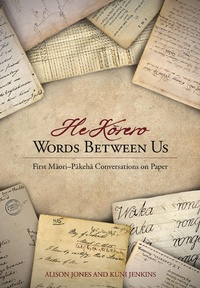
Words Between Us
He Korero: First Maori-Pakeha Conversations on Paper
Published on 6. November 2015
256 pages
978-1-77550-271-5 (ISBN)
Description

This book traces Maori engagement with handwriting from 1769 to 1826. Through beautifully reproduced written documents, it describes the first encounters Maori had with paper and writing and the first relationships between Maori and Europeans in the earliest school. The book tells an image-led story about the earliest relationships between Maori and Pakeha based around the written word and sheds light on a larger story of the first attempts of Maori and Europeans to live together in the early 1800s, the negotiation of the relationship through conversations and correspondence, and frustrations of Maori at the limits of the teaching Europeans offered. Key people link the stories as the written words between Maori and Pakeha are tracked through documents such as Maori vocabularies, a map, letters, the alphabet, signatures, the first school roll, copybook pages and the first letter written independently by Maori.
More details
Other editions
Additional editions
Book
01/2013
Huia Publishers
€32.00
Article not available at the moment
Persons
Alison Jones is a professor of education at the University of Auckland. She has worked with Maori scholars and students in the field of education for twenty-five years and has a fascination with the complexities of Maori-Pakeha educational relationships.
Content
- Intro
- Title Page
- Contents
- He Pao Waka Taki
- Acknowledgements / He mihi
- ONE. Finding the first Maori-Pakeha conversations on paper
- This book
- Interpretation
- TWO. Word-giving in 1769
- How words were collected
- Words remain behind
- Word-giving as first teaching encounters
- THREE. Tukitahua teaches Europeans in 1793
- Kidnapping a teacher
- Tuki and Huru give words to be written down
- Tuki draws a map and gives political instruction
- FOUR. First Maori use of written texts: the early 1800s
- Maori authority enshrined in text
- FIVE. Maui studies writing in 1806
- Maui leaves home
- Maui returns home 'cramped by civilisation'
- The first problems of Euclid
- SIX. A letter to Ruatara in June 1814
- Ruatara's farm in Australia
- Ruatara meets Marsden
- Ruatara invites a teacher to come to the Bay of Islands
- The expected visitors from Australia
- SEVEN. The 1814 journey to collect a Pakeha teacher
- Going to get 'our Pakeha' from Australia
- The rangatira have doubts about their invitation
- Mana and the invitation for Pakeha settlement
- EIGHT. Not a sermon: an educational event on Christmas Day, 1814
- A ritual of encounter: a powhiri for the first European arrivals
- An important instructional event
- A haka to the future
- NINE. Ta moko signatures on the first land deeds, 1815 and 1819
- A mark on paper to 'sow the Pakeha into the whenua'
- Hongi's ta moko on his own land deal
- Ta moko as signature
- Words written on the body
- TEN. The first school roll - August 1816
- A delusion of order
- Slaves, orphans and rangatira
- One fish for each scholar
- Strange school objects
- A young writer called 'Mayree'
- The school becomes famous
- The star graduate of the first school
- ELEVEN. 'A Korao no New Zealand': the first New Zealand book, 1815
- Maori instruct the European teachers
- A teaching book
- Teaching the Pakeha about Maori life
- 'Reading' and 'writing' become Maori words in A Korao
- TWELVE. Maori at school in Australia from 1815
- A school for security
- Teaching and debate at the Parramatta seminary
- Maori and the Darug people
- Maori deaths at the Australian school
- The joy of writing
- THIRTEEN. Maori letters from the Industrial Revolution: 1818
- Going to England to gain all the information in their power
- Drawings on paper
- Messages to take home
- The teachers make impossible demands
- Tuai and Titere return with the missionaries they reject
- FOURTEEN. 'Daily life written down': the 1820 Grammar
- Daily life written down
- The categories 'maori' and 'Pakeha' in the Grammar
- School language in the Grammar 171
- A sheep should be called a sheep!
- FIFTEEN. Writing at school in Rangihoua in 1826
- Writing and the body
- 'Waka rongo ki te korero': learning new meaning through writing
- 'They do not receive our message'
- Writing for things
- SIXTEEN. The first Maori letter, in 1825: 'E te tini rangatira o ropi'
- Young rangatira at school
- Desire for a school
- Hongi Hika's advice: teach the children
- Hongi writes political documents
- SEVENTEEN. Conclusion: making writing Maori
- ENDNOTES
- BIBLIOGRAPHY. Primary sources
- Archives, libraries, manuscripts and images
- Personal communications
- Newspapers and journals
- Published books and articles
- Unpublished theses
- Index
- Copyright
