

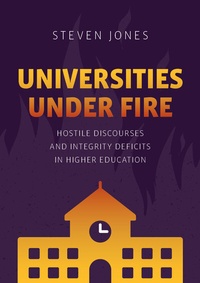
Universities Under Fire
Description

This book explores the ways in which the contemporary university is talked about, and talks about itself. Focusing on English higher education, Jones documents how an under-confident sector internalised the language and logic of government policy, and individual institutions then set about normalising competition and gaming short-term advantage at the expense of collectively serving a common good. A flawed marketisation project was attended and sustained by hostile discourses , with purportedly woke universities becoming a soft target for right-leaning politicians and media commentators, and campuses reluctant battlefields for manufactured culture wars . Within this context, integrity deficits soon arose: universities bragged about diversity and social responsibility without commensurate action; global ambitions went unmatched by local accountability; senior management grew more distant and self-rewarding as contractual precarity increased for frontline staff. Jones does not call for a return to any golden age of academic self-rule. Rather, he warns that without self-assured new stories, firmly underpinned by more transparent and moral forms of governance, universities risk further compromising their standing as trusted public institutions at the very moment they are needed most.
Reviews / Votes
This is a well-written and engaging book. Jone's ability to write an introductory paragraph is a model that could serve all academic writers. There was a quote on almost every page that I wanted to commit to memory. I hope it inspires more people to believe in the benefit of higher education and counter the destructive narratives that undermine it." (Liz Morrish, Higher Education Policy Institute, hepi.ac.uk, August 31, 2022)More details
Other editions
Additional editions
Person
Steven Jones is Professor of Higher Education at the University of Manchester, UK, and currently head of Manchester Institute of Education. His academic background is in English Linguistics, and he brings the tools of critical discourse analysis to the university sector. He has written op-ed pieces for The Guardian and presented research evidence to policy-makers and government ministers.
Content
Higher education: a sector unloved.- How university staff are talked about.- How university funding is talked about.- How university students are talked about.- How free speech is talked about.- New stories for an old sector?.
