

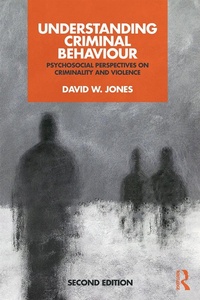
Understanding Criminal Behaviour
Psychosocial Perspectives on Criminality and Violence
2nd Edition
Published on 13. August 2019
338 pages
978-1-315-40657-2 (ISBN)
Description

Our understanding of criminal behaviour and its causes has been too long damaged by the failure to integrate the emotional, psychological, social and cultural influences on the way people behave.
This book offers a concise and accessible introduction to criminal behaviour, examining and integrating perspectives from criminology and psychology. It proposes a range of 'psychosocial' approaches that seek to understand the emotions that surround criminal behaviour, allowing for an exploration of individual differences and social and cultural issues that help to bridge the gap between disciplinary approaches. It offers substantive chapters on a range of topics, including:
mental disorder and the relationship between mental health and offending;
criminal career research;
youth crime and the question of criminal responsibility;
gender and crime; and
violent crime, including homicide and sexual crime.
This new edition has been fully updated, including a revised opening chapter that offers an introduction to psychosocial criminology, up-to-date discussion of changes in the criminal justice system in the context of mental health, and two new chapters on race and crime, and public violence, extremism and terrorism.
This book is essential reading for students taking a range of courses on criminal behaviour, criminological theory, criminal psychology and psychological criminology.
This book offers a concise and accessible introduction to criminal behaviour, examining and integrating perspectives from criminology and psychology. It proposes a range of 'psychosocial' approaches that seek to understand the emotions that surround criminal behaviour, allowing for an exploration of individual differences and social and cultural issues that help to bridge the gap between disciplinary approaches. It offers substantive chapters on a range of topics, including:
mental disorder and the relationship between mental health and offending;
criminal career research;
youth crime and the question of criminal responsibility;
gender and crime; and
violent crime, including homicide and sexual crime.
This new edition has been fully updated, including a revised opening chapter that offers an introduction to psychosocial criminology, up-to-date discussion of changes in the criminal justice system in the context of mental health, and two new chapters on race and crime, and public violence, extremism and terrorism.
This book is essential reading for students taking a range of courses on criminal behaviour, criminological theory, criminal psychology and psychological criminology.
Reviews / Votes
Praise for the second edition:'The psychosocial perspective, integrating both sociological and psychological insights, is among the most exciting new developments in criminology, and there is no better guide on that journey than David W. Jones. This fascinating, highly readable text, drawing on real life case studies, is the ideal introduction to understanding the complexity of criminal behaviour.' - Shadd Maruna, Professor of Criminology, Queen's University Belfast, UK
'The social problems confronted by criminologists include everything from the social and moral development of children, the personal and political appetites for punishing and reintegrating offenders, and the infusion of violence - including that perpetrated by state actors - with experiences of fear, anger and humiliation that are routinely inflected by the inequalities of gender, ethnicity and class. David W. Jones' book carefully articulates why only a criminology that is dynamically psychosocial is required to develop a better understanding of these problems and why such understanding is necessary to improve our responses to crime. An essential introduction to the relevance of psychosocial and psychoanalytic concepts that builds on the historical foundations of psychological and sociological criminologies.' - David Gadd, Professor of Criminology, University of Manchester, UK
Praise for the first edition:
'Understanding Criminal Behaviour's strap line should be 'the holy grail' as it promises a whole new level of understanding of criminal behaviour. Probably once in a professional career is a paradigm shift of this significance ever proposed, and several conditions have to be right for this to happen...David Jones proposes an eclectic psychological approach to understanding the nature of criminal behaviour that promises to integrate criminological and clincal perspercitves into a holistic theory.' - Monica Lloyd, Forensic Psychologist, NOMS, in Probation Journal
'Jones breaks new ground in integrating psychological perspectives into the mainstream of criminological theory. He makes a compelling case that by emphasizing a psychosocial outlook as opposed to the traditional psychological approach, scholars may more effectively analyze criminality. . . . Jones presents a well conceived, timely, and well packaged work that begins to build a bridge between adversarial approaches. Highly recommended.' - F.E Knowles in CHOICE
'This is a timely book given the growth of psychosocial studies and the increasing political and cultural focus on criminality. JonesaEUR (TM)s book is both comprehensive and detailed in its outline of explanations of criminal behaviour, and Jones gives a convincing account of why psychological research has been increasingly omitted from criminological topics.' - Amanda Holt in The Psychologist,
' . . . Jones succeeds admirably in his goal to present "a constructive view of how psychology already does contribute, but might have more to contribute, to the debate about the problem of crime" (pxx) . . . Anyone working in the criminological field knows that Jones is right about the depth of division that currently exists between psychology and sociology. To those who are as bored as I am with these pointless and destructive theory wars, Jones' book is a refreshing tonic.' - Richard Wortley, International Criminal Justice Review
'I would recommend Jones' book to those who [do not have a first degree in criminology] as a critical, wide-ranging introduction. And there is much in the text to remind non-neophytes of aspects they may well have forgotten....' - Herschel Prins, University of Leicester in The Journal of Forensic Psychiatry & Psychology, vol 21 no 6
More details
Edition
2nd edition
Language
English
Place of publication
London
United Kingdom
Publishing group
Taylor & Francis Ltd
Target group
College/higher education
Illustrations
18 Tables, black and white; 1 Line drawings, black and white; 1 Illustrations, black and white
ISBN-13
978-1-315-40657-2 (9781315406572)
Copyright in bibliographic data and cover images is held by Nielsen Book Services Limited or by the publishers or by their respective licensors: all rights reserved.
Schweitzer Classification
Other editions
Additional editions
Book
08/2019
2nd Edition
Routledge
€64.00
Shipment within 10-20 days
Book
08/2019
2nd Edition
Routledge
€208.30
Shipment within 10-20 days
Person
David W. Jones is Senior Lecturer in Psychology at The Open University. He is also author of Disordered Personalities and Crime: A Historical Analysis of Moral Insanity (2016).
Content
1. The Need for a Psychosocial Criminology; 2. Mental Disorder: Madness, Personality Disorder and Criminal Responsibility; 3. The Contribution of Criminal Career Research; 4. Familial and Parental Influences; 5. Youth Crime; 6. Gender and Crime; 7. Understanding Violence: Learning from Studies of Homicide; 8. Intimate Violence and Sex Crime; 9. Public Violence and crimes of terror; 10. 'Race' and Crime'; 11. Conclusion
