

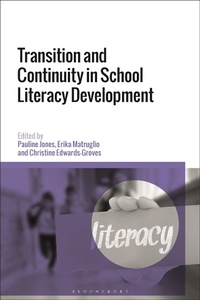
Transition and Continuity in School Literacy Development
1st Edition
Published on 18. November 2021
356 pages
978-1-350-14886-4 (ISBN)
Description

This book addresses a significant gap in the research literature on transitions across the school years: the continuities and discontinuities in school literacy education and their implications for practice. Across different curriculum domains, and using social semiotic, ethnographic, and conversation-analytic approaches, the contributors investigate key transition points for individual students' literacy development, elements of literacy knowledge that are at stake at each of these points, and variability in students' experiences. Grounding its discussion in classroom voices, experiences and texts, this book reveals literacy-specific curriculum demands and considers how teachers and students experience and account for these evolving demands.
The contributors include a number of established names (such as Freebody, Derewianka, Myhill, Rowsell, Moje and Lefstein), as well as emerging scholars gaining increasing recognition in the field. They draw out implications for how literacy development is theorized in school curriculum and practice, teacher education, further research and policy formation. In addition, each section of the book features a summary from an international scholar who draws together key ideas from the section and relates these to their current thinking. They deploy a range of different theoretical and methodological approaches in order to bring rich yet complementary perspectives to bear on the issue of literacy transition.
The contributors include a number of established names (such as Freebody, Derewianka, Myhill, Rowsell, Moje and Lefstein), as well as emerging scholars gaining increasing recognition in the field. They draw out implications for how literacy development is theorized in school curriculum and practice, teacher education, further research and policy formation. In addition, each section of the book features a summary from an international scholar who draws together key ideas from the section and relates these to their current thinking. They deploy a range of different theoretical and methodological approaches in order to bring rich yet complementary perspectives to bear on the issue of literacy transition.
More details
Edition
1. Auflage
Language
English
Place of publication
London
United Kingdom
Publishing group
Bloomsbury Publishing PLC
Target group
Professional and scholarly
Illustrations
71 bw illus
ISBN-13
978-1-350-14886-4 (9781350148864)
Copyright in bibliographic data and cover images is held by Nielsen Book Services Limited or by the publishers or by their respective licensors: all rights reserved.
Schweitzer Classification
Other editions
Additional editions
Pauline Jones | Erika Matruglio | Christine Edwards-Groves
Transition and Continuity in School Literacy Development
Book
06/2023
Bloomsbury Academic
€44.70
Shipment within 15-20 days
Persons
Pauline Jones is Associate Professor of Language in Education at the University of Wollongong, Australia.
Erika Matruglio is Senior Lecturer in TESOL and Secondary Literacy at the University of Wollongong, Australia.
Christine Edwards-Groves is Professor of Literacy and Professional Practice at the Australian Catholic University, Australia.
Erika Matruglio is Senior Lecturer in TESOL and Secondary Literacy at the University of Wollongong, Australia.
Christine Edwards-Groves is Professor of Literacy and Professional Practice at the Australian Catholic University, Australia.
Content
List of Illustrations
List of Contributors
Acknowledgements
Foreword, Debra Myhill (University of Exeter, UK)
Part I: Theory, Curriculum and Practice in Transition
1. Rethinking School Literacy Progressions, Pauline Jones (University of Wollongong, Australia) and Christine Edwards-Groves (Australian Catholic University, Australia)
2. A Review of the Literature around Literacy Transition, Trish Weekes (Literacy Works, Australia)
3. Representing Writing Development: Research and Policy, Beverly Derewianka (University of Wollongong, Australia)
4. Chapter Transitions in School Literacy: Co-Opting Everyday Rationalities, Bjorn Kindenberg (University of Stockholm, Sweden) and Peter Freebody (University of Wollongong, Australia)
Summary of Part I, Jennifer Roswell (Brock University, Canada)
Part II: Investigating the Conditions for Literacy Learning and Teaching in Transition
5. Transition from Preschool to School: Spaces, Time, Interactions and Resources, Lisa Kervin and Jessica Mantei (University of Wollongong, Australia)
6. Transitions in Literacy and Classroom Interaction across the School Years, Christine Edwards-Groves (Australian, Catholic University, Australia), Peter Freebody (University of Wollongong, Australia) and Stephanie Garoni (Charles Sturt University, Australia)
7. Understanding Literacy Transitions: Pedagogic Practices in Primary Writing Classrooms, Honglin Chen (University of Wollongong, Australia), Helen Lewis (University of Wollongong, Australia) and David Rose (University of Sydney, Australia)
8. Investigating Pedagogic Discourse in Late Primary and Junior Secondary English, Pauline Jones (University of Wollongong, Australia), Erika Matruglio (University of Wollongong, Australia) and David Rose (University of Sydney, Australia)
9. Exploring Multimodal Meaning Making in Science at the Transition to High School, Annette Turney and Emma Rutherford Vale (University of Wollongong, Australia)
10. Categories, Appraisals and Progress in Teachers' Accounts of Literacy Teaching, Erika Matruglio (University of Wollongong, Australia)
Summary of Part II, Adam Lefstein (Ben-Gurion University, Israel)
Part III: Horizons of Consequence: Accounting for Transition
11. Literate Identities in the Early Years of Primary School, Jessica Mantei and Lisa Kervin (University of Wollongong, Australia)
12. Articulating their Education: Interviewing Primary Years Students on their Literacy Learning, Christine Edwards-Groves (Australian Catholic University, Australia) and Peter Freebody (University of Wollongong, Australia)
13. Transitioning from Primary to High School, Emma Rutherford Vale, Helen Lewis, Honglin Chen and Pauline Jones (University of Wollongong, Australia)
Summary of Part III, Elizabeth Moje (University of Michigan, USA)
Epilogue
References
Index
List of Contributors
Acknowledgements
Foreword, Debra Myhill (University of Exeter, UK)
Part I: Theory, Curriculum and Practice in Transition
1. Rethinking School Literacy Progressions, Pauline Jones (University of Wollongong, Australia) and Christine Edwards-Groves (Australian Catholic University, Australia)
2. A Review of the Literature around Literacy Transition, Trish Weekes (Literacy Works, Australia)
3. Representing Writing Development: Research and Policy, Beverly Derewianka (University of Wollongong, Australia)
4. Chapter Transitions in School Literacy: Co-Opting Everyday Rationalities, Bjorn Kindenberg (University of Stockholm, Sweden) and Peter Freebody (University of Wollongong, Australia)
Summary of Part I, Jennifer Roswell (Brock University, Canada)
Part II: Investigating the Conditions for Literacy Learning and Teaching in Transition
5. Transition from Preschool to School: Spaces, Time, Interactions and Resources, Lisa Kervin and Jessica Mantei (University of Wollongong, Australia)
6. Transitions in Literacy and Classroom Interaction across the School Years, Christine Edwards-Groves (Australian, Catholic University, Australia), Peter Freebody (University of Wollongong, Australia) and Stephanie Garoni (Charles Sturt University, Australia)
7. Understanding Literacy Transitions: Pedagogic Practices in Primary Writing Classrooms, Honglin Chen (University of Wollongong, Australia), Helen Lewis (University of Wollongong, Australia) and David Rose (University of Sydney, Australia)
8. Investigating Pedagogic Discourse in Late Primary and Junior Secondary English, Pauline Jones (University of Wollongong, Australia), Erika Matruglio (University of Wollongong, Australia) and David Rose (University of Sydney, Australia)
9. Exploring Multimodal Meaning Making in Science at the Transition to High School, Annette Turney and Emma Rutherford Vale (University of Wollongong, Australia)
10. Categories, Appraisals and Progress in Teachers' Accounts of Literacy Teaching, Erika Matruglio (University of Wollongong, Australia)
Summary of Part II, Adam Lefstein (Ben-Gurion University, Israel)
Part III: Horizons of Consequence: Accounting for Transition
11. Literate Identities in the Early Years of Primary School, Jessica Mantei and Lisa Kervin (University of Wollongong, Australia)
12. Articulating their Education: Interviewing Primary Years Students on their Literacy Learning, Christine Edwards-Groves (Australian Catholic University, Australia) and Peter Freebody (University of Wollongong, Australia)
13. Transitioning from Primary to High School, Emma Rutherford Vale, Helen Lewis, Honglin Chen and Pauline Jones (University of Wollongong, Australia)
Summary of Part III, Elizabeth Moje (University of Michigan, USA)
Epilogue
References
Index
