

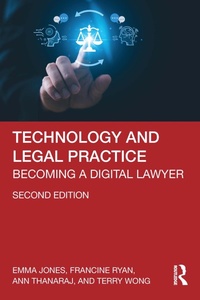
Technology and Legal Practice
Becoming a Digital Lawyer
2nd Edition
Published on 1. June 2026
546 pages
978-1-040-55631-3 (ISBN)
Description

In today's rapidly changing legal landscape, becoming a digital lawyer is vital to success within the legal profession. Technology and Legal Practice: Becoming a Digital Lawyer is a toolkit for gaining the key attributes and skills required to utilise technology within legal practice effectively.
Digital technologies have already begun a radical transformation of the legal profession and the justice system. This textbook introduces students to key topics, from the role of blockchain to the use of digital evidence in courtrooms, supported by contemporary case studies and integrated, interactive activities.
The second edition updates reflect the changes that have been brought about by developments in Generative AI since the textbook was first published, along with general updates throughout the book. Using this textbook will allow students to identify, discuss, and reflect on emerging issues and trends within digital lawyering in a critical and informed manner, drawing on both its theoretical basis and accounts of its use in legal practice.
Technology and Legal Practice is ideal for use as a main textbook on modules focused on technology and law, and as a supplementary textbook on modules covering lawyering and legal skills more generally.
Digital technologies have already begun a radical transformation of the legal profession and the justice system. This textbook introduces students to key topics, from the role of blockchain to the use of digital evidence in courtrooms, supported by contemporary case studies and integrated, interactive activities.
The second edition updates reflect the changes that have been brought about by developments in Generative AI since the textbook was first published, along with general updates throughout the book. Using this textbook will allow students to identify, discuss, and reflect on emerging issues and trends within digital lawyering in a critical and informed manner, drawing on both its theoretical basis and accounts of its use in legal practice.
Technology and Legal Practice is ideal for use as a main textbook on modules focused on technology and law, and as a supplementary textbook on modules covering lawyering and legal skills more generally.
More details
Edition
2nd edition
Language
English
Place of publication
London
United Kingdom
Publishing group
Taylor & Francis Ltd
Target group
College/higher education
Professional and scholarly
Illustrations
31 Line drawings, black and white; 4 Halftones, color; 9 Halftones, black and white; 4 Illustrations, color; 40 Illustrations, black and white
File size
14,76 MB
ISBN-13
978-1-040-55631-3 (9781040556313)
Copyright in bibliographic data and cover images is held by Nielsen Book Services Limited or by the publishers or by their respective licensors: all rights reserved.
Schweitzer Classification
Other editions
Additional editions
Book
06/2026
2nd Edition
Routledge
€191.50
Shipment within 10-20 days
Book
06/2026
2nd Edition
Routledge
€52.50
Shipment within 10-20 days
Persons
Emma Jones is a senior lecturer in law and Director of Sheffield Digital Justice at the University of Sheffield's School of Law. Her research interests focus upon emotions and wellbeing in legal education and the legal profession, and the role of digital technology in legal practice. She leads undergraduate and postgraduate digital lawyering modules and is director of Sheffield Digital Justice, an extra-curricular and multidisciplinary initiative designed to foster students' critical AI literacy.
Francine Ryan is a senior lecturer in law, Director of the Open Justice Centre at The Open University in the UK, and a qualified solicitor. Her teaching and research interests are clinical legal education with a particular focus on technology and innovation-enhanced learning. She leads a virtual reality courtroom project and a UKRI, Responsible AI funded project: AI Law and Legal Training.
Ann Thanaraj works at the intersection of AI, digital education, and legal practice, and works globally to advance AI-driven, multidisciplinary education. She is creator and founder of "Digital Lawyering" and her research on digital lawyering, cited by the UK House of Lords, shapes policy, legal governance, and curriculum innovation. Having started her career in legal practice before undertaking various leadership roles in higher education, Ann has multiple lenses through which to explore "What Is the Point of Education, Anyway?", a forthcoming literary work that questions multiple facets of education and learning. Ann is Head of Digital and AI Innovations and Chair of AI Operations at Teesside University.
Terry Wong is a technology entrepreneur based in Hong Kong. Born, raised, and educated in the United States, he holds degrees in architecture and management from the Massachusetts Institute of Technology. Terry is the founder and CEO of Cydeas, a global team of system architects, software developers, and user experience designers who invest in, build, and actively manage technology-led businesses, with interests in legal and financial services.
Francine Ryan is a senior lecturer in law, Director of the Open Justice Centre at The Open University in the UK, and a qualified solicitor. Her teaching and research interests are clinical legal education with a particular focus on technology and innovation-enhanced learning. She leads a virtual reality courtroom project and a UKRI, Responsible AI funded project: AI Law and Legal Training.
Ann Thanaraj works at the intersection of AI, digital education, and legal practice, and works globally to advance AI-driven, multidisciplinary education. She is creator and founder of "Digital Lawyering" and her research on digital lawyering, cited by the UK House of Lords, shapes policy, legal governance, and curriculum innovation. Having started her career in legal practice before undertaking various leadership roles in higher education, Ann has multiple lenses through which to explore "What Is the Point of Education, Anyway?", a forthcoming literary work that questions multiple facets of education and learning. Ann is Head of Digital and AI Innovations and Chair of AI Operations at Teesside University.
Terry Wong is a technology entrepreneur based in Hong Kong. Born, raised, and educated in the United States, he holds degrees in architecture and management from the Massachusetts Institute of Technology. Terry is the founder and CEO of Cydeas, a global team of system architects, software developers, and user experience designers who invest in, build, and actively manage technology-led businesses, with interests in legal and financial services.
Content
Chapter 1 Introduction. Chapter 2 The 21st-century Legal Professional. Chapter 3 A Guide to Technology. Chapter 4 Delivering Legal Services Without Lawyers. Chapter 5 The Use and Practice of Social Media. Chapter 6 Big Data and Analytics. Chapter 7 Artificial Intelligence and Legal Practice. Chapter 8 Digital Evidence and Its Admissibility in the Courtroom. Chapter 9 Online Justice. Chapter 10 Blockchain. Chapter 11 Digital Lawyering Skills. Chapter 12 The Changing Legal Profession. Chapter 13 Professional Identity and the Digital Lawyer. Chapter 14 Conclusion.
